
We’ve all been there. For the first few months, you’re hitting a Personal Best (PB) every week. Then, the wall hits. You’re pushing harder, drinking more pre-workout, and screaming at the bar, but the weight won’t budge. This is the training plateau, and it’s usually caused by a fundamental misunderstanding of progressive overload. In 2026, the “just add 5lbs every week” mantra is dead. To unlock serious gains, you need a workout periodization strategy that treats your body like the high-performance machine it is.
The Progressive Overload Trap: Why Your Gains Stalled
Most lifters think progressive overload is a straight line. They believe that as long as they keep adding iron to the bar, they’ll keep growing. But your central nervous system (CNS) doesn’t work that way. Eventually, the systemic fatigue outweighs your body’s ability to adapt.
When “More” Becomes “Less”
When you push to failure every single session, your cortisol levels skyrocket. High cortisol is the enemy of muscle protein synthesis. If you’ve noticed you’re getting weaker, losing sleep, or feeling “burnt out,” you haven’t lost your drive—you’ve simply maxed out your linear adaptation. You need to stop testing your strength and start building it.
The 12-Week Periodization Blueprint
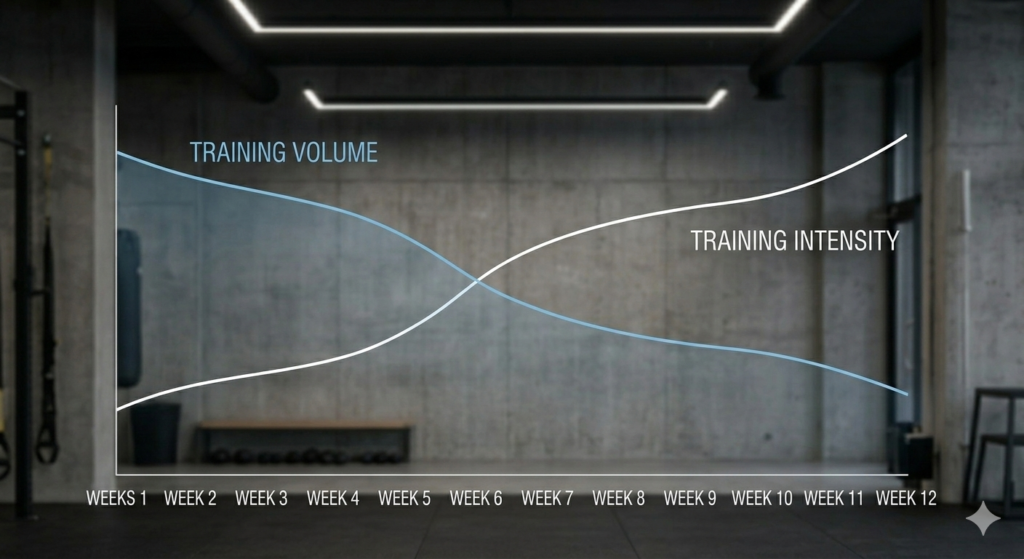
To break through a training plateau, we use a “Wave-Loading” approach. Instead of trying to go up forever, we manipulate volume and intensity across three distinct phases. This is the professional athlete’s secret to long-term workout periodization.
The Periodization Cycle
| Phase | Duration | Primary Focus | Avg. Intensity (% of 1RM) | Target Volume |
| Phase 1: Hypertrophy | Weeks 1-4 | Muscle Cross-Section | 65% – 75% | High (12-15 reps) |
| Phase 2: Strength | Weeks 5-8 | Neuromuscular Power | 80% – 90% | Moderate (4-6 reps) |
| Phase 3: Peaking | Weeks 9-11 | Absolute Max Strength | 90% – 100% | Low (1-3 reps) |
| Phase 4: Deload | Week 12 | Systemic Recovery | 50% | Very Low |

Phase 1: Building the Hypertrophy Base
Weeks 1 through 4 are about “structural integrity.” You aren’t trying to move the heaviest weight possible here. You’re trying to increase the cross-sectional area of the muscle.
High Volume, High Sweat
During this phase, you’ll be doing more reps and shorter rest periods. This creates massive metabolic stress. It’s also where you’ll test the limits of your gear. At KineticV, our high-breathability training tees are designed for these “high-rep hell” sessions. When you’re dripping sweat during your fourth set of 15, you need a fabric that won’t weigh you down.
Phase 2: Mastering Neuromuscular Strength
Once you’ve built the “engine” (muscle) in Phase 1, Phase 2 is about teaching your brain how to use it. This is where progressive overload gets tactical.
Increasing the Intensity
We drop the reps and crank the weight. You’re now teaching your motor units to fire simultaneously. This puts a massive strain on your joints and connective tissues. Many athletes prefer the added stability of KineticV compression gear during this phase to help with joint warmth and muscle proprioception.

The Crucial Role of the Deload Week
The biggest mistake lifters make? Skipping the Deload. Around week 12, your body is screaming for a break. A deload week isn’t a week off; it’s a week where you reduce the weight by 50% to allow your joints and CNS to recover.
According to research from the National Strength and Conditioning Association (NSCA), strategic deloading is actually when the “supercompensation” happens—this is when your body actually becomes stronger than it was before.
FAQ: Breaking Your Stagnation
Q: Can I use this plan for weight loss? Yes. Periodization works for any goal. During a calorie deficit, the “Strength Phase” is actually crucial for maintaining muscle mass while the fat drops off.
Q: What if I miss a workout? Don’t sweat it. Don’t try to double up the next day. Just pick up where you left off. The 12-week blueprint is a guide, not a prison sentence.
Q: Is this suitable for home workouts? As long as you have enough resistance to challenge yourself at the 5-rep range and the 15-rep range, this workout periodization plan will work with dumbbells, bands, or a barbell.
Final Thoughts: Play the Long Game
If you keep doing what you’ve always done, you’ll keep getting the same (stalled) results. Breaking a training plateau requires more than just “grit”—it requires a map. Follow this 12-week blueprint, listen to your body during the deload, and stop measuring your worth by a single session’s performance.
Ready to gear up for your next cycle? Check out our latest Performance Collection and find the gear that works as hard as your new plan.