
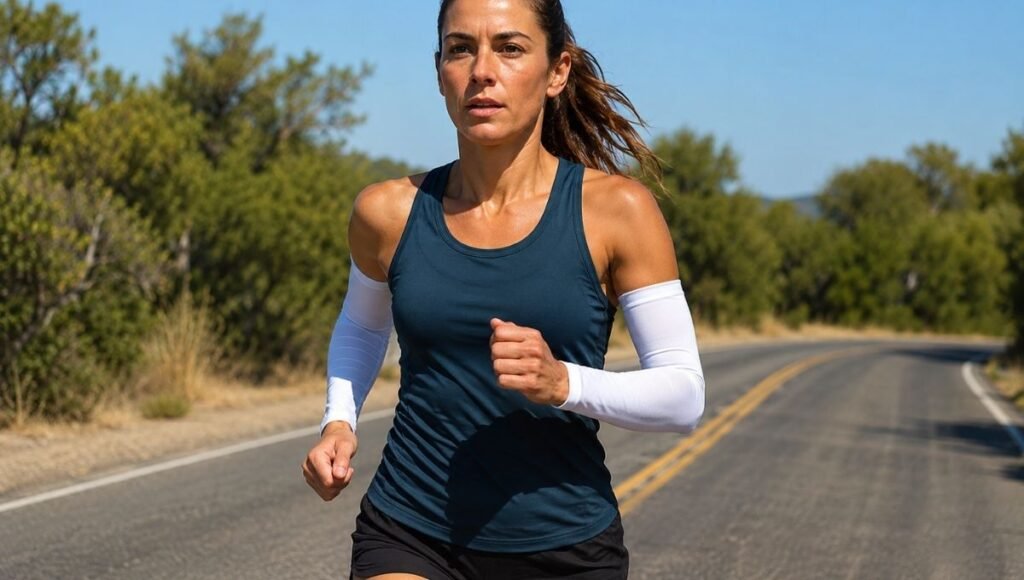
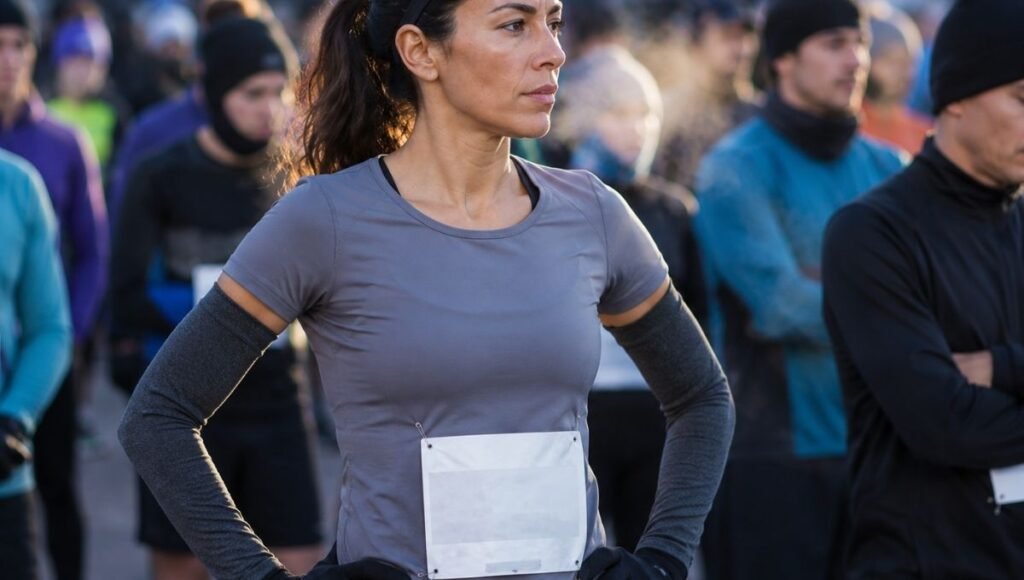
You’ve seen them at race start lines — runners wearing what appears to be a short sleeve shirt but with an extra tube of fabric pulled over their arms. You’ve seen elites crossing marathon finish lines with arm warmers bunched around their wrists. You’ve seen trail runners in summer heat with what looks like long sleeves but can’t possibly be, given the temperature.
Running arm sleeves are one of those accessories that look optional until you understand why serious runners use them — and then they make complete sense. The core insight: a sleeve you can put on and take off without stopping, without removing other gear, and without breaking your stride is a fundamentally different tool from a long-sleeve shirt. That’s not a small distinction. It’s the entire reason they exist.
This guide separates the two different types of running arm sleeves — warm weather sun sleeves and cold weather arm warmers — explains what each one actually does, and gives you the specific features that determine whether a sleeve stays put through 13 miles or ends up bunched around your wrist by mile 3.
Key Takeaways
- Running arm sleeves come in two fundamentally different types — sun sleeves (lightweight, UPF 50, for warm weather UV protection) and arm warmers (insulated, for cold starts) — and they solve different problems; buying the wrong type is the most common mistake
- The silicone grip band at the upper bicep is the single most important feature — sleeves without a secure upper cuff will slide down within the first mile regardless of how well they fit initially
- Mid-race removal is the primary functional advantage — peeling off arm warmers during a marathon without stopping is a skill that requires practice, and sleeve design (smooth vs textured outer surface) affects how easily this works
- UPF 50 is the minimum threshold for sun sleeves — anything below UPF 40 provides insufficient protection during the sustained UV exposure of a long outdoor run; the fabric construction matters more than the marketing claims
- Cotton arm warmers are worse than no arm warmers — cotton absorbs sweat and holds it against your skin, making your arms heavier, colder in wind, and more prone to chafing than bare skin would be
Sun Sleeves vs Arm Warmers: Two Different Products
This is the distinction most buying guides blur together, and it’s the one that matters most before you make a purchase decision.
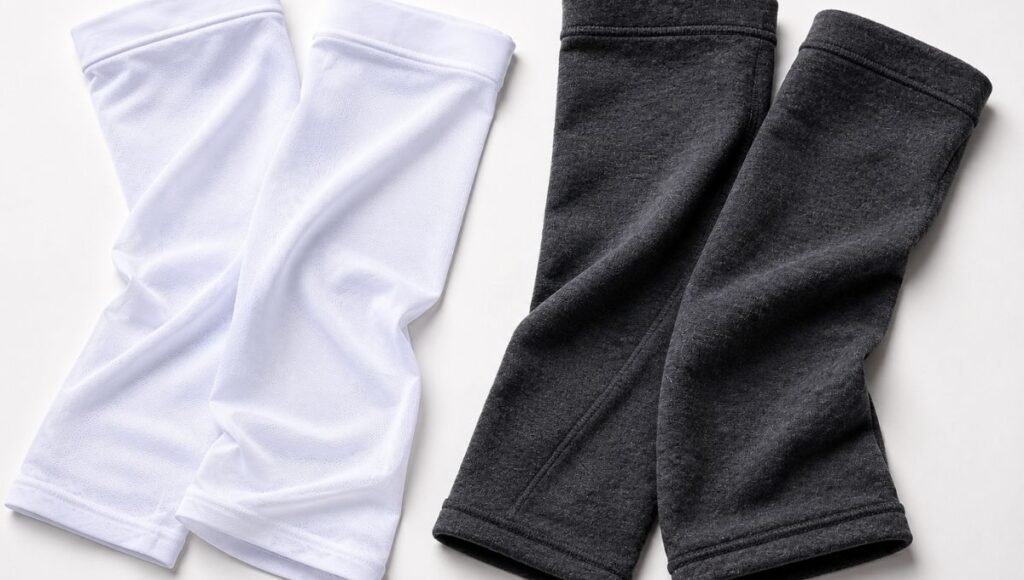
Running Sun Sleeves (Warm Weather)
Sun sleeves are ultralight, UPF-rated fabric tubes worn specifically to protect your arms from UV radiation during warm-weather running. They are not compression garments. They are not warming garments. They are sunscreen alternatives — lightweight fabric that blocks UV while remaining breathable enough to wear in temperatures where a long-sleeve shirt would be unbearable.
The mechanism: a densely woven polyester or nylon fabric that blocks UV photons while allowing airflow and moisture evaporation. Quality sun sleeves feel cooler than bare skin in direct sun because they block radiant heat from the sun’s UV component while wicking sweat efficiently. Some sun sleeves use ice-cooling technology or cooling agents in the fabric for additional temperature reduction.
When you need sun sleeves:
- Running more than 60 minutes in direct sun
- Trail running at altitude where UV exposure is significantly higher
- Runners with fair or sun-sensitive skin who want to reduce total sunscreen application
- Anyone who has developed an arm farmer’s tan from consistent morning runs and wants to prevent further skin damage
What distinguishes quality sun sleeves: UPF 50 rating (blocks 98% of UVA and UVB), lightweight breathable fabric that doesn’t trap heat, and a secure upper cuff that holds position during arm swing.
Running Arm Warmers (Cold Weather)
Arm warmers are a layering tool for cold weather running — specifically for the temperature range where you want arm coverage at the start of a run but know you’ll warm up and want to remove that coverage within the first few miles. They’re designed to be added and removed without stopping.
The functional advantage over a long-sleeve shirt is complete: a long-sleeve shirt commits you to that layer for the entire run, or requires a full stop to remove it and carry it. Arm warmers can be peeled off mid-stride, bundled up, and stuffed in a shorts waistband or vest pocket in about 15 seconds without breaking pace. This makes them the intelligent choice for any run where start temperature and mid-run temperature diverge significantly.
When you need arm warmers:
- Temperature at start is 35–50°F and you expect to warm up significantly during the run
- Racing where start temperature is cold but race effort will generate substantial heat
- Trail running where elevation changes create temperature variation during the run
- Any situation where committing to a jacket for the full run is too much but bare arms at the start is too little
The Silicone Grip Band: Why This Detail Makes or Breaks the Purchase
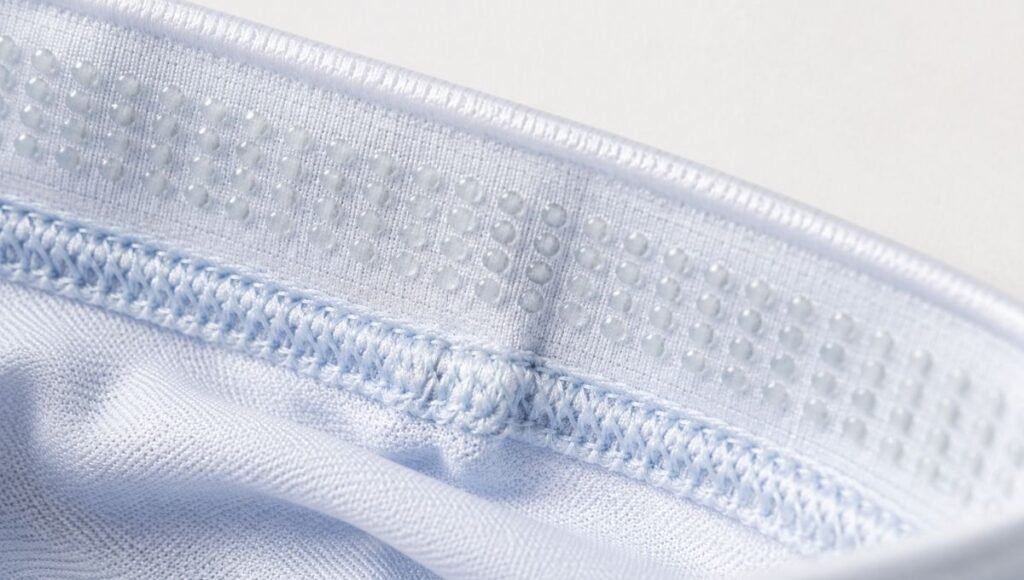
Every running arm sleeve guide mentions silicone grip bands. Most don’t explain why this feature is so critical — or why sleeves without it are functionally useless for actual running.
During running stride, your arms swing forward and back through a range of roughly 45 degrees per stride. This repeated movement creates a consistent downward force on any sleeve sitting at the upper arm — gravity plus the mechanical energy of arm swing both pull the sleeve toward the wrist. Without a secure upper cuff, a sleeve that fits perfectly while standing still will migrate to your elbow within a mile.
A silicone inlay or silicone grip band sewn into the inner surface of the upper cuff creates friction against your bicep skin that resists this downward pull. The sleeve can still be slid up or down intentionally (for removal), but it resists the passive migration that occurs during running movement. This is not a luxury feature — it’s the minimum construction standard for a sleeve that will actually stay on your arm during a run.
Testing before you buy: Put the sleeve on, position it correctly on your upper arm, then do 20 arm swing repetitions at running pace. If the sleeve migrates more than an inch without intentional adjustment, the upper cuff isn’t secure enough for running use.
What to look for specifically: Silicone dot, silicone stripe, or full silicone inlay band at the upper cuff. Smooth elastic alone — even tight elastic — doesn’t grip skin effectively during running motion. The grip needs to be tacky.
How to Remove Arm Warmers Mid-Run (Without Stopping)
This is the skill that makes arm warmers worth owning, and almost no guide actually explains how to do it cleanly.
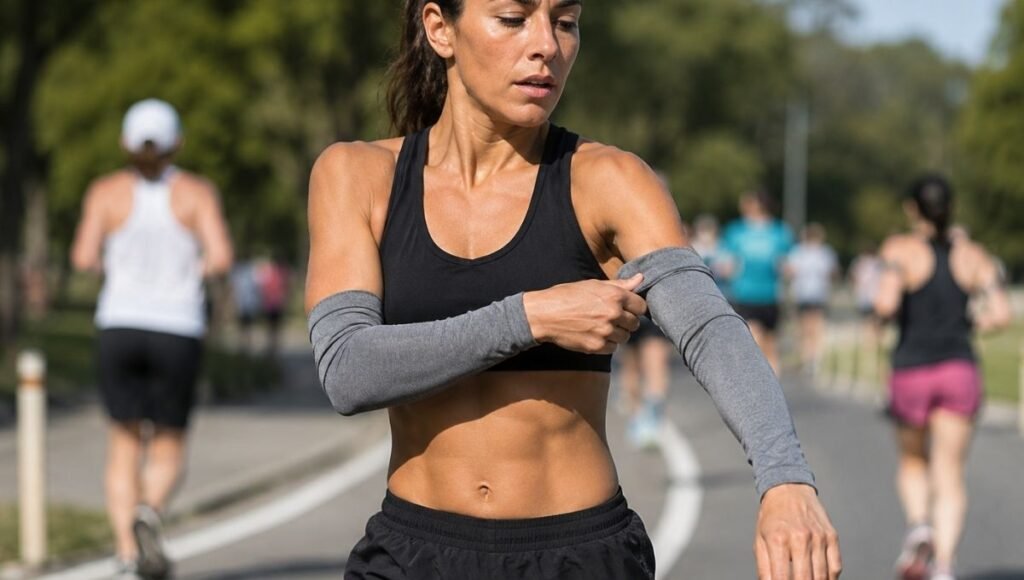
The technique:
Start with one arm at a time. Use the hand of the arm you’re keeping your sleeve on to grip the upper cuff of the sleeve you’re removing, while continuing to run at pace. Pull the sleeve down toward the wrist — the silicone grip releases when pulled intentionally in this direction. Once the sleeve is at the wrist, use your teeth or the fingers of the other hand to peel the sleeve off the hand entirely.
You now have a tube of fabric. Ball it up with one hand and tuck it under the waistband of your shorts at the back, or stuff it into a vest or belt pocket if you’re carrying one. Repeat with the other arm.
Practice this before race day. The first time you try to remove arm warmers while running at pace without stopping, it will feel awkward and slow. After 2-3 practice runs, it becomes automatic. Never attempt this technique for the first time in a race.
The sleeve construction that makes this easier: A smooth outer surface allows the balled sleeve to tuck cleanly under a waistband without catching. Textured or printed outer surfaces can snag on shorts fabric and make the tuck more difficult. If mid-race removal is important to you, test the packability of the sleeve before buying.
UPF Ratings Explained: What Actually Protects You
The American Academy of Dermatology states that cumulative UV exposure is a documented risk factor for skin cancer, and outdoor athletes receive significantly higher lifetime UV exposure than non-athletes due to sustained time in direct sun. This makes sun protection in running gear a genuine health consideration rather than just a comfort preference.
UPF (Ultraviolet Protection Factor) works similarly to SPF for sunscreen: a UPF 50 fabric allows 1/50th of UV radiation to pass through — meaning it blocks 98% of UVA and UVB rays. UPF 30 blocks 96.7%. The difference sounds small but compounds over hours of exposure.
The UPF threshold for running sun sleeves: UPF 40 or higher. Below UPF 30, the fabric provides less protection than a broad-spectrum SPF 30 sunscreen applied correctly, and sunscreen is cheaper and lighter. If you’re wearing arm sleeves specifically for sun protection, the UPF rating needs to be worth the effort.
The construction caveat: UPF ratings can be applied as a fabric coating or built into the fiber construction. Coatings degrade with washing — typically after 20-30 wash cycles. Fiber-built UPF (where the fabric weave itself provides the blocking) maintains its rating throughout the garment’s life. Check whether the UPF rating is coating-applied or fiber-integrated before buying sleeves you intend to use long-term.
The Best Running Arm Sleeves in 2026

Best Sun Sleeve: Nike Dri-FIT UV Solar Arm Sleeves
The Nike Dri-FIT Solar earns its consistent top placement through a specific achievement: UPF 50 protection built into the fabric fiber construction rather than applied as a surface coating, combined with genuine Dri-FIT moisture management that prevents the heavy, wet-sleeve feeling that makes some sun sleeves unbearable in summer heat.
The silicone grip at the upper cuff holds through sustained arm swing without becoming uncomfortably tight. The sleeve stays in position through a full marathon distance — which is the test that separates functional from fashionable. The fabric weight is light enough that wearing them in temperatures above 65°F doesn’t cause overheating.
Best for: Road running and trail running in direct sun above 60°F, runners who want to reduce arm sunscreen application, longer efforts in exposed conditions.
Best Arm Warmer: Craft Warm Arm Warmer
Craft builds cold-weather running apparel as a core product category rather than an afterthought, and the Warm Arm Warmer shows the difference. The brushed inner surface provides meaningful warmth for cold-start running at 30-45°F, the outer surface is smooth enough to pack cleanly for mid-race removal, and the silicone grip at the upper cuff holds position through running pace without the digging that some warmer options create.
At this temperature range, the Craft provides enough warmth to make a short sleeve shirt comfortable at the start without committing to a jacket for the entire run. The packability — how small it bundles when removed — is better than most competing options.
Best for: Cold-start road racing and training between 30-45°F, marathon and half marathon racing in cool morning conditions, any run with significant temperature variation during the effort.
Best Budget Option: Aegend UV Protection Cooling Arm Sleeves
For runners who want to try sun sleeves without a premium investment, the Aegend provides the functional essentials: UPF 50 protection, moisture-wicking polyamide-spandex blend, and a fit that works across most arm sizes. The upper cuff grip is less secure than premium options, which means they require occasional repositioning on longer efforts.
At a fraction of premium pricing and often sold in multi-pack, these are the right starting point for runners who aren’t sure whether sun sleeves will become a regular part of their kit.
Best for: Sun protection on training runs, runners testing the category for the first time, backup pairs for rotation.
Best for Cold Weather Running: Compressport Thermo Arm Warmer
For temperatures below 30°F where standard arm warmers aren’t warm enough, the Compressport Thermo uses a thicker thermal construction that provides meaningful insulation while remaining specifically designed for running rather than general outdoor use. The compression component is more structured than basic sleeves, providing muscle support during hard efforts in cold conditions.
Best for: Cold weather running below 30°F, trail runners who experience significant temperature drop on mountain routes, winter racing where arm coverage needs to last longer than a warm-up period.
Arm Sleeve Mistakes That Runners Make
Buying arm warmers for sun protection (or vice versa). These solve different problems. A thick insulated arm warmer worn in summer heat traps heat and makes the problem worse. A lightweight sun sleeve worn in 35°F conditions provides almost no warmth. Identify your primary use case before purchasing.
Skipping the silicone grip check. Sleeves without silicone upper cuff grip will slide. This is not a fit problem — it’s a construction problem. No amount of sizing adjustment fixes a sleeve that lacks grip.
Cotton arm warmers. These exist and they’re sold. Cotton absorbs sweat, holds it against your skin, and becomes heavy and cold in wind. Cotton arm warmers are worse than bare skin in wet or windy conditions. Technical fabric only.
Not practicing mid-run removal before race day. If you plan to remove arm warmers during a race, practice the technique on training runs first. Fumbling with a sleeve for 30 seconds during a race is more disruptive than the warmth they provided was worth.
Machine drying. The silicone grip degrades with heat. Machine dry on high heat enough times and the grip that holds the sleeve in position simply stops working. Air dry all arm sleeves, every time.
FAQ: What Runners Ask About Running Arm Sleeves
What do running arm sleeves actually do? They serve two distinct purposes depending on type: sun sleeves provide UPF protection from UV radiation during warm-weather running, allowing you to skip sunscreen on your arms. Arm warmers add a removable insulating layer for cold-start running that can be peeled off mid-run as you warm up without stopping. The ability to remove them without stopping is the key functional advantage over long-sleeve shirts.
Are running arm sleeves worth it? For specific use cases: yes. If you run frequently in direct sun without arm coverage, sun sleeves reduce your UV exposure and farmer’s tan problem simply and cheaply. If you run in conditions with cold starts that warm up significantly — common in spring and fall racing — arm warmers solve a real layering problem. If neither situation applies to your running, they’re an unnecessary addition.
Do arm sleeves keep you warm or cool? Both, in different types. Arm warmers (cold weather type) add insulation to keep arms warm in cold temperatures. Sun sleeves (warm weather type) can keep arms cooler than bare skin in direct sun by blocking radiant UV heat while wicking sweat efficiently. The two types are not interchangeable.
Why do runners wear arm sleeves in marathons? Primarily for the removability advantage. Marathon morning temperatures are often 20-30°F cooler than mid-race temperatures. Arm warmers allow runners to dress for the start temperature and remove the layer mid-race as they warm up, without stopping. Elite runners also sometimes wear arm warmers on the upper arm for muscle support during the latter stages of a race.
How do you keep running arm sleeves from sliding down? The silicone grip band at the upper cuff is the solution. Sleeves with this feature grip the bicep skin during arm swing and resist the downward migration that sleeves with smooth elastic cuffs can’t prevent. If your sleeves are sliding, they either lack this feature or the silicone grip has degraded from heat drying. Replace or switch to a sleeve with a proper silicone grip construction.
The Bottom Line
Running arm sleeves earn their place in your kit for two specific situations: sustained warm-weather running in direct sun, and cold-start runs where you’ll want to remove a layer mid-run without stopping. Outside of these situations, they’re genuinely optional.
If sun protection is your need, prioritize UPF 50 fiber-built protection and lightweight breathable fabric that won’t trap heat. If cold-start removability is your need, prioritize silicone grip construction and a smooth outer surface that packs cleanly for a shorts waistband tuck.
The silicone grip requirement applies to both. Sleeves without it aren’t worth buying for running, regardless of how good everything else about them is.
For your complete cold-weather running outfit, check out our winter running outfit guide — arm sleeves fit into a layering system, and that guide covers the full temperature-by-temperature picture. Our best running gloves guide covers the extremities you’ll want to protect alongside your arms when temperatures drop.
References:
- American Academy of Dermatology Association. (2024). Sun Protection for Outdoor Athletes. AAD Patient Education.
- Schnohr, P., et al. (2015). Dose of Jogging and Long-Term Mortality. Journal of the American College of Cardiology.
- RunnersBlueprint. (2025). Running Arm Sleeves — Benefits, Uses & How to Pick. RunnersBlueprint.com.
- American College of Sports Medicine. (2023). UV Exposure and Outdoor Exercise. ACSM’s Health & Fitness Journal.