

You step outside at 6am. It’s 32°F, the air bites at your face, and you immediately think: I should have worn more. So you go back inside, add a layer, and head out again. By mile two, you’re sweating through everything you put on. You tie your jacket around your waist, push your sleeves up, and spend the rest of the run quietly resenting your own decision-making.
This is the central frustration of winter running outfit planning — and almost every runner gets it wrong in the same direction. We dress for how cold we feel standing still, not for how warm we’ll be 10 minutes into a run. The result is a closet full of winter running clothes that get abandoned halfway through every cold-weather run.
Here’s what nobody explains clearly: your body generates significant heat during running, even in freezing temperatures. Your muscles produce warmth fast, your core temperature rises, and within 10 minutes of running at moderate effort, you’ll feel anywhere from 10 to 20 degrees warmer than the actual temperature outside. The winter running outfit that makes you comfortable at mile two is the one that feels almost too cold at the front door.
This guide gives you a complete temperature-by-temperature framework for winter running clothes, explains the layering logic that actually works, and covers the one body part most runners dress wrong: their extremities.
Key Takeaways
- Dress for 10–20°F warmer than the actual temperature — your body heat during running compensates for the cold within the first 10 minutes
- Extremities first, core second — hands and ears get cold before your torso; add gloves and an ear band before adding a second base layer
- The three-layer system (base + mid + shell) works for temperatures below 20°F; above that, two layers or even one are often sufficient
- Cotton is dangerous in winter running, not just uncomfortable — wet cotton against cold skin accelerates heat loss and increases hypothermia risk in extreme cold
- Wind chill changes everything — a 35°F day with a 20mph headwind feels like 22°F; always check feels-like temperature, not just the thermometer reading
Why the First Mile Is Always a Liar
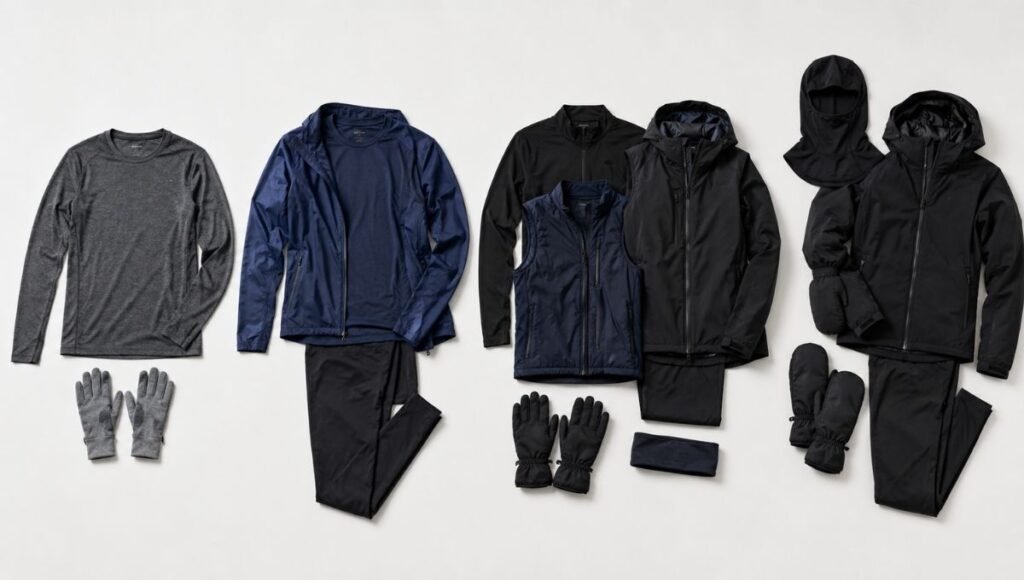
This is the thing running guides don’t say directly enough: if you feel comfortable when you step out the door in winter, you are almost certainly overdressed.
The physiology is straightforward. At rest, your body produces a baseline level of heat. The moment you start running, muscle activity increases heat production dramatically — your body temperature rises, blood flow accelerates, and sweat production begins, even in freezing air. Research published in the Journal of Applied Physiology confirms that metabolic heat production during moderate-intensity exercise is roughly 4–8 times higher than at rest. In practical terms: you generate a significant amount of warmth just by running.
The first mile feels cold because your cardiovascular system hasn’t fully ramped up yet. Blood is still being pulled toward your core. Your extremities feel the ambient temperature most acutely. You’re not yet generating peak running heat. So the first mile lies — it tells you that you’re underdressed when you’re actually appropriately dressed for miles 2 through 10.
The fix is simple in principle and hard in practice: step outside feeling slightly cool. Not miserable, not shivering, but not comfortable either. That slight chill at the start is exactly right. It means you’ll be comfortable once your body heat kicks in, rather than peeling off layers at the first water fountain.
The 10-Degree Rule (And When to Ignore It)

The standard advice — dress as if the temperature is 10–20°F warmer than the thermometer reading — is a useful starting point, but it has variables that matter.
Dress closer to the 20°F adjustment if:
- You’re running at moderate to hard effort (tempo runs, intervals)
- You run hot naturally — you finish most runs sweaty regardless of temperature
- It’s sunny and calm
- You’re running mid-day when ambient temperature is at its peak
Dress closer to the 10°F adjustment (or the actual temperature) if:
- You’re doing an easy, slow, or recovery run at lower intensity
- It’s windy — wind chill bypasses your body’s heat-generating advantage significantly
- It’s overcast, damp, or humid — moisture in the air conducts heat away from your body faster than dry cold
- You tend to run cold, or you’re returning from injury at lower-than-usual effort
Pro runner and marathoner Stephanie Rothstein Bruce puts it well: a 30°F day in humid East Coast conditions should be dressed for at 30°F, because the sun isn’t warming you and humidity holds cold against the skin. That same 30°F day in sunny, dry Colorado? Dress for 50°F.
Winter Running Outfit by Temperature: A Practical Guide

40–50°F: The Tricky Zone
This is the temperature range where most runners make mistakes in both directions. It feels cold enough to pile on layers but warm enough that you’ll overheat quickly if you do.
What to wear:
- Moisture-wicking long-sleeve base layer (not cotton — ever)
- Running shorts or light running tights depending on your cold tolerance
- Light gloves — hands feel the cold before the rest of you
- Ear band if it’s windy
What to skip: A jacket is usually unnecessary unless there’s significant wind or rain. A long-sleeve base layer at this temperature range handles most conditions without trapping the heat that a jacket would.
Editor’s note: This is the temperature range where having a lightweight packable windshell in your pocket is the perfect compromise. Start without it, put it on if conditions change.
30–40°F: Standard Winter Running Territory
Most winter training happens in this zone. The layering system earns its place here.
What to wear:
- Moisture-wicking long-sleeve base layer as your foundation
- Lightweight running jacket or windshell over the top
- Thermal running tights or running pants — regular leggings aren’t enough at the lower end of this range
- Running gloves (not just liner gloves — actual insulated running gloves)
- Ear band or light running hat
What to watch: Wind direction matters. Running into a headwind at 35°F can feel like 25°F. Plan your route so the second half (when you’re tired and generating less heat) isn’t directly into the wind.
20–30°F: Serious Cold Territory
At this temperature, layering becomes genuinely important, and skipping any element of your kit will result in a miserable run rather than just a slightly uncomfortable one.
What to wear:
- Moisture-wicking base layer (thermal weight if available)
- Mid-layer: a lightweight fleece or insulated running vest over the base
- Windproof running jacket as the outer shell
- Thermal running tights or windproof running pants
- Insulated running gloves — standard running gloves aren’t sufficient
- Running hat that covers your ears fully, or ear band plus buff around your neck
- Consider a thin balaclava or neck gaiter for the face on windy days
The vest option: A running vest (sleeveless insulated layer) is underrated for this temperature range. It keeps your core warm while leaving your arms free to regulate temperature — arms are more effective at heat dumping than your torso, so keeping them accessible helps you avoid overheating.
Below 20°F: Know Your Limits
At this temperature, dressing correctly becomes a safety matter, not just a comfort matter. The National Weather Service data shows that frostbite can occur in 30 minutes or less at temperatures below 0°F with wind. At 20°F with a 20mph wind, the feels-like temperature drops to 4°F — frostbite risk window narrows to 30 minutes of exposed skin.
What to wear:
- Two base layers: a thin moisture-wicking layer against skin, thermal layer over it
- Insulated running jacket with wind protection
- Thermal windproof running pants or tights with a wind-resistant outer layer
- Waterproof insulated mittens (mittens retain heat better than gloves in extreme cold — fingers share warmth)
- Full-coverage running hat plus balaclava or buff covering nose and mouth
- Thermal running socks
When to stay inside: If the feels-like temperature is below -10°F, or if conditions involve freezing rain, black ice, or limited visibility, the treadmill is the right call. No training goal is worth frostbite or a fall on ice.
The Extremities Rule: Hands and Ears Before Everything Else
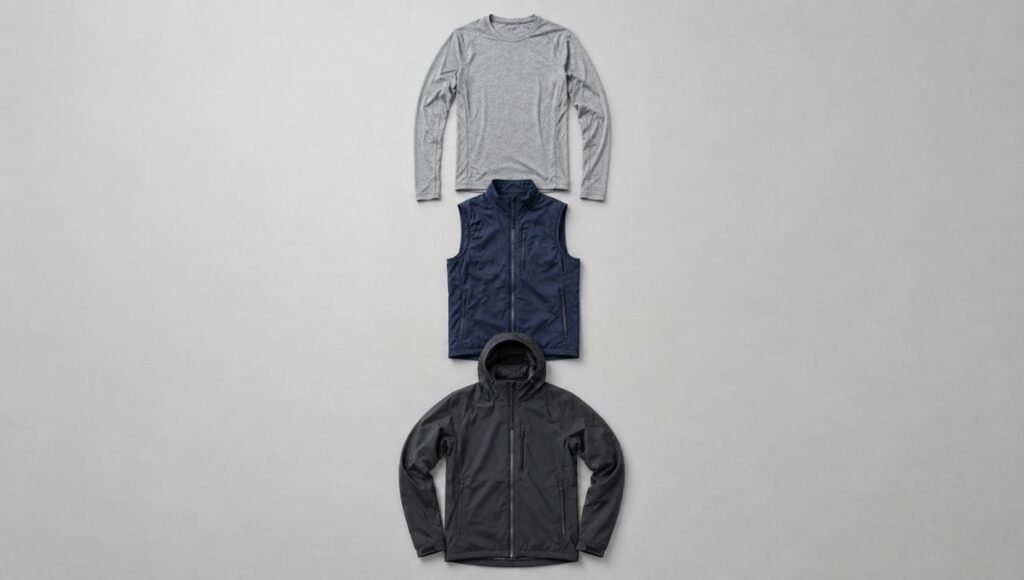
This is the principle most winter running guides underemphasize, and it’s the one that will immediately improve your cold-weather runs.
Your hands and ears lose heat faster than your torso because they’re small, have high surface-area-to-volume ratios, and receive reduced blood flow in the cold as your body prioritizes core temperature. In cold weather, blood vessels in your extremities constrict — it’s a protective mechanism that keeps your vital organs warm at the expense of your fingers, toes, and ears.
The practical implication: add gloves and an ear covering before you add a second base layer or heavier jacket. Your legs and torso generate heat through muscle activity and retain warmth through their mass. Your hands don’t run. They just sit there getting cold.
The layering order for cold-weather running:
- Gloves first (add at 50°F or whenever your hands feel the chill)
- Ear coverage second (ear band at 45°F, full hat at 35°F or below)
- Long sleeves over short sleeves third
- Thermal tights over regular tights fourth
- Outer jacket layer last
Many runners — especially newer cold-weather runners — try to solve hand coldness by adding a heavier jacket, which doesn’t address the actual problem. Gloves cost less than $20, weigh almost nothing, and solve 80% of the “too cold” problem in the 35–50°F range.
The Three-Layer System for Serious Winter Running
For temperatures below 30°F, the three-layer system is the framework that professional running coaches and serious winter runners use. Understanding what each layer does — and choosing it accordingly — is more useful than any specific product recommendation.
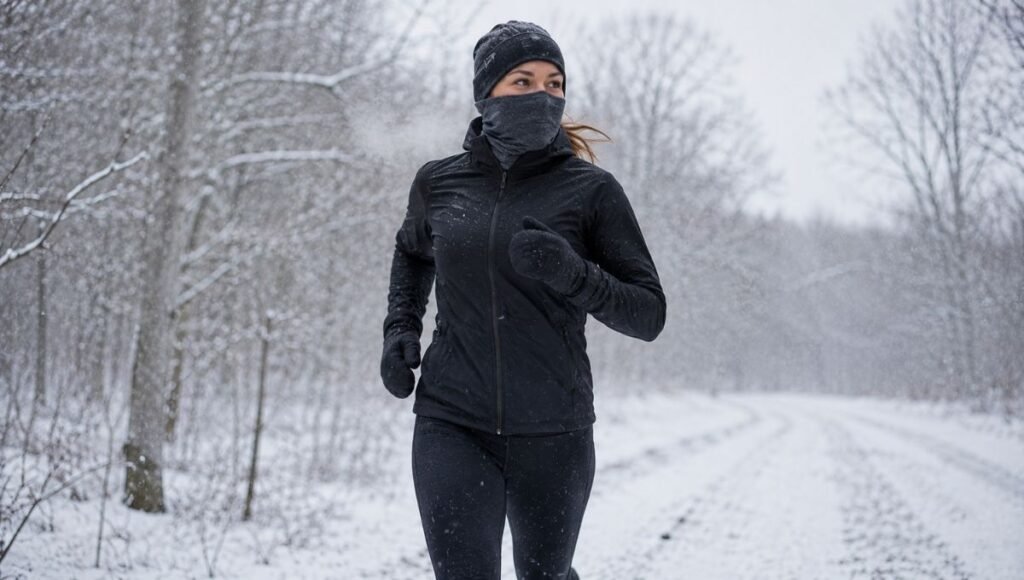
Layer 1: Base Layer (Moisture Management)
The base layer sits against your skin. Its job is to move sweat away from your body surface so it can evaporate — if it traps moisture against your skin, that moisture cools rapidly in cold air and makes you significantly colder. This is why cotton is genuinely dangerous as a base layer in cold weather, not just uncomfortable. Wet cotton conducts heat away from your skin roughly 25 times faster than dry fabric.
Choose: synthetic moisture-wicking fabrics (polyester, nylon) or merino wool. Merino has the additional advantage of retaining warmth even when damp — useful if you’re a heavy sweater who generates more moisture than synthetics can manage.
Layer 2: Mid Layer (Insulation)
The mid-layer traps warm air generated by your body and holds it close to your core. It does the actual warming. Fleece, lightweight down, or synthetic insulation all work — the choice depends on whether conditions include precipitation (down loses insulating ability when wet; synthetics maintain warmth in damp conditions).
For running specifically, a running vest is often more effective than a full mid-layer jacket — it insulates your core without restricting arm movement or trapping arm heat that your body wants to release.
Layer 3: Outer Shell (Wind and Weather Protection)
The shell’s job is to block wind and precipitation while allowing moisture vapor from your first two layers to escape. A windproof shell with breathability — not a waterproof shell that traps everything — is usually the right choice for running in temperatures above 20°F. Fully waterproof membranes are warranted for rain running specifically.
Winter Running Outfit Mistakes That Are Ruining Your Cold Runs
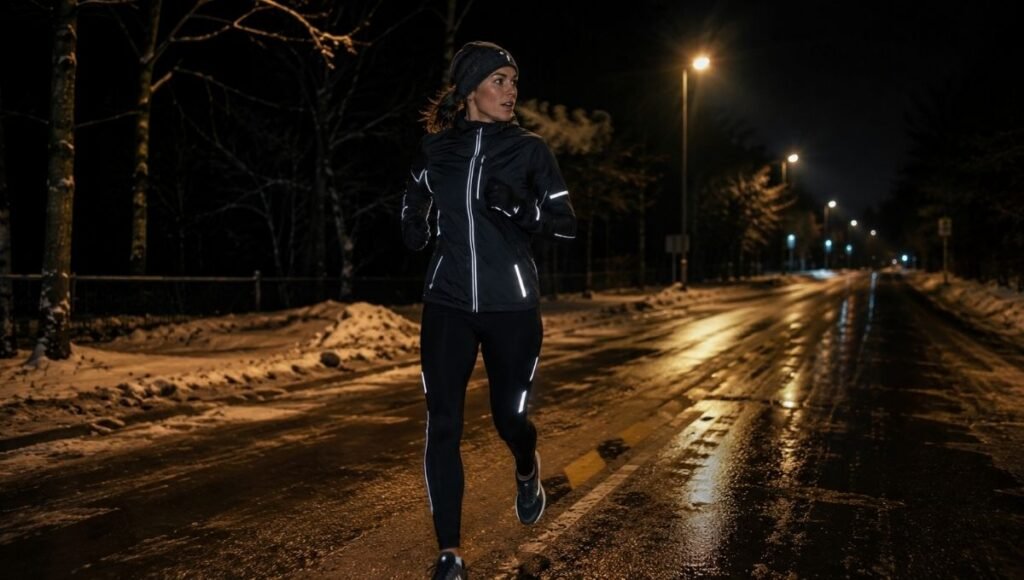
Wearing cotton anything. This bears repeating until it stops happening. Cotton absorbs sweat and holds it. In winter running, a saturated cotton base layer becomes a cold compress against your skin. The temperature drop that happens when you pause at a stoplight or slow your pace can be startling and, in extreme cold, genuinely dangerous.
Dressing for the temperature you feel at the start. The first mile is a liar. Dress for miles 3 through 8, not mile 0.5.
Ignoring wind chill and checking only the thermometer. A 40°F day with a 25mph headwind has a feels-like temperature of 28°F. These are entirely different dressing scenarios. Always check the wind speed and direction before choosing your outfit.
Skipping the extremities. Your legs generate heat by running. Your hands don’t. Add gloves before you add any other layer.
Wearing your summer running shoes on icy surfaces. Running shoes designed for road running have minimal traction on snow and ice. If you run through winter, either add screw-in traction devices (like Yaktrax) to your existing shoes or invest in a trail running shoe with aggressive lugs for winter conditions. A fall on ice ends your training cycle faster than any cold-weather discomfort.
When Winter Running Becomes a Safety Issue
Cold-weather running is generally safe for healthy adults when dressed appropriately. It becomes a genuine concern in specific conditions:
Frostbite risk appears when feels-like temperatures drop below 0°F, especially with wind. Warning signs include numbness, white or grayish-yellow skin, and hard or waxy-feeling skin on extremities. If you notice these on a run, get indoors immediately and seek medical attention.
Hypothermia risk increases when you’re both cold and wet — either from precipitation or from sweat in inadequate layering. Symptoms include intense shivering, confusion, slurred speech, and loss of coordination. This is a medical emergency.
Exercise-induced asthma can be triggered or worsened by breathing cold dry air. If you experience chest tightness, wheezing, or shortness of breath during cold-weather runs that doesn’t resolve when you warm up, consult a physician before continuing outdoor winter running.
Ice and black ice pose a fall risk that proper clothing can’t address. Reduce your pace on any surface that looks potentially icy, shorten your stride for more contact points, and consider route adjustments after freezing rain.
FAQ: What Runners Ask About Winter Running Outfits
What should I wear running in 30-degree weather? At 30°F: a moisture-wicking long-sleeve base layer, a windproof running jacket, thermal running tights, insulated running gloves, and a hat that covers your ears. If it’s windy, add a neck gaiter or buff. Avoid cotton in any layer.
Do I need running tights or running pants for winter running? Running tights work well for most winter running conditions down to about 20°F when they’re thermal or fleece-lined. Below 20°F, or in significant wind, a wind-resistant running pant worn over tights adds meaningful protection. Regular yoga-style leggings without thermal properties are insufficient below 40°F.
What temperature is too cold to run outside? There’s no universal cutoff, but most running coaches and sports medicine physicians recommend avoiding outdoor running when the feels-like temperature drops below -10 to -15°F due to frostbite risk. At these temperatures, exposed skin can develop frostbite within 20–30 minutes. Below 0°F, cover all exposed skin including face and ears.
Should I wear a hat or just an ear band for winter running? An ear band is usually sufficient from 35–45°F when wind is calm. Below 35°F or in significant wind, a full running hat provides better coverage and retains more warmth. Many runners find a buff or gaiter more versatile — it can function as a neck warmer, be pulled up to cover the lower face, or folded into a headband.
How do I stop my hands from getting cold when running in winter? Insulated running gloves, not just liner gloves, for temperatures below 35°F. For below 20°F, consider mittens over gloves — fingers sharing warmth in a mitten retain heat significantly better than isolated fingers in a glove. If your hands consistently get cold despite gloves, check whether your jacket sleeves are leaving a gap at the wrist.
The Bottom Line
A good winter running outfit isn’t about wearing the most layers — it’s about wearing the right layers in the right order for the specific conditions you’re running in. Start slightly cold, protect your extremities first, and remember that your body generates enough heat to bridge the gap within the first mile.
The temperature guide above covers the mechanics. The rest is learning your own body: how hot you run, how fast you warm up, whether you’re an ear-gets-cold person or a hands-get-cold person first. That self-knowledge, built over a few cold-weather runs with deliberate attention to how you feel, will make you a more accurate dresser for winter than any chart can.
Cold-weather running requires the right layers from head to toe. Check out our guide to the best running jacket for women for the outer layer that handles wind and rain — and our best running leggings for women guide for the thermal bottom half of your winter kit.
References:
- González-Alonso, J., et al. (1999). Influence of body temperature on the development of fatigue during prolonged exercise in the heat. Journal of Applied Physiology.
- National Weather Service. (2024). Wind Chill Chart and Frostbite Risk Guide. National Oceanic and Atmospheric Administration.
- Rothstein Bruce, S. Pro Marathoner. Expert commentary on regional cold-weather dressing strategy. NBC News Better, 2023.
- American College of Sports Medicine. (2023). Prevention of Cold Injuries During Exercise. ACSM Current Comment.