
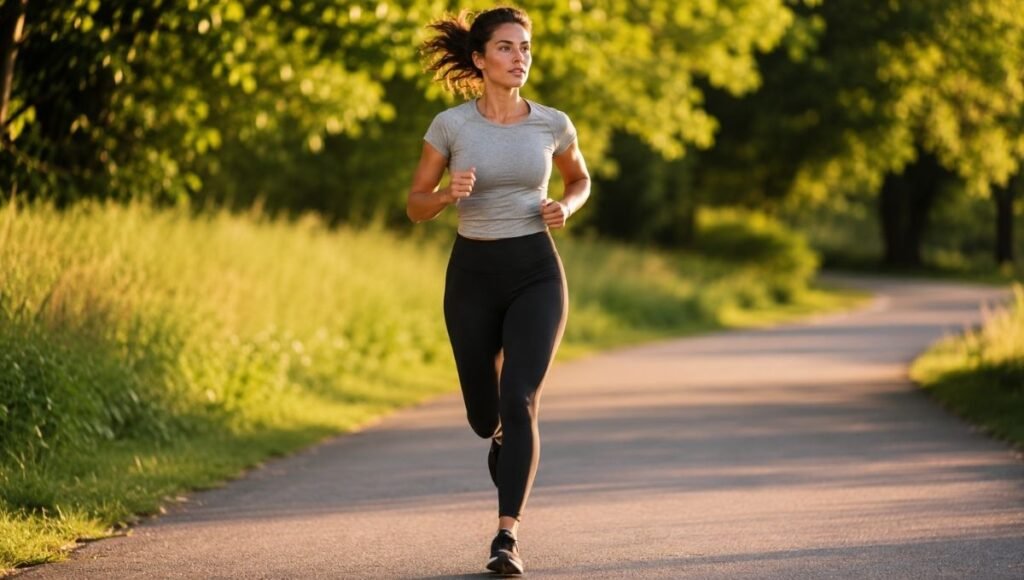
You’re three miles in. Your rhythm is good, your breathing is steady, and then — you feel it. The waistband starting its slow descent. One hand reaches down to pull it back up. You keep running. Another half mile, same thing. By mile five, half your mental energy is going toward managing your pants instead of your run.
If you’ve lived that particular frustration, you already know that not every pair of leggings labeled “running” is actually built for running. A lot of them are built for yoga, gym sessions, or walking — activities where the waistband doesn’t face the same sustained downward pressure that happens when you’re striding forward, mile after mile. Running is a different mechanical demand, and the best running leggings for women are engineered around that specific reality.
This guide is for runners who are done guessing. We break down exactly what separates a true running legging from everything else, what to look for in fabric, waistband, and compression — and which specific pairs are worth your money in 2026 across every budget and body type.
Key Takeaways
- Not all “athletic” leggings are running leggings — yoga and gym leggings often lack the compression, moisture management, and waistband stability required for sustained running
- The waistband is the single most important feature — a wide, high-rise waistband with an internal drawstring is the only reliable way to prevent mid-run sliding
- Fabric should be at least 15–20% spandex or elastane blended with nylon or polyester for the right compression-to-stretch ratio, according to running coaches
- Pockets need to be functional, not decorative — a pocket that can’t hold a phone flat against the thigh is essentially useless for running
- Body type matters more than brand — the best running leggings for curvy runners, athletic builds, and petite frames are genuinely different products
Running Leggings vs Regular Leggings: Why It Actually Matters
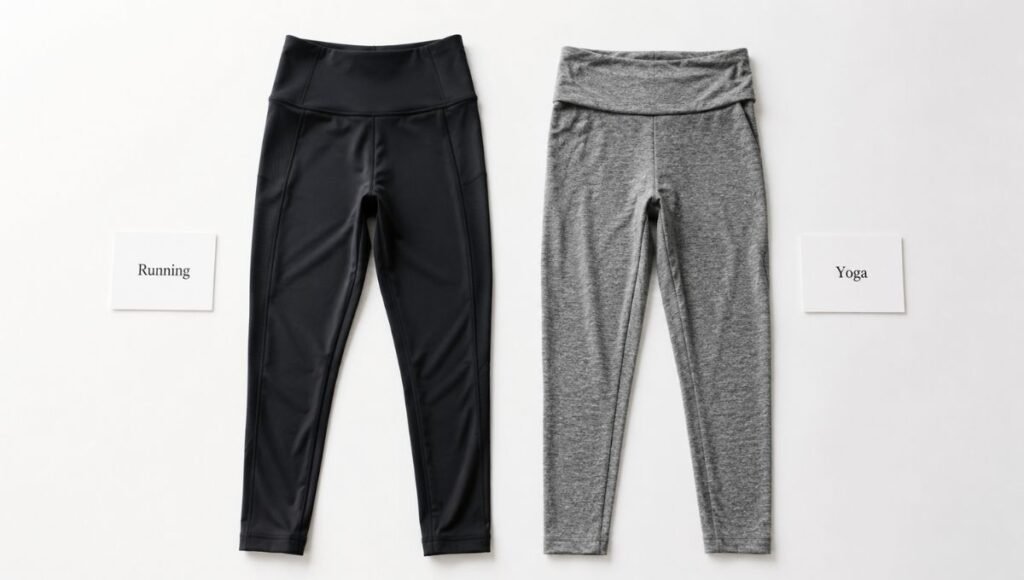
This is the conversation most buying guides avoid, probably because it means saying something uncomfortable: that popular, well-reviewed leggings from major brands are sometimes wrong for running specifically.
Take the Lululemon Align — universally loved, buttery soft, excellent for yoga and low-impact movement. On a long run, that same buttery softness becomes a liability. The fabric is too lightweight to provide meaningful compression, the waistband lacks the structural support needed to resist forward stride pressure, and the moisture management isn’t built for sustained sweat output. They’re genuinely great leggings. They’re just not running leggings.
The difference comes down to three mechanical demands that running places on clothing that other activities don’t:
Sustained forward stride pressure — Each running step creates a downward and forward force on your waistband that doesn’t exist in yoga, weightlifting, or walking. A waistband that holds during a squat can still slide during a 6-mile run.
Continuous moisture output — Running produces significantly more sweat than most gym activities, sustained over longer time periods. Fabric that wicks well during a 45-minute spin class may saturate during a two-hour long run.
Inner thigh friction — The repetitive stride cycle means your thighs brush together thousands of times per run. Any seam or fabric edge in the wrong place compounds that friction into chafing that doesn’t show up until mile 8 or 9.
True running leggings are built around all three. Everything else is a compromise — sometimes a good one for shorter distances, but a compromise nonetheless.
How to Choose Running Leggings: What Actually Matters
Fabric: The 15–20% Rule
Running coach and fitness expert Tara Sullivan recommends looking for leggings with at least 15 to 20 percent spandex or elastane blended into nylon or polyester. That ratio delivers the right balance: enough compression to support muscles and prevent chafing, enough stretch to accommodate full running stride, and moisture management that moves sweat to the fabric surface where it can evaporate.
What to avoid: high cotton content (holds moisture, increases friction), overly soft “buttery” fabrics without structural compression (slides and stretches out), and cheap polyester blends that pill and lose shape after a few runs.
What to look for on the label: nylon-spandex or polyester-elastane blends, moisture-wicking technology, four-way stretch, and anti-pilling construction.
Waistband Type: The Feature Most Runners Underestimate
The waistband is where most running leggings succeed or fail — and yet it’s the feature most buyers pay the least attention to in store. After three miles on the road, you’ll know exactly how important it is.
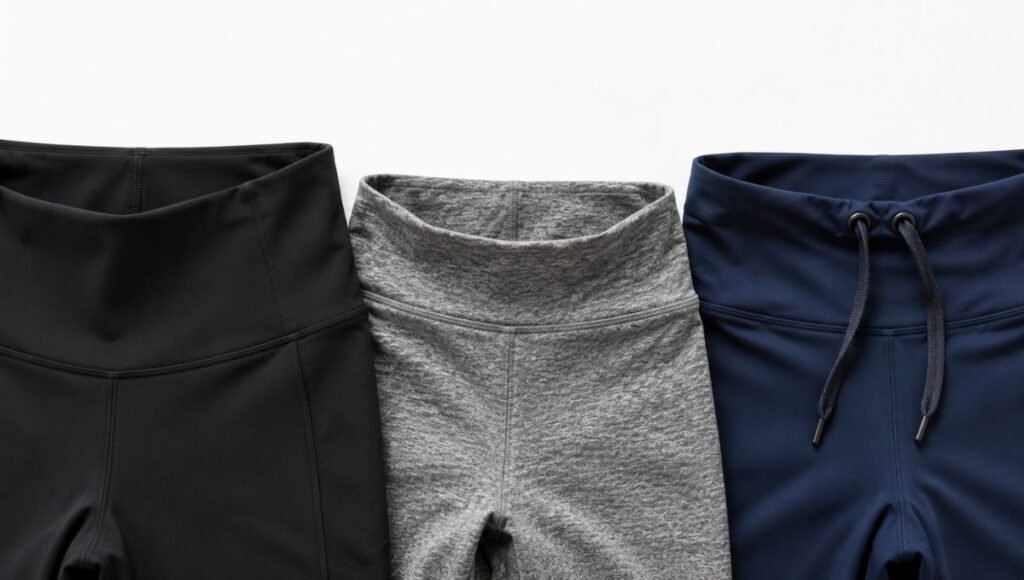
Wide flat waistband (3+ inches): The most stable option for running. Distributes pressure evenly across the midsection, resists rolling, and doesn’t create the “muffin top” pinching that narrow bands cause during high-output movement. This is what you want.
Fold-over waistband: Popular in yoga leggings, problematic for running. The fold creates an unstable double layer that shifts position unpredictably during stride. What folds down nicely in a forward bend unfolds and slides during running movement.
Drawstring waistband: The most adjustable and reliable option, especially for runners with a smaller waist relative to hips. The internal drawstring (not external, which bounces and flaps) allows custom fit that holds through any distance.
Narrow elastic waistband: The riskiest option for running. Works fine for low-impact activity, but the narrow band concentrates pressure on a small area of the midsection, which tends to roll or dig during sustained movement.
Compression Level: Match to Your Purpose
Light compression: Good for easy runs, recovery runs, and runners who prefer minimal restriction. Feels closer to a second skin than a true compression garment. Best for shorter distances and warmer weather where you want maximum breathability.
Medium compression: The versatile sweet spot for most running scenarios. Provides enough muscle support to reduce fatigue on longer efforts without restricting movement. Works from 5K training through half marathon distances.
High compression: Best for long distances, marathon training, and runners prone to muscle fatigue or cramping. Creates a “locked in” sensation that some runners love and others find too restrictive — personal preference matters here. Also the best option for cold weather, where the tighter fit provides additional insulation.
Pocket Design: Functional vs Decorative
A pocket that can’t hold a phone flat against your thigh without bouncing is not a running pocket — it’s a design feature. Real running pockets are either built into a wide waistband with a secure zipper or pouch construction, or they’re built into the side seam of the thigh with enough depth and tension to hold a modern smartphone flat during stride.
Before buying, check: can the pocket hold a phone without the phone visibly bouncing in product demonstration videos? Is the pocket access point secured (zipper or tight elastic entry)? Is there a secondary pocket for a key or card?
For races and long runs specifically: you want at least one secure waistband pocket for keys and two thigh pockets or waistband pockets large enough for gels.
The Best Running Leggings for Women in 2026
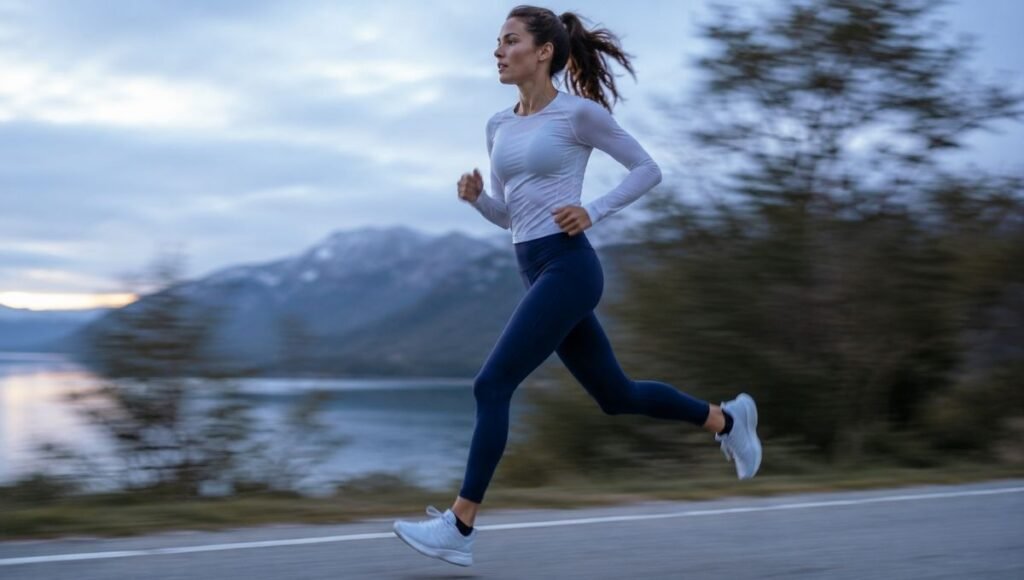
Best Overall: Lululemon Fast and Free High-Rise Tight
The Fast and Free is the rare case where the most popular option is also genuinely the best option for most runners. The Nulux fabric is lightweight, compressive without being restrictive, and moves sweat efficiently enough for long runs in warm conditions. The high-rise waistband stays put through mileage that would fold most other options.
What makes it specifically right for running: drop-in thigh pockets large enough for a smartphone, a waistband that maintains position through stride rather than yoga poses, and a fabric weight that balances compression with breathability. Available in 25″ and 28″ inseam options.
Best for: Everyday training, road running, 5K through marathon distance, runners who want one pair that handles most conditions.
Editor’s note: Yes, these are expensive. The cost-per-mile math still works out if you’re running more than three times a week. These are what serious runners actually wear.
Best for Preventing Chafing: Sweaty Betty Zero Gravity Legging
The Zero Gravity uses a bonded construction that eliminates raised interior seams entirely — the primary mechanical cause of inner thigh chafing during running. The fabric is smooth against skin throughout the full stride cycle. The compression level is medium-high, which keeps the fabric from shifting and creating friction points during long efforts.
Sweaty Betty built these specifically around running biomechanics, which shows in the flat inner thigh seams, the positioned waistband, and the technical fabric that manages high sweat output over extended time periods.
Best for: Runners who chronically chafe on long runs, half marathon and marathon training, any runner who has tried anti-chafe balm as a substitute for better gear.
Best High-Waisted (Waistband That Won’t Move): Brooks Run Visible Tight
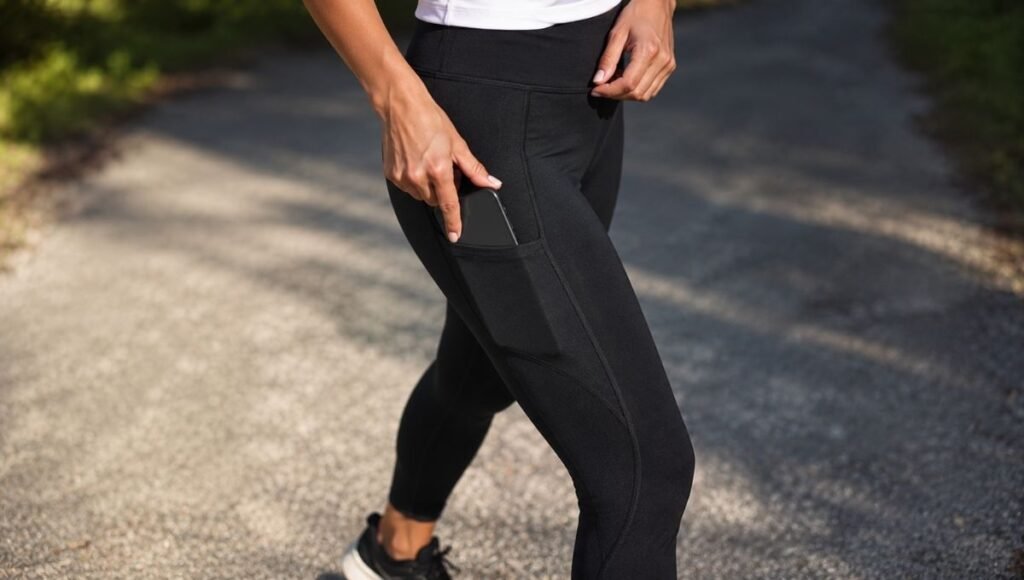
The Brooks Run Visible solves the waistband problem definitively. The high-rise design combined with an internal drawstring means you set the waist position once and it stays there — mile 1 through mile 13. The reflective detailing across the legs earns the “Visible” name and makes these the obvious choice for dawn and dusk running.
The fabric weight is slightly heavier than ultralight running tights, which adds warmth for cooler conditions and gives the waistband additional structural stability. Deep pockets. Functional construction throughout.
Best for: Runners whose primary complaint is waistband movement, early morning and evening runners, fall and spring running temperatures.
Best Budget Pick: The Gym People Running Leggings
At roughly one-third the price of premium options, these punch significantly above their price point. Four-way stretch, high-waisted construction, deep side pockets, and fabric thickness that passes the opacity test. The compression level is medium — honest and appropriate for the price.
These won’t outlast a Lululemon pair, and the fabric management over very long runs isn’t at the same level. But for beginner runners building mileage, backup pairs for rotation, or anyone who runs three or fewer times per week, the value proposition is real.
Best for: New runners, budget-conscious runners building their wardrobe, backup pairs for rotation, treadmill and shorter road runs.
Best for Cold Weather Running: Girlfriend Collective Compressive High Rise Legging
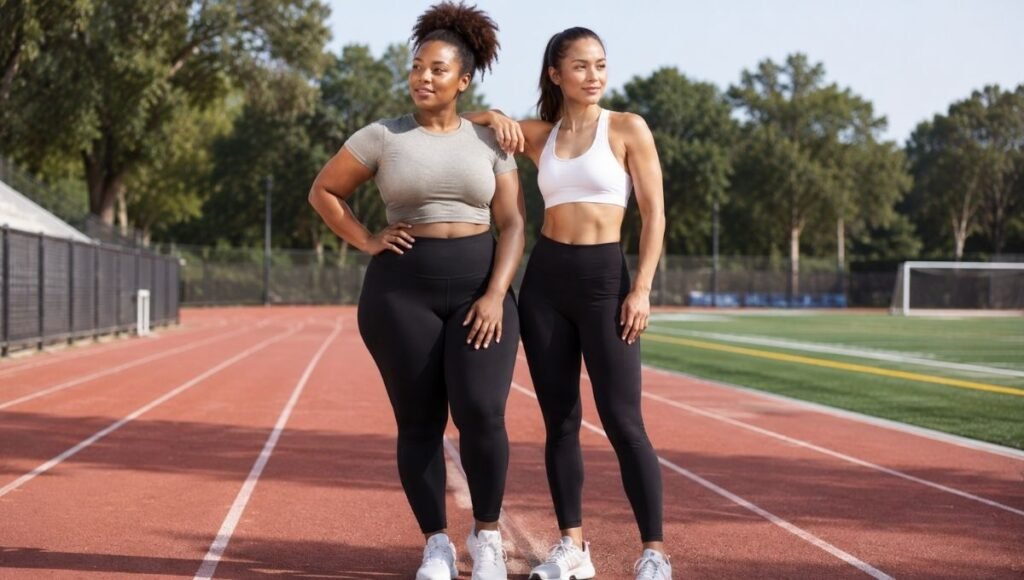
Cold weather running demands a different kind of fabric — one that provides insulation without adding bulk, maintains compression through temperature changes, and dries efficiently when you transition from outdoor cold to indoor heat. The Girlfriend Collective Compressive legging uses a recycled fabric blend that handles all three.
The compression level is medium-high, which adds warmth through muscle-hugging fit rather than additional fabric bulk. The high-rise waistband provides coverage that matters more when you’re wearing a shorter base layer in cold conditions. The brushed interior adds enough warmth for temperatures down into the low 40s°F without the heavy fleece lining that makes some cold-weather tights feel overbuilt for actual running.
Best for: Cold weather running from 40–55°F, fall and winter training, runners who run hot and want light insulation rather than heavy lining.
Best for Curvy and Plus-Size Runners: Fabletics On-The-Go Powerhold Legging
Most running legging brands engineer for a standard athletic build and then extend sizing on a chart without changing the fit architecture. Fabletics built the Powerhold with extended sizing as a design consideration, not an afterthought — the waistband construction, hip-to-waist ratio, and inner thigh seam placement all account for curvier proportions.
The Powerhold fabric provides high compression that holds its position through stride, which matters especially for runners with larger thighs where fabric migration is a more common problem. The high-rise waistband is wide enough to stay flat rather than rolling or digging.
Best for: Curvy runners, plus-size runners, runners whose primary issue is leggings that fit the waist but are too tight through the thighs, or vice versa.
Finding Running Leggings That Fit Your Body Type
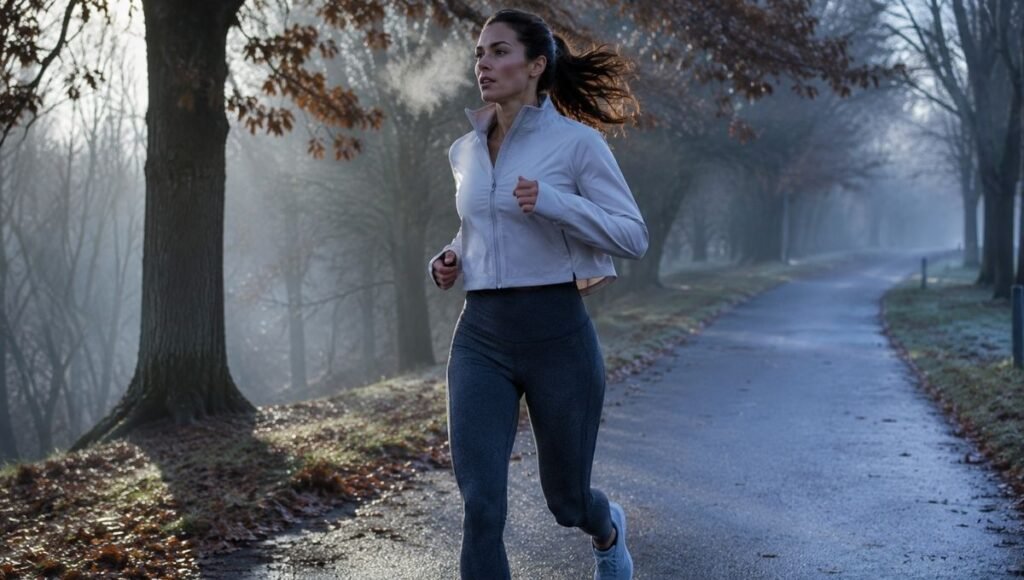
Body type isn’t a minor consideration in running leggings — it’s often the most important one. The same pair of leggings performs completely differently on different builds.
Athletic / muscular build: Prioritize wider leg openings and medium-to-high compression fabrics that hold without digging. The issue for muscular builds is usually fabric that fits the waist but is too tight through the thighs, creating a tourniquet effect. Look for brands that specifically mention thigh fit in their sizing guidance.
Curvy / pear-shaped build: High-rise is non-negotiable — a mid-rise waistband will slide down constantly because the waist-to-hip ratio means there’s less holding the waistband in place. Internal drawstrings are your best friend. Avoid fold-over waistbands entirely.
Petite runners: Inseam length matters as much as waist fit. A 28″ inseam on a 5’2″ frame turns into a bunching problem at the ankle that creates friction points. Look for 25″ inseam options or brands that offer petite-specific cuts.
Tall runners: The opposite problem — standard 25″ inseams hit mid-calf and expose cold skin in winter running. Prioritize brands with 28″ or 30″ inseam options. Brooks and Lululemon both offer longer inseam options in their running lines.
Plus-size runners: Width sizing and compression balance are the key variables. Heavy compression can restrict stride and circulation; too little compression means the fabric shifts. Medium compression in a brand that builds for extended sizing (Fabletics, Girlfriend Collective, Nike’s extended sizing line) tends to perform better than size-extended versions of standard-fit leggings.
Running Leggings Mistakes That Are Quietly Hurting Your Runs
Buying yoga leggings and expecting them to run. This is the most common and most expensive mistake. Yoga leggings are designed for slow, controlled movement with minimal sweat output. They’re not engineered for the stride mechanics, sustained moisture, and waistband pressure of running. They feel great in the store and betray you by mile 4.
Ignoring the inseam length. A legging that’s too long bunches at the ankle and creates friction. Too short and you’re dealing with compression stopping mid-calf, which feels odd and can restrict circulation in cold weather. Always check inseam length against your actual measurement before buying.
Trusting “squat-proof” claims without checking reviews. Many brands make this claim. Some deliver; many don’t. Check reviews from runners specifically — the opacity demands of a squat are different from the opacity demands of a forward-stride running gate. Look for review photos from running contexts, not just gym contexts.
Sizing down for more compression. A legging that’s too small doesn’t provide better compression — it provides restriction. True compression comes from the fabric’s inherent compression construction, not from wearing a smaller size. Sizing down adds pressure without adding performance, and it increases the likelihood of waistband digging and circulation restriction on longer runs.
Never rotating pairs. Like running shoes, leggings need recovery time between uses to restore their shape and compression properties. Running in the same pair three days in a row degrades the fabric faster and means you’re running in a legging that’s still slightly damp from your last session — a chafing risk. Rotate at least two to three pairs.
FAQ: What Runners Really Want to Know About Running Leggings
Why do my running leggings keep falling down? Usually one of three causes: the waistband style isn’t suited to running mechanics (fold-over and narrow bands are the most common culprits), the compression level is too low for the stride pressure your run creates, or you need a smaller size in the waistband specifically. Try a pair with a wide flat high-rise waistband and an internal drawstring — these are the most reliable solution to the sliding problem.
Are running leggings different from regular leggings? Yes, in meaningful ways. Running leggings are engineered for sustained forward stride pressure on the waistband, higher and longer moisture output, and inner thigh friction that occurs thousands of times per run. Regular athletic leggings are usually built around lower-impact activities and don’t address these specific demands. The difference shows up most clearly on runs over 5 miles.
What are the best running leggings for women with big thighs? Look for leggings with wider leg openings, bonded or flat inner thigh seams (no raised seam ridge to cause friction), and medium-to-high compression that holds position without digging. The Sweaty Betty Zero Gravity and Fabletics Powerhold are both specifically engineered to work well for runners with muscular or larger thighs.
Should running leggings be tight? They should feel compressive but not restrictive. You should be able to take a full running stride without feeling the fabric pull against your movement, and you should be able to breathe normally with the waistband in place. If the waistband digs after 10 minutes of sitting, it’s too tight. If you can pinch excess fabric at the thigh, it’s too loose.
How long should running leggings last? With proper rotation and care, quality running leggings should last 18–24 months of regular use — roughly 300–400 runs. Signs it’s time to replace: the fabric has lost its opacity, the waistband has permanently stretched and no longer holds position, or the compression feel has gone flat and the fabric hangs rather than hugs.
The Bottom Line
The best running leggings for women are the ones you stop thinking about after the first quarter mile. No waistband management, no transparency anxiety, no mid-run chafing — just your legs doing what they’re supposed to do.
Start with the waistband: wide, high-rise, with an internal drawstring if your hip-to-waist ratio makes standard fits slide. Match the compression level to your typical run distance. And be honest about whether you’re buying running leggings or buying leggings that you’ll also use for running — those are genuinely different products, and knowing which one you need saves you a drawer full of expensive disappointments.
For most runners, the Lululemon Fast and Free covers everyday needs. For cold weather, the Girlfriend Collective Compressive. For chafe-prone runners, the Sweaty Betty Zero Gravity. For budget-conscious runners building their rotation, The Gym People delivers real value.
Ready to sort out the rest of your running kit? Check out our guide to the best running shorts for women for warmer days — and our breakdown of the best running socks for women to make sure what’s underneath is doing its job too.
References:
- Sullivan, T. Running Coach. Expert commentary on running leggings fabric and fit. Women’s Health, 2025.
- Garage Gym Reviews. (2025). Best Running Leggings: 25 pairs tested across 12+ brands. Garage Gym Reviews.
- Laing, R.M., et al. (2020). Textile and clothing comfort in sport: A review of current knowledge. Sports Medicine.
- American College of Sports Medicine. (2023). Compression Garments and Exercise Performance. ACSM’s Health & Fitness Journal.