
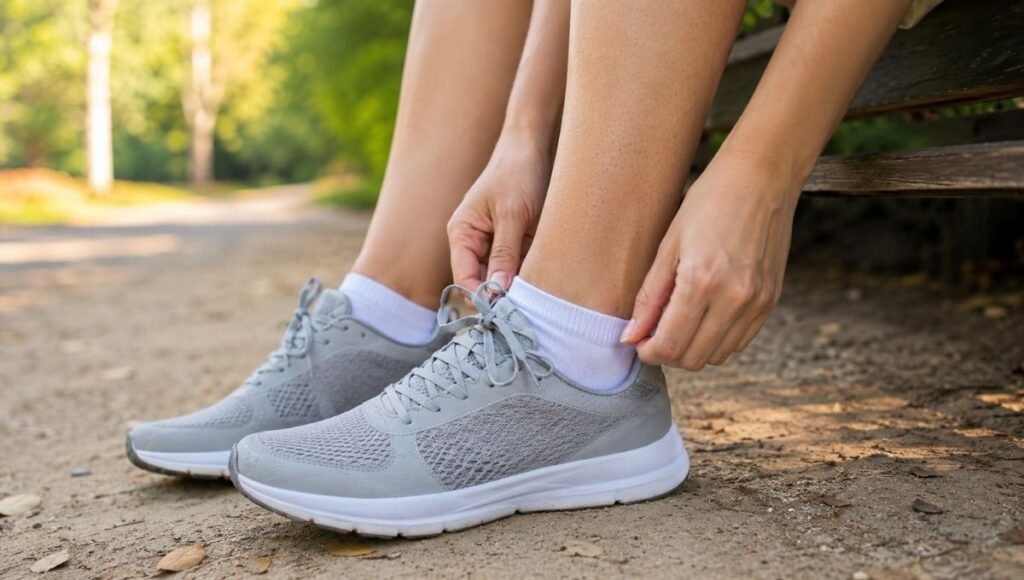
Mile 18 of a marathon. You’ve trained for months. Your legs feel heavy but manageable. And then — a hot spot on your left heel that wasn’t there at mile 10. By mile 20, it’s a full blister. By the finish line, you’re limping. Not because of your shoes. Not because of your training. Because of a pair of socks you grabbed off a shelf without thinking twice.
If you’ve ever crossed a finish line with bloody heels, peeled off your shoes after a long run to find a quarter-sized bubble on your toe, or just spent the last three miles of a run mentally narrating your foot pain — this one’s for you. The best running socks for women aren’t a luxury. They’re the difference between a run you remember fondly and one you’d rather forget.
Here’s what nobody tells you: most running problems people blame on their shoes are actually sock problems. The friction, the moisture, the bunching, the sliding — socks are the variable most runners never optimize. We fix that today.
Key Takeaways
- Cotton is the enemy — cotton absorbs and holds moisture, which creates friction, which creates blisters. No exceptions.
- Cushion level should match your distance — ultralight for speed and short runs, medium cushion for daily training, maximum cushion for long runs and trails
- Seamless toe construction is non-negotiable for distance running — a single seam ridge causes more damage over 26.2 miles than you’d believe
- Sock height affects more than aesthetics — crew socks offer ankle support and shin splint relief; no-show tabs protect your Achilles from heel cup friction
- A good pair of running socks costs $15–$25 — that’s less than a single blister treatment kit, and they’ll last hundreds of miles
Why Running Socks Matter More Than You Think
There’s a reason serious runners spend real money on socks — and it’s not about brand loyalty or gear snobbery. It’s physics.
When your foot moves inside a shoe, there’s friction. The sock sits between your skin and the shoe’s interior. If that sock bunches, slips, holds moisture, or has a raised seam in the wrong place, you get a blister. The American Academy of Dermatology describes blisters as the result of repeated friction causing layers of skin to separate and fill with fluid. The mechanism is simple: moisture softens skin, friction tears it. A well-designed running sock interrupts both variables at once.
What makes running socks different from regular athletic socks isn’t marketing language — it’s construction. Running-specific socks use moisture-wicking fibers, strategic cushion placement, seamless toe construction, and zone compression that regular socks simply don’t have. Dr. Lori Grant, MD, a board-certified foot and ankle surgeon at Orlando Health, puts it plainly: the wrong socks create little wounds or sores on your feet. The right ones prevent them entirely.
One more thing worth saying: the runners who complain most about blisters are almost always wearing the wrong socks — not the wrong shoes.
How to Choose Running Socks: The 3 Factors That Actually Matter
Before we get to specific recommendations, let’s build a selection framework. This is what separates a smart purchase from an expensive drawer full of regret.
Fabric: Why You Need to Ditch Cotton Forever
This is not a suggestion. Cotton is genuinely problematic for running socks. It absorbs sweat and holds it against your skin, keeping your foot wet mile after mile. Wet skin is soft skin. Soft skin blister more easily. And because cotton retains moisture, it also increases your risk of fungal infections over time.
What you want instead:
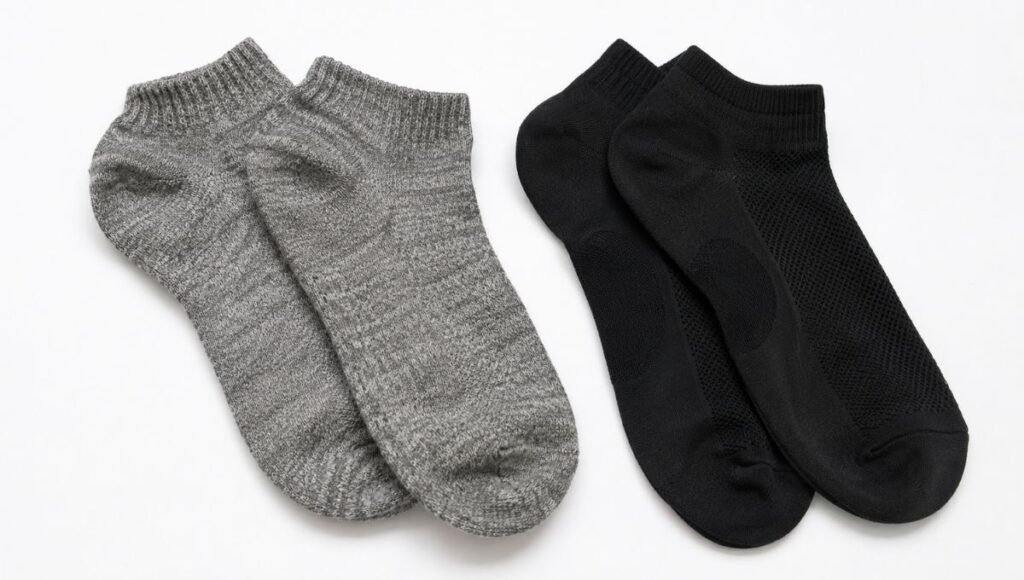
Merino wool is the gold standard. It regulates temperature (warm in cold, cool in heat), wicks moisture efficiently, and has natural antimicrobial properties that keep odor in check. Merino feels softer than you’d expect from wool and works year-round — even in summer. If you run in cold weather or have sweaty feet, this is your best bet.
Synthetic blends (nylon, polyester, Lycra, spandex) are the practical everyday option. They dry faster than merino, tend to be more durable for high-mileage use, and usually cost less. Brands like Feetures and Balega have engineered synthetic blends that perform close to merino at a lower price point.
Wool-synthetic blends split the difference — the temperature regulation of merino with the durability of synthetic fiber. Many of the best running socks on this list use exactly this approach.
Cushion Level: Match This to Your Miles
Cushion in running socks is measured in three general tiers:
Ultralight / No-cushion — Minimal padding, closest-to-the-ground feel. Best for: speed work, track sessions, short road runs, runners who prefer to feel the shoe. Not ideal for: long runs, trail running, high-impact terrain.
Light to Medium Cushion — The sweet spot for most everyday runners. Enough padding to absorb impact without adding bulk. Best for: daily training runs, 5Ks to half marathons, general use.
Maximum Cushion — Full padding underfoot and through the toe box. Best for: marathons and ultras, trail running, any run over 90 minutes, runners prone to hot spots on longer efforts.
The instinct to grab the thickest cushion option isn’t always right. A heavily cushioned sock in a snug-fitting shoe can create pressure points and restrict circulation. Fit your cushion level to your run, not to your anxiety about your feet.
Sock Height: This Affects More Than Style
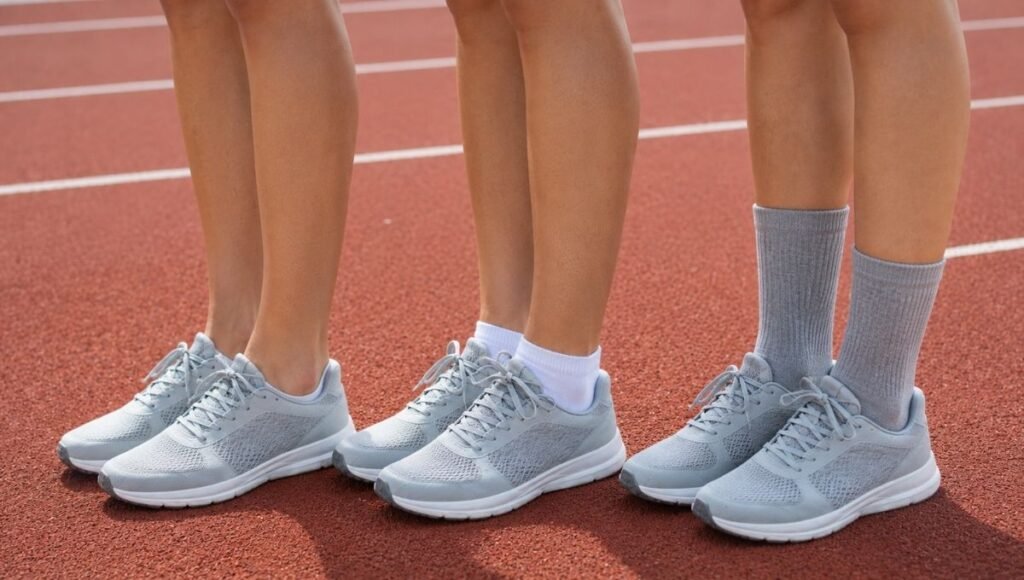
No-show / Hidden — Sits below the ankle, often with a small tab to protect the Achilles tendon from heel cup friction. Great for: warmer weather, low-cut shoes, runners who prefer maximum ventilation.
Ankle — The most versatile height. Sits just above the ankle bone, provides a bit more coverage without the bulk of a crew. Works for almost every running scenario.
Quarter / Mini crew — Sits at the lower calf. Useful for trail running where debris can enter low-cut shoes. Also adds a layer of warmth without full crew coverage.
Crew — Hits mid-calf. Recommended for: runners dealing with shin splints (light compression can help), cold weather running, trail running in brush. According to running coach Steve Mura of New York Road Runners, calf-height socks with mild compression can support ankle stability during longer efforts.
The Best Running Socks for Women in 2026
These picks are organized by what you need them to do. No filler recommendations — every pair on this list earned its place.
Best Overall: Feetures Elite Light Cushion No-Show Tab
Feetures builds their socks with anatomical left-right construction — meaning each sock is shaped for the specific foot it goes on. That single design decision eliminates the bunching and twisting that causes most mid-run friction. Add zone-specific compression, a seamless toe, and moisture-wicking synthetic fabric, and you have a sock that covers every base for most runners.
The light cushion level works for daily training runs and race days up to the half marathon distance. The no-show tab protects your Achilles heel from the shoe’s heel cup — a friction point that most sock brands completely ignore.
Best for: Everyday training, road running, 5K to half marathon distances, runners who want one reliable go-to pair.
Editor’s note: These are the socks we’d hand to any runner who asked for a starting point. Not flashy. Just right.
Best for Blister Prevention: Balega Blister Resist Quarter
The name isn’t exaggerating. Balega engineers their Blister Resist line around a patented mohair fiber blend that creates a friction-free barrier between your skin and the shoe. Where other socks try to prevent blisters through tight construction, Balega uses fiber technology — and it shows in the results.
The quarter height adds just enough ankle coverage to catch debris and prevent sock slippage. The HEX tread sole provides non-slip grip inside the shoe. If you’ve tried everything and still get blisters, this is the pair to try before you give up on socks as a solution.
Best for: Blister-prone runners, long training runs, anyone who has tried multiple options without success.
Best for Long Distance and Marathons: Darn Tough Run No-Show Tab Ultra-Lightweight
Darn Tough builds with a merino wool and Coolmax polyester blend that earns its “run all day” reputation. The ultra-lightweight construction means zero bulk — these socks disappear inside your shoe, which is exactly what you want by mile 20. The seamless construction throughout (not just at the toe) eliminates every friction point.
The reason Darn Tough makes this list over other merino options: their unconditional lifetime guarantee. If your socks wear out, develop holes, or fall apart for any reason, they replace them. For socks you’ll use for marathon training cycles, that warranty is genuinely meaningful.
Best for: Marathon training, long runs over 13 miles, runners who run hot, any condition from summer roads to winter trails.
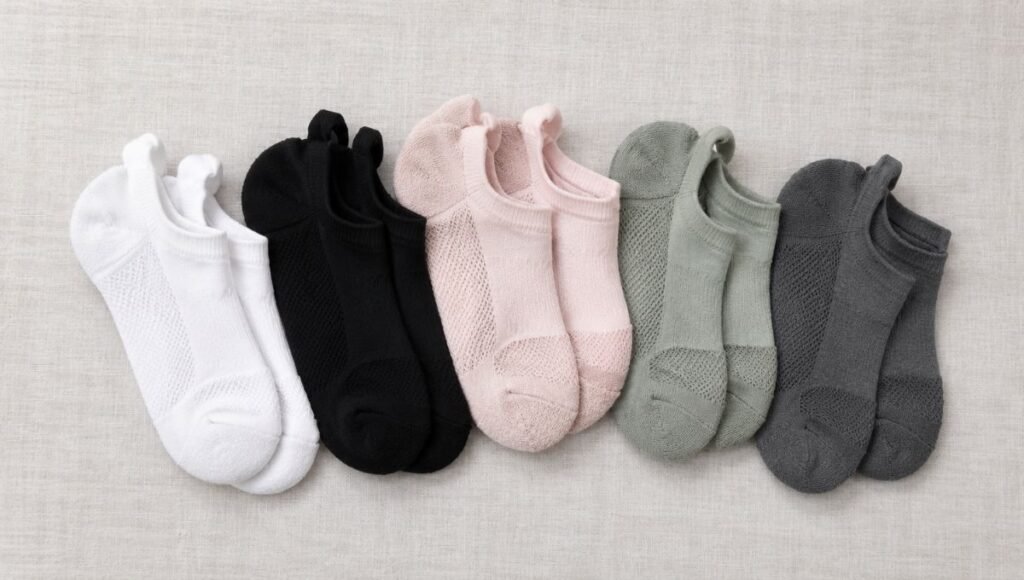
Best Budget Pick: Bombas Women’s Running Ankle Sock
Bombas gets the balance right at a price that doesn’t sting. Light compression, a blister tab, seamless toe, airflow venting, and moisture-wicking fabric — all the checkboxes at a price point that makes it easy to own enough pairs to rotate properly. (Which, by the way, you should. More on that below.)
The lightly compressive fit keeps the sock from shifting during faster runs. The cushion level is light, which makes these versatile across different run types without feeling too built-up in the shoe.
Best for: Beginner runners building their rotation, runners who need multiple pairs without spending $20+ per pair, daily training use.
Best for Hot Weather: Balega UltraGlide No-Show Tab
Summer running demands a specific kind of sock — one that pulls moisture away fast, adds minimal heat, and stays put in a sweaty shoe. The UltraGlide hits all three. The mohair and synthetic blend moves moisture exceptionally fast, the no-show design keeps things ventilated, and the fitted construction means no shifting even when your feet are wet from sweat or puddles.
The “UltraGlide” name refers to the friction-free inner surface — the yarn is engineered to slide smoothly against skin rather than grip it, which reduces the mechanical cause of blisters during high-sweat runs.
Best for: Summer training, hot and humid conditions, runners prone to sweaty feet, short-to-medium distance in warm weather.
Best Merino Wool Option: Feetures Merino 10 Cushion No-Show Tab
If you run year-round and want one sock type that adapts across seasons, merino is the answer — and Feetures’ Merino 10 blend uses an innovative spinning technique that makes the wool stretchier, softer, and more durable than standard merino. It wicks moisture in summer and insulates in winter, and the natural antimicrobial properties mean you can get more runs out of a pair before washing becomes urgent.
The cushion level is medium — enough for long runs without adding so much bulk that the shoe fit changes. These work from marathon training through cold-weather runs without skipping a beat.
Best for: Year-round running, cold weather, runners who run in varying conditions, anyone who prefers natural fibers.
Match Your Sock to Your Run: A Quick Reference
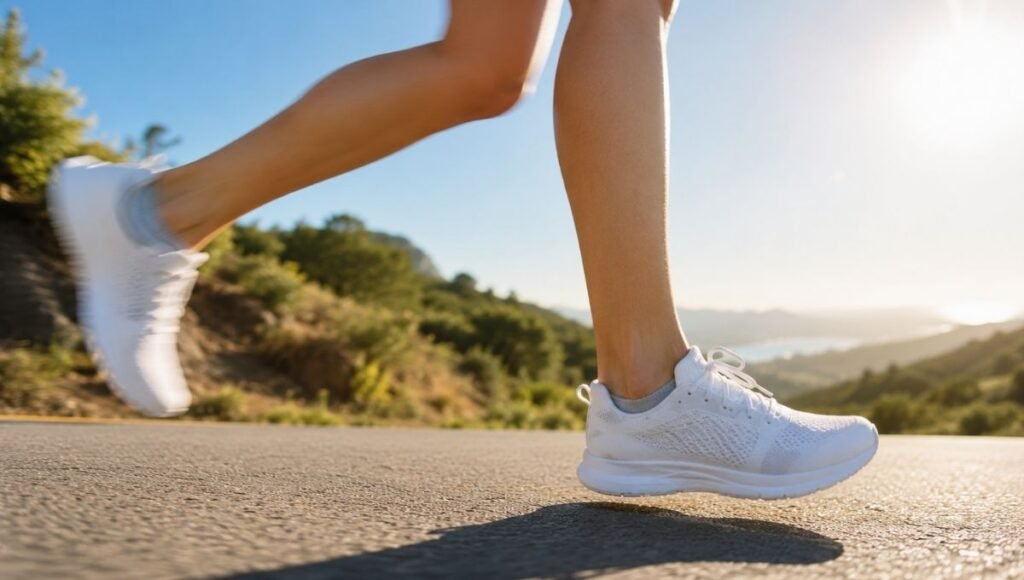
This is the practical summary most guides skip. Different runs genuinely need different socks.
5K / Speed Work / Track: Ultralight or no-cushion synthetic. You want ground feel and minimal weight. No-show or ankle height.
Daily Training (3–8 miles): Light to medium cushion synthetic blend. This is your workhorse pair — Feetures Elite or Bombas fit here perfectly.
Long Runs (10+ miles): Medium to maximum cushion, seamless construction throughout, moisture-wicking fabric. This is where Darn Tough and Balega earn their premium price.
Marathon / Race Day: Whatever you trained in. Never race in a new sock. Test your race-day pair on at least two long training runs before the event.
Trail Running: Crew or quarter height to keep debris out. More cushion than road running equivalents. Merino for temperature regulation across varying terrain.
Hot Weather Runs: Ultralight, fast-drying, ventilated. Balega UltraGlide or similar mohair-blend options.
Cold Weather Runs: Merino or wool-blend, crew height for warmth, medium to maximum cushion. Feetures Merino 10 or Darn Tough merino options.
Running Sock Mistakes That Are Quietly Ruining Your Runs
Wearing cotton. We covered this, but it bears repeating. Every sports brand sells “athletic” cotton socks. They’re fine for the gym. They’re not fine for a 10-mile run.
Running in socks that are even slightly too big. A sock that has any extra fabric — at the toe, at the heel, anywhere — will bunch. Bunching creates friction points. Friction creates blisters. Running socks should fit like a second skin, not like a slightly loose glove.
Buying one “good” pair and wearing them into the ground. Socks need rotation time to fully dry and restore their shape between runs. Running in damp socks from yesterday is almost as bad as running in cotton. Aim for at least 3–4 pairs in rotation if you run more than three times a week.
Breaking in new socks on race day. This falls into the same category as race-day shoe experiments. Don’t do it. Wear your race socks on at least two long training runs first.
Ignoring the fit around the heel. A sock that slips at the heel is a blister waiting to happen. The heel pocket should fit snugly and not shift during a test walk — if it moves before you start running, it’s already telling you something.
When to Replace Your Running Socks
Most runners keep socks too long. A worn-out sock loses its cushioning, its moisture-wicking efficiency, and its structural integrity — all of the things that made it worth buying.
Replace your running socks when:
- The cushioning feels noticeably flatter than when new
- The fabric has thinned to the point of near-transparency at the heel or ball of the foot
- The sock consistently slips down during runs despite proper sizing
- You start getting blisters in pairs that previously gave you none
- The elastic at the cuff no longer holds the sock position
As a rough rule: if you run 20–25 miles per week, plan to replace your primary training socks every 4–6 months. High-mileage runners will burn through them faster.
FAQ: What Runners Actually Want to Know About Running Socks
Do running socks really prevent blisters? Yes — when the right pair is matched to the right conditions. The key factors are moisture-wicking fabric (prevents softening of the skin), seamless construction (eliminates mechanical friction points), and proper fit (prevents bunching and shifting). A well-matched running sock removes all three primary causes of blister formation.
Is merino wool too hot for summer running? Counterintuitively, no. Merino’s temperature-regulating properties mean it helps keep feet cooler than synthetic fabrics in heat by wicking moisture more efficiently and allowing evaporative cooling. Many ultramarathon runners in desert conditions choose merino specifically for this reason.
What’s the difference between running socks and regular athletic socks? Running socks are engineered specifically for the repetitive forward motion and foot strike of running: seamless toes, strategic cushion placement at heel and ball of foot, moisture-wicking fiber composition, zone compression, and anatomical left-right construction. Regular athletic socks are built for general movement and rarely include all of these features together.
How do I know if my running socks fit correctly? The sock should lie flat against your foot with no bunching anywhere — at the toe, the heel, or the arch. The heel pocket should sit exactly at your heel bone without slipping. There should be no excess fabric at the toe box. If any of those conditions aren’t met, try a different size or different brand.
Should I size up in running socks for wider feet? Not necessarily. Sizing up adds length, which can create toe-box bunching — the opposite of what you want. Look for brands that offer wide width options in their standard sizes, or brands with more forgiving stretch construction. Feetures and Balega both offer wider fit ranges that accommodate broader foot shapes without going up a full size.
The Bottom Line
The best running socks for women aren’t the most expensive pair or the ones with the most features. They’re the ones that disappear on your feet — no friction, no moisture buildup, no mid-run awareness of your socks at all. That’s what good socks feel like.
Start with your fabric (no cotton, ever), match your cushion level to your distance, and get the right sock height for your shoe and terrain. From there, the specific brand matters less than the construction principles.
If you want our honest starting point: Feetures Elite for everyday training, Darn Tough for long runs and marathons, Balega Blister Resist if you’ve struggled with blisters specifically. Those three cover most runners, most conditions, most of the time.
Getting your socks right is one piece of the puzzle. The other is what you’re running in above the knee — check out our guide to the best running shorts for women to make sure the rest of your kit is doing its job too.
References:
- American Academy of Dermatology Association. (2023). How to treat blisters. AAD Patient Education.
- Mura, S. Manager of Runner Training & Education, New York Road Runners. Expert commentary via NBC Select, 2024.
- Grant, L., MD. Board-Certified Foot and Ankle Surgeon, Orlando Health. Expert commentary via NBC Select, 2024.
- Laing, R.M., et al. (2020). Textile and clothing comfort in sport: A review of current knowledge. Sports Medicine.