
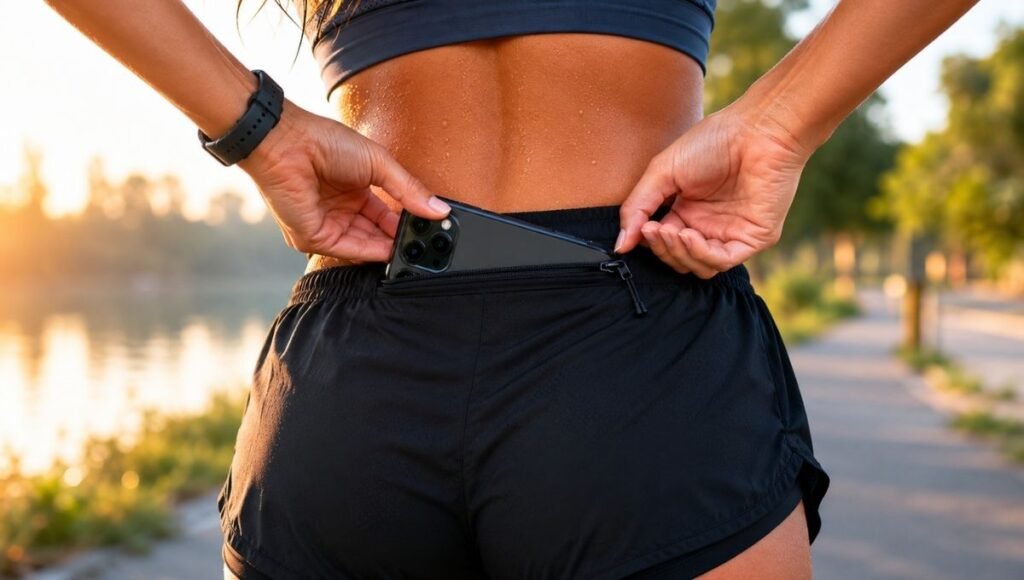
Here’s the version of this that happens all the time: you buy running shorts specifically because they have pockets. You put your phone in the pocket. You start running. By the end of the first mile, your phone has bounced enough times that you can feel it through the fabric. By mile 3, you’re running with one hand pressed against the pocket to hold it still. By mile 5, you’ve decided that arm bands are actually fine and these shorts are going in a drawer.
The problem isn’t that running shorts with pockets don’t work. It’s that most “pockets” on running shorts are not actually phone pockets — they’re key pockets with ambitions. A pocket that technically fits a phone and a pocket that holds a phone securely during 60 minutes of running at pace are two completely different engineering achievements. The first is easy. The second requires specific construction choices that most brands get wrong.
This guide explains what actually determines whether a pocket works for running, how pocket location affects bounce, and which specific pairs deliver on the promise of phone-secure running without requiring a separate belt or arm strap.
Key Takeaways
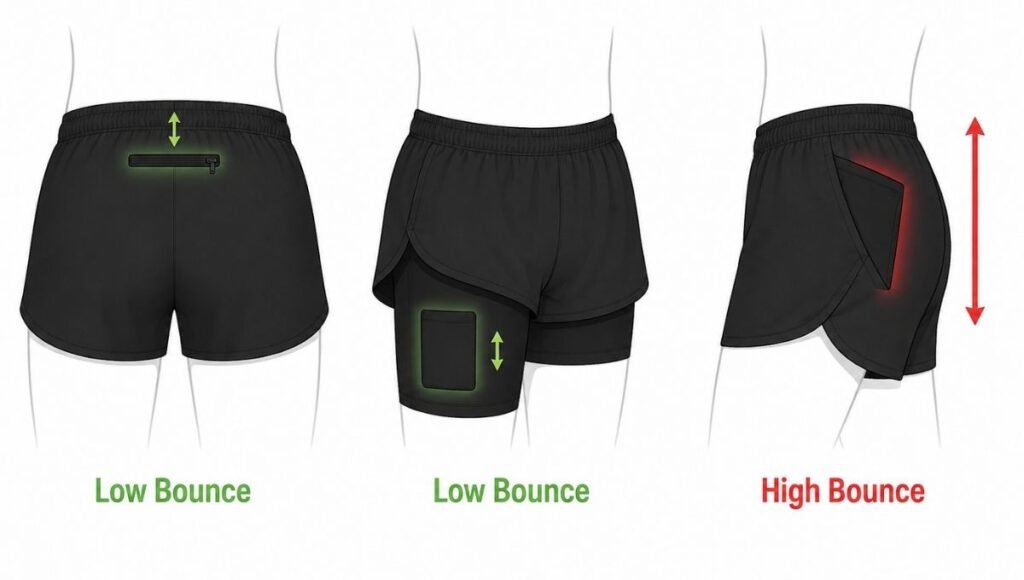
- Pocket location is the primary factor in phone bounce — rear waistband pockets are closest to your body’s center of mass and bounce least; side hip pockets are farthest from center and bounce most; compression liner pockets sit against the thigh and stay put
- “Fits a phone” and “holds a phone securely while running” are different claims — test any pocket with your specific phone by jogging in place in the store before buying
- Zippered rear waistband pockets are the most secure single-phone storage option for road running; compression liner thigh pockets are second; open hip pockets last
- The number of pockets is less important than pocket quality — one well-designed rear waistband pocket outperforms four decorative side pockets that bounce and gape
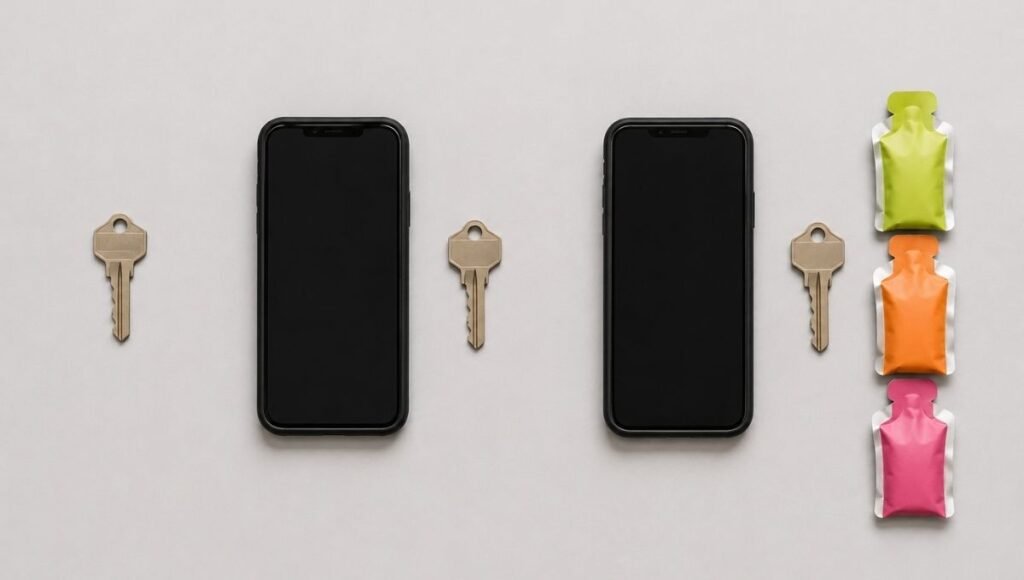
- Your carry needs should match your pocket configuration — key only needs one small zippered pocket; phone plus gels plus key needs multiple secure pockets or a running belt
Why Running Shorts Pockets Fail: The Physics Explanation
Understanding why pockets bounce helps you identify which construction choices actually fix the problem.
During running, your body oscillates vertically with every stride — your center of mass rises and falls rhythmically. Any object attached to your body participates in this oscillation. The key variable is how far the object is from your body’s core. Objects held close to center of mass move less during oscillation; objects held far from center move more.
This creates the hierarchy of pocket locations:
Rear waistband (lowest bounce): Positioned at the small of your back, directly over the lumbar spine — close to your body’s vertical center of mass. A phone in a snug rear waistband pocket moves with your torso, not independently of it. The close body contact also prevents the pocket from swinging side to side during arm drive.
Compression liner thigh pocket (very low bounce): Built into a compression liner that’s snug against the thigh, a liner pocket prevents independent phone movement by enclosing it in fabric that’s already moving with your leg. When done correctly, this is as secure as a rear waistband pocket.
Front waistband (moderate bounce): Similar proximity to center as rear waistband, but sits at the front where arm drive can create side-to-side movement that the rear waistband doesn’t experience. Better than hip pockets, less consistent than rear waistband.
Side hip pockets (highest bounce): Located at the widest point from your center of mass and at the side of the hip joint that’s in active rotation during every stride. An open hip pocket with a phone in it creates a pendulum effect — the weight swings forward and back with each arm drive and stride cycle. This is why the “I had to hold it still” experience happens in shorts with side pockets.
The Phone Pocket Test: How to Evaluate Before You Buy
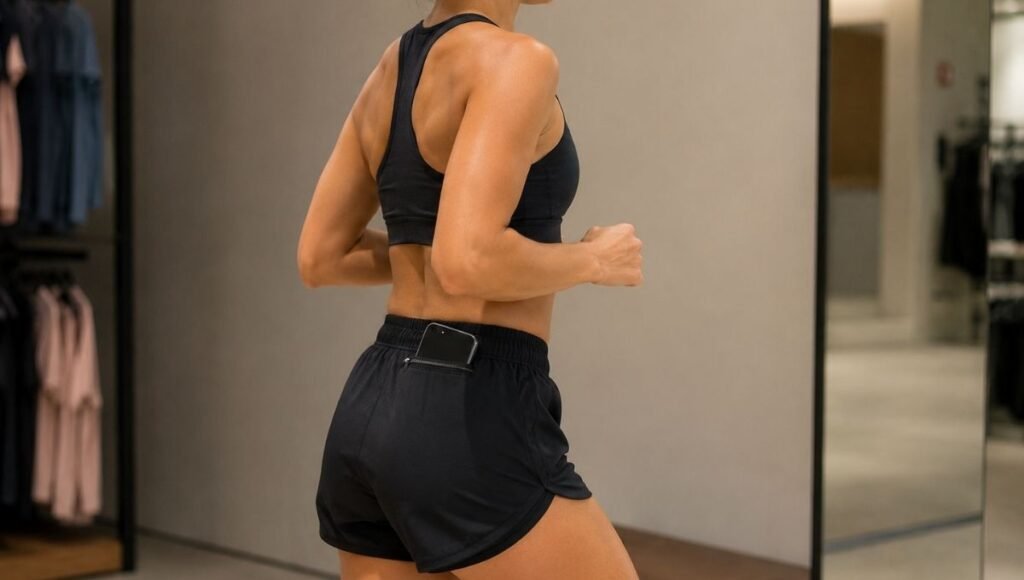
This is the practical screen that most runners skip — and then regret.
Step 1: Size check. Put your specific phone in the pocket. Not just the front; fully insert it as you would during a run. If you can only get three-quarters of the phone in, the pocket will allow the phone to partially eject during running. If it fits with room to spare, there’s no tension holding it in place.
Step 2: Retention check. With your phone in the pocket, hold the shorts at waist level and shake them rhythmically in a running motion. The phone should not move visibly inside the pocket. If it shifts even slightly, it will bounce during actual running.
Step 3: Jogging test. If you’re in a store with a return policy, do 30 seconds of light jogging in place with your phone in the pocket. This is the fastest and most reliable test. Alternatively, test at home immediately after purchase during a short trial run before removing any tags.
What a good pocket feels like: Your phone is held snugly enough that you become unaware of it within the first quarter mile. You don’t feel it moving. You don’t feel the need to check that it’s still there. It simply ceases to be a variable in your run.
Running Shorts Pocket Types: What Each Design Does
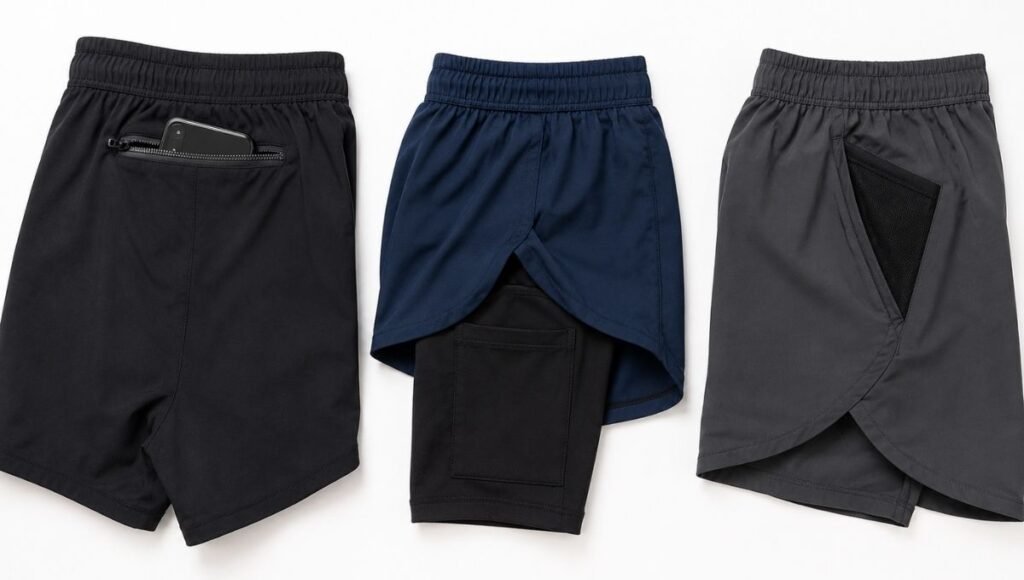
Rear Waistband Zippered Pocket
The most functional phone storage for road running. The zipper prevents the phone from launching if the pocket opening is stressed during stride, and the rear position minimizes bounce as explained above. Most rear waistband pockets are designed to hold a modern smartphone with minimal clearance — the snug fit is intentional and is what prevents bounce.
The zipper consideration: Zipper orientation matters. A zipper that opens toward your spine (parallel to your back) is more accessible mid-run and less likely to accidentally open than a zipper that opens perpendicular to your body. Pull the zipper open while in a running position before buying — some zipper placements are genuinely awkward to access during a run.
Compression Liner Pocket
A pocket built into the compression liner (the inner shorts that line the outer shell). Because the liner sits against your thigh and moves with your leg rather than independently, phones stored here move very little during running. The trade-off is access — reaching into a liner pocket during a run requires more hand-to-hip coordination than a waistband pocket, and the tighter construction means the pocket opening may not accommodate larger phones easily.
Front Waistband Pocket
Common in running tights and increasingly in shorts. Better than hip pockets for security, but the front position means the pocket sits at your hip flexor — an area that’s actively working during running stride. Phones in front waistband pockets can press against the hip flexor and create discomfort on longer efforts. Works well for smaller items (gels, cards) where the contact pressure is minimal.
Side Hip Pocket (Open)
The standard athletic shorts pocket. Works well for keys, gels, and items that weigh under an ounce or two. Not suitable for phone storage during running. A phone in an open side hip pocket will bounce, full stop, regardless of how well the shorts fit everywhere else.
Multiple Pocket Systems
Some trail running shorts and longer-distance shorts offer 4-6 pockets across waistband and liner positions. The advantage is distributing carry weight rather than concentrating it in one location — a phone in the rear, gels in the front waistband pockets, a key in a small zippered side pocket. Distributed weight bounces less than concentrated weight.
Best Running Shorts with Pockets: Picks by Use Case
Best for Phone Storage: Rabbit FKT 2.0 5″
Six pockets total — including a large rear pocket that holds modern smartphones with minimal bounce — in a shorts construction that doesn’t sacrifice fit or weight to get there. The four mesh hip pockets and two rear pockets distribute carry weight efficiently, and the flat seam liner keeps everything comfortable during extended efforts.
The rear pocket opening is large enough for most current smartphones without requiring you to force-fit the phone or risk seam stress on the pocket. Tested by multiple reviewers specifically for phone bounce and consistently called out as one of the most phone-secure options available.
Best for: Road running and trail running with full carry load — phone, keys, gels. Long training runs and races where you need to carry everything without a belt.
Best Women’s Option: Lululemon Fast and Free High-Rise Short 5″
Drop-in thigh pockets sized for modern smartphones, paired with a high-rise waistband that creates additional storage space. The thigh pocket construction keeps phones against the leg rather than in a swinging hip position, which is why these get consistent positive reviews for phone security specifically.
Three waistband pockets plus the thigh pockets give meaningful carry capacity without adding bulk. The shorts themselves maintain the non-negotiable running short requirements — waistband that stays, liner that doesn’t ride up — alongside the storage.
Best for: Women runners who want reliable phone storage in a shorts format that works from training to racing.
Best Trail Running with Pockets: REI Co-op Swiftland 5″
The rear zip pocket accommodates a smartphone, and the wide 3-inch waistband provides additional secure storage for smaller items. The waistband construction is specifically designed to hold items without bouncing — the width distributes pressure and prevents the pocket from shifting during stride.
GearJunkie testers noted the rear pocket opening is snug for larger phones (Samsung Galaxy-sized), which is actually the feature that prevents bounce — the tension that makes insertion slightly challenging is the same tension that holds the phone in place during running.
Best for: Women runners who prioritize lightweight construction alongside genuine pocket functionality.
Best for Minimal Carry: Janji AFO Middle 5″
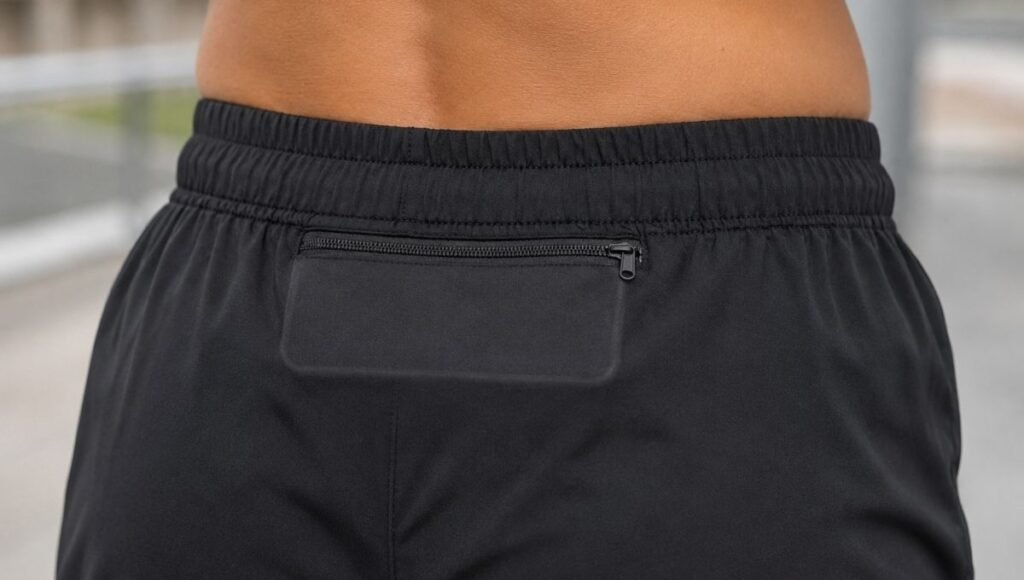
One rear pocket that holds most smartphones with minimal bounce, at a weight of 4.3 ounces total for the shorts. If your carry needs are phone-plus-key only, the AFO Middle provides the storage without the additional pocket systems that add weight for carry loads you don’t need.
The front key pocket placement is unconventional (pelvis-forward rather than hip) — test this position for your body specifically, as some runners find it comfortable and others find it awkward during stride.
Best for: Minimalist runners, racing with just a phone and key, runners who want phone security without multi-pocket bulk.
Best Budget Option with Real Pockets: Baleaf 5″ Running Athletic Shorts
A zippered pocket that genuinely holds a smartphone at a budget price point. GearJunkie specifically called this out as the budget option that doesn’t sacrifice the key functional feature — the zippered pocket is legitimate, not decorative.
The fit runs large — size down from your usual size. The liner provides moderate support. For runners who don’t want to spend $60-100 on shorts with pockets, this is the honest budget entry point.
Best for: Budget-conscious runners, trying the category for the first time, backup pairs for rotation.
How Much Do You Actually Need to Carry? Match Pockets to Distance
Easy runs under 45 minutes: One small zippered pocket for a key. You don’t need your phone for 45 minutes — leave it home and enjoy the run.
Training runs 45–90 minutes: One secure phone pocket (rear waistband or liner) plus one small pocket for a key or card. Two total pockets, both functional.
Long runs over 90 minutes: Phone pocket plus 2-3 gel pockets or waistband storage. You need to fuel, which means carrying gel packets that need to be accessible without stopping. Front waistband pockets or multiple liner pockets serve this need.
Trail runs and self-supported efforts: Maximum pocket configuration or a running vest. When you need to carry water, extra fuel, emergency layers, and a phone for navigation and safety, shorts pockets alone aren’t the answer — a running vest with chest storage and hip pockets is the right tool.
The principle: Don’t buy shorts with six pockets if you only run 45 minutes with a key. The extra pockets add weight and construction complexity that you don’t benefit from. Match the pocket system to your actual carry needs.
Running Shorts Pocket Mistakes That Create the Problems You’re Trying to Solve
Buying pockets without testing your specific phone. Phone sizes vary enormously. A pocket that holds a standard iPhone SE has nothing to do with holding an iPhone 15 Pro Max. Test your actual phone in the actual pocket before removing tags.
Treating open hip pockets as phone pockets. Open hip pockets are key and gel pockets with accidental phone-fitting dimensions. They will bounce. The physics can’t be overcome with a tighter fit or different shorts.
Overpacking pockets. Every pocket has a functional carry limit beyond which the weight causes bounce regardless of pocket quality. A rear waistband pocket designed for one phone bounces when you add a phone plus three gels plus a card plus a key. Distribute weight across pockets or switch to a running belt.
Ignoring the pocket opening angle. Pockets with openings that face outward (away from the body) allow items to fall out more easily during running than pockets with openings that face the body or parallel the spine. Check the pocket opening orientation — items should be retained by gravity and pocket tension, not fighting them.
FAQ: What Runners Ask About Running Shorts with Pockets
What is the best pocket placement to prevent phone bounce in running shorts? Rear waistband zippered pockets and compression liner thigh pockets bounce least during running. Both keep the phone close to the body’s center of mass and enclosed by snug fabric. Side hip pockets bounce most because they’re positioned farthest from center of mass and at the hip rotation point.
Can running shorts pockets actually hold a phone without bouncing? Yes, but only specific pocket designs. Rear waistband pockets with a snug fit and zipper closure, and compression liner thigh pockets, can hold modern smartphones with minimal bounce at running pace. Open side hip pockets cannot, regardless of how snugly the shorts fit overall.
How many pockets do I need in running shorts? Match pocket count to carry needs. Easy runs need one small zippered key pocket. Training runs need one phone pocket plus one key pocket. Long runs need phone plus multiple gel storage. More pockets than your carry needs add weight without benefit.
What size phone do running shorts pockets typically fit? Most shorts marketed as phone-pocket running shorts are designed for current mid-size smartphones (iPhone 14/15 standard or similar). Larger phones (Pro Max models, large Samsung Galaxy) may not fit in all pockets — check product dimensions or test specifically. Budget shorts tend to have smaller pockets than premium options.
Are running shorts with pockets worth the extra cost over shorts without pockets? If you run with a phone regularly: yes. Running without a phone for safety and GPS is a real trade-off. A dedicated running belt is the alternative, but many runners find shorts with integrated pockets more comfortable and convenient for training runs. For racing, most runners prefer the lightest option and use a minimal belt if needed.
The Bottom Line
Running shorts with pockets that actually work share one characteristic: the phone stays put because of specific construction choices — pocket location, snug fit, zipper closure — not because of brand name or marketing language.
Buy based on pocket location first. Rear waistband with zipper or compression liner pocket for phone. Size your phone against the pocket before committing. Match pocket count to your actual carry needs rather than defaulting to the maximum.
The Rabbit FKT 2.0 5″ covers most carry needs for most runners. The Lululemon Fast and Free is the women’s option with the best combination of phone security and overall shorts quality. The Baleaf 5″ is the honest budget entry that delivers on the primary function without asking you to spend $100.
For the complete running shorts picture beyond pockets — inseam length, liner construction, body type fit — see our full best running shorts for women and best running shorts for men guides. If your carry needs exceed what shorts pockets can handle, our best running belt guide covers the alternatives.
References:
- OutdoorGearLab. (2025). 10 Best Running Shorts: Tested and Ranked. OutdoorGearLab.com.
- GearJunkie. (2026). The Best Running Shorts of 2026: Tested. GearJunkie.com.
- The Runner’s Digest. (2025). No Bounce: The Best Running Shorts with a Phone Pocket. TheRunnersDigest.com.
- American College of Sports Medicine. (2023). Running Equipment and Performance. ACSM’s Health & Fitness Journal.