

You’ve tried holding your phone in your hand for a long run. Your arm gets tired, your grip sweats, and the whole thing is exactly as miserable as it sounds by mile 8. So you get a running belt. Then the running belt bounces. Not subtly — visibly, rhythmically, in a way that you’re acutely aware of for the entire second half of every long run.
The bouncing problem is real, it’s specific, and it has a physics-based explanation that most running belt guides ignore entirely. When weight sits at your waist during running, it rises and falls with every stride unless it’s secured flat against your body at the right position. A belt that positions the weight too far forward bounces; one that’s too loose bounces; one that’s loaded unevenly bounces. The solution isn’t just “buy a better belt” — it’s understanding where and how to carry things while running.
This guide covers the best running belt options across every use case, explains the decision between belts, fanny packs, and vests, and gives you the specific fit criteria that separates a belt that disappears on your body from one you’re managing for 13.1 miles.
Key Takeaways
- The bounce problem is a fit problem, not a belt problem — a belt worn too loosely or loaded too heavily at a single point will always bounce; the fix is tighter fit and distributed weight
- Running belts, fanny packs, and vests serve different purposes — belts are for essentials (phone, keys, gels); fanny packs add capacity; vests replace belts for trail running and ultras where you need water and significant gear
- Position matters — wearing a belt at the natural waist (not the hips) reduces bounce significantly; the closer to your center of mass, the less movement amplification
- Race day and training day have different needs — a training belt needs to carry your phone for music and GPS; a race day belt needs gels and a key, and your phone may not be necessary at all
- Waterproof or water-resistant construction is worth paying for — running generates significant sweat output and gear gets wet; zippers and fabric that can handle moisture extend usable life significantly
Running Belt vs Fanny Pack vs Running Vest: Which Do You Actually Need?
This is the decision most buyers skip, and it results in buying the wrong category entirely.
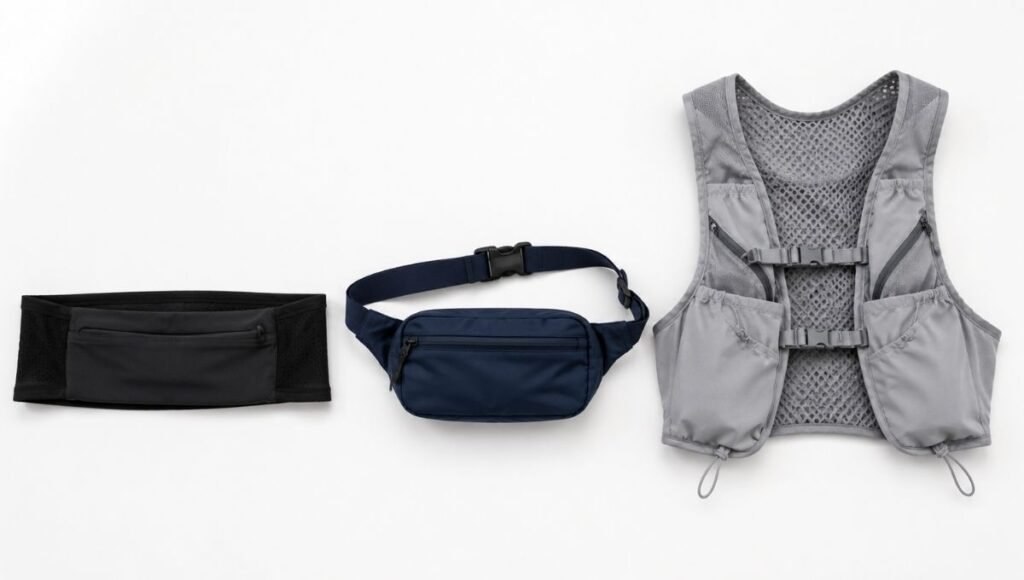
Running Belt (Slim Waist Band)
A running belt is a slim, stretch-fabric band worn at the waist with one or more pockets integrated into the band itself. The pockets sit flat against the body rather than standing away from it. Because the storage is flush with your torso, weight is distributed around your circumference rather than concentrated at a single point.
Running belts are right for you when:
- You need to carry a phone, key, and 1–2 gels on a training run
- You want minimum bulk and maximum forgettability
- You’re racing a road marathon or half marathon where aid stations provide water and you just need nutrition and a key
- Your running shorts have inadequate or no pockets
The limitation: Capacity. A running belt can carry your essentials; it can’t carry enough nutrition for a self-supported trail run, a hydration pack, or significant gear. When you need more than your phone, a key, and 2–3 gels, you’ve outgrown the belt category.
Running Fanny Pack / Waist Pack
A running fanny pack sits around the waist with a dedicated pouch that stands away from the body — it’s a larger, structured version of a belt with meaningfully more capacity. The weight is concentrated in the pouch rather than distributed around the belt.
Running fanny packs are right for you when:
- You need to carry more than a belt can hold — multiple nutrition items, headphones, cards, sunscreen for a long trail run
- You want the ability to access items mid-run without stopping
- You’re doing trail runs under 3 hours where you don’t need hydration capacity
The bounce risk: The concentrated, higher-capacity pouch creates more bounce potential than a flat belt. Fanny packs need to be worn snug, tested at pace before committing to them for long efforts, and loaded with weight distributed across multiple pockets rather than stacked in one.
Running Vest (Hydration Vest)
A running vest sits on the torso like a lightweight, breathless backpack — shoulder straps distribute weight across the chest and back, and front pockets add accessible storage. Most running vests integrate soft flask holders for water or electrolyte drinks.
Running vests are right for you when:
- You’re running trail distances over 90 minutes where you need to carry water
- You’re doing self-supported runs with significant nutrition, emergency gear, or layers
- You’re racing trail events where the course requires mandatory gear (headlamp, emergency blanket, etc.)
- You consistently feel like a belt or fanny pack isn’t enough
The trade-off: Bulk, warmth, and cost. A running vest is overkill for road marathon training and most casual trail running. It earns its place when the distance and conditions require carrying more than a belt can handle.
Why Running Belts Bounce (And How to Fix It)
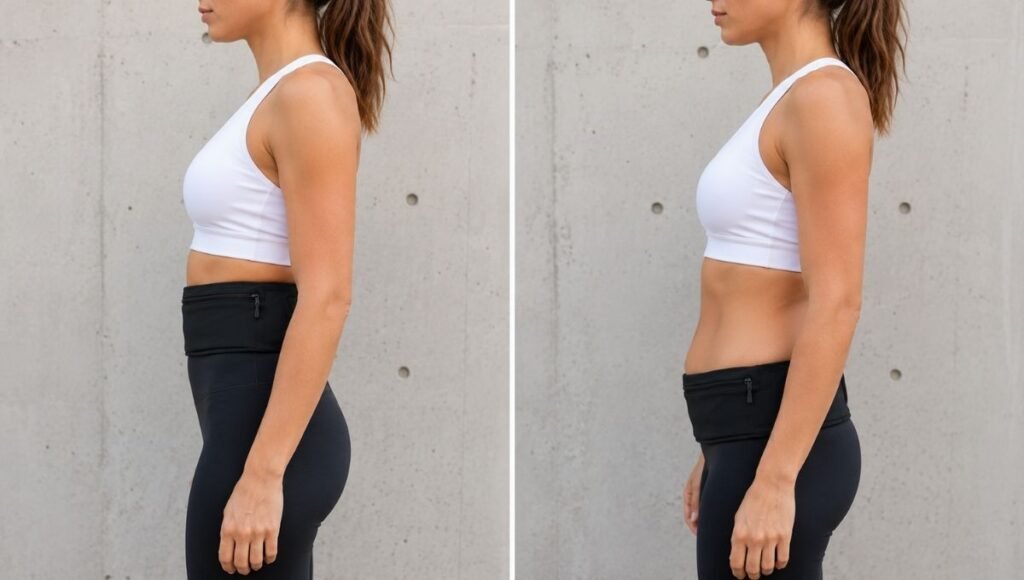
Understanding the physics makes buying and using a running belt significantly more effective.
Running creates a repetitive vertical oscillation — your body rises and falls slightly with each stride. Any object attached to your body participates in this oscillation. If the object is secured flush against your body and the weight is distributed evenly, the oscillation is minimal because the object moves with you rather than being slung around by inertia. If the object stands away from your body or is concentrated in one spot, inertia causes it to continue moving after your body has changed direction — this creates the perceptible bounce.
The specific causes of belt bounce:
Too loose: A belt worn with slack allows the entire band to shift position with each stride. The band moves down, the weight at the front swings forward and back. Tighten it so there’s no slack — it should feel snug but not uncomfortable.
Weight concentrated at the front: Putting your phone in a single front pocket concentrates heavy weight at your anterior midline. When your body rises in stride, that weight wants to continue upward; when your body falls, it falls faster than the belt. The solution: distribute weight around the belt or choose a belt that positions the phone pocket at the back or side.
Belt positioned too low: Wearing a belt at your hips rather than your natural waist amplifies bounce because it’s further from your center of mass. Position the belt at or just above the natural waist — even 2–3 inches higher makes a meaningful difference.
Overloaded: More weight equals more inertia equals more bounce at any position. Match the belt’s capacity to your actual needs — don’t carry more than the belt was designed for.
The Best Running Belt for Every Use Case
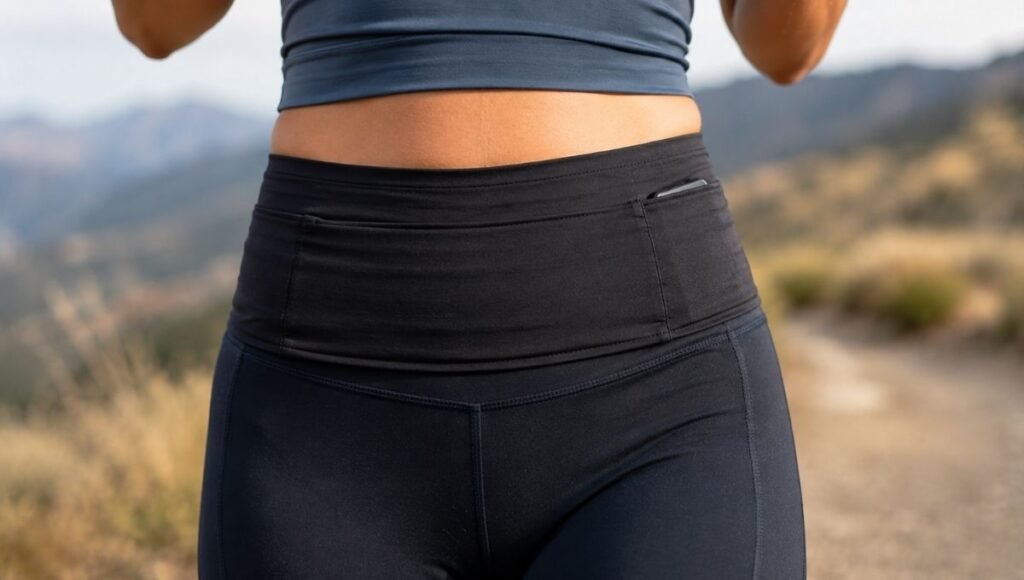
Best Overall: Lululemon Fast and Free Running Belt
The Fast and Free Belt earns its recommendation through the combination of fit security and thoughtful pocket design. The adjustable waistband buckle allows precise fit calibration that stretchy-only belts can’t match — you set the tension once and it holds. The zippered stretch phone pocket accommodates large modern phones, the side pockets hold gels without them launching, and reflective details add low-light visibility.
The one honest caveat: getting your phone in and out mid-run requires a full stop. This is true of most secure phone pockets — the same construction that keeps the phone in place requires two-handed operation to access. For training runs where music and GPS are running continuously, this is acceptable. For anyone who needs frequent phone access during a run, plan for stopping.
Best for: Road marathon and half marathon training, runners who want premium construction, race day carry for key + gels + minimal essentials.
Best Minimalist: Naked Running Band
The Naked Running Band is the benchmark for runners who want a belt to genuinely disappear. The wide stretch-fabric band fits flush against the skin with no hardware, no bouncing, and no seams in uncomfortable positions. Multiple flat pockets around the band hold cards, gels, a phone, and a key without any single point of weight concentration.
The construction principle is simple and effective: the wider the band, the more surface area pressing flat against the body, the less bounce. At full waist coverage, weight is distributed rather than concentrated. You forget you’re wearing it by mile 2 — which is the whole point.
Best for: Minimalist runners, anyone whose primary complaint about belts is bounce, everyday training runs, warm weather when additional layers aren’t needed.
Best for Race Day: SPIbelt Original
The SPIbelt has been the race-day belt of choice for serious runners for over a decade, and for straightforward reasons: it’s small, it’s light, it holds exactly what a marathon runner needs (phone, gels, key, ID), and it doesn’t bounce. The expandable pocket stretches to accommodate different phone sizes, the adjustable band keeps it snug at any waist size, and the elastic construction eliminates hardware noise.
At roughly the price of a training meal, it’s the lowest-commitment entry into the belt category — easy to try, easy to use, easy to replace if it eventually wears out.
Best for: Road marathon and half marathon racing, short training runs, anyone who wants a functional entry-level belt without significant investment.
Best Running Fanny Pack: Ultimate Direction Access 300

When you need more capacity than a slim belt provides, the Ultimate Direction Access 300 is the organized option. Three pockets of different sizes allow sorting: phone in the large zippered main pocket, nutrition in the accessible side pocket, keys and cards in the small front pocket. The stretch-mesh construction moves with stride rather than fighting it, and the waistband positions weight closer to the body than rigid-construction alternatives.
Test it loaded before a long run — the heavier the fanny pack, the more important the fit adjustment. At full capacity, worn snug at the natural waist, bounce is manageable for most runners.
Best for: Trail runs under 3 hours, runs requiring more gear than a belt holds, runners who want one bag that works for both running and light hiking.
Best Running Vest: Nathan VaporAiress 7L
For female runners specifically, the Nathan VaporAiress 7L solves the fit problem that plagues unisex running vests — the contoured shoulder straps and waist adjustment are built for a female torso geometry rather than scaled down from a men’s vest. The 7-liter capacity handles everything a self-supported trail run or ultramarathon requires: two 20oz soft flasks, nutrition for 4+ hours, a rain layer, phone, and emergency gear.
The vest fits snug enough to minimize bounce across technical terrain, the front pockets are accessible without stopping, and the overall weight at 170g (empty) is genuinely light for the capacity it offers.
Best for: Trail running over 90 minutes, self-supported runs, trail races with mandatory gear requirements, any run where hydration needs to be carried rather than sourced from aid stations.
Best Budget Belt: FlipBelt Classic
At a fraction of premium belt prices, the FlipBelt delivers the core functionality without complexity: a tube-style stretch-fabric belt with flip-in pockets around the circumference. No buckles, no hardware, no adjustment — you pull it on like a waistband and it either fits or it doesn’t. The sizing system (XS through XL) works for most runners.
The trade-off for the price is less adjustment precision than buckle-closure belts. Runners on the cusp between sizes may find it slightly too loose or too tight. Order based on your waist measurement rather than your clothing size — the company’s size chart is accurate.
Best for: Budget-conscious runners, beginners trying belts for the first time, runners who want a simple no-hardware option, shorter training runs.
What to Carry: Training Day vs Race Day
Most runners overpack their training belt and underpack their race day belt. The right inventory differs significantly.
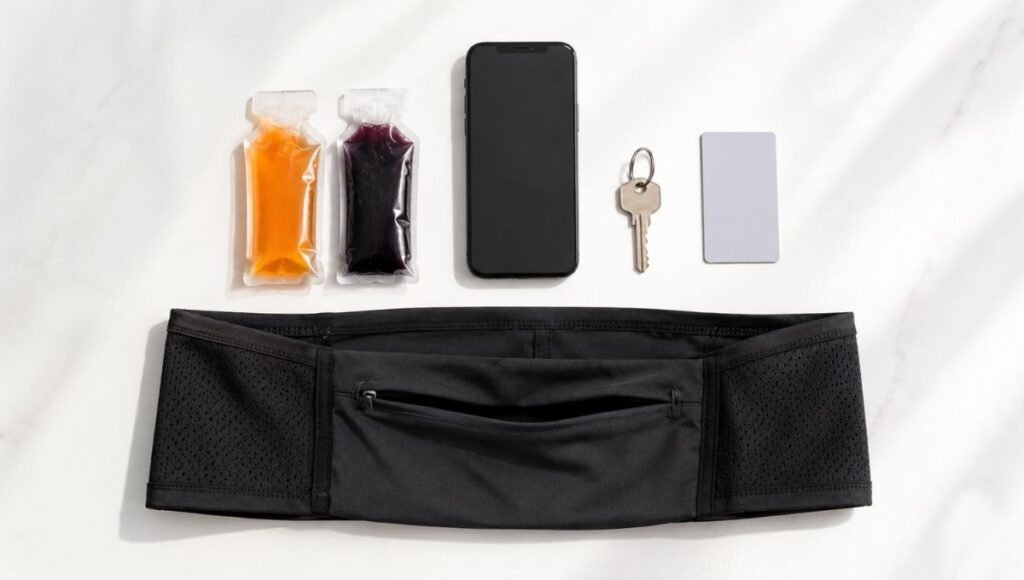
Training Runs
Short runs (under 60 minutes): Phone (for safety and music), house key. That’s it. You don’t need gels for an easy 6-mile run — eat before if you need fuel.
Medium runs (60–90 minutes): Phone, key, 1 gel or chews, $20 cash (for emergencies), ID if running in an unfamiliar area.
Long runs (90+ minutes): Phone, key, 2–4 gels depending on distance, electrolyte chews or tabs, $20 cash, ID, small sunscreen stick for summer.
Race Day
5K/10K: Usually nothing — most runners don’t carry a belt for short races. Your race bib has a pocket for a gel if needed.
Half Marathon: Key, 1–2 gels (if you use them and the course doesn’t provide sufficient aid), ID. Phone is optional — consider whether you actually use it during races or just carry it out of habit.
Marathon: Key, 3–5 gels if carrying personal nutrition, ID, emergency card with emergency contact. Your phone is your call — many runners run marathons without one when racing seriously.
Running Belt Mistakes That Make Every Run Worse

Wearing it too loose. This is responsible for 80% of belt bounce complaints. If there’s slack in the band, there’s bounce in the belt. Tighten it until there’s no slack — snug but not uncomfortable.
Overloading for the distance. Every ounce of belt weight adds to your body weight for the run. Carry what you need for the distance, not everything you might possibly want. A gel you don’t eat is dead weight for 20 miles.
Putting everything in one pocket. Weight concentrated at a single point bounces more than weight distributed around the circumference. If your belt has multiple pockets, use them.
Not testing before race day. A belt that feels fine on a 3-mile test run can create unexpected problems at mile 18 — chafing at the buckle, a pocket zipper that’s annoying to access at pace, a fit that shifts as you fatigue. Test your race day belt on at least two long training runs before the event.
Buying for capacity you’ll never use. A belt with eight pockets that you fill with two items is carrying unnecessary hardware, elastic, and fabric. Match the belt capacity to your actual carry needs.
FAQ: What Runners Ask About Running Belts
What is the best running belt that doesn’t bounce? The Naked Running Band and SPIbelt get the most consistent positive reviews for minimal bounce, primarily because they sit flush against the body with distributed weight rather than a concentrated pouch. For any belt: wear it snug at the natural waist, not the hips, and distribute weight across multiple pockets rather than loading one side.
Should I use a running belt or running vest? Belt for road running, short-to-medium trail runs, and races where aid stations provide water. Vest for trail runs over 90 minutes where you need to carry hydration, trail races with mandatory gear requirements, or self-supported runs. Most road marathon runners never need a vest.
Where should a running belt sit on your body? At or just above the natural waist — the narrowest point of your torso. This is the position closest to your center of mass, which minimizes the bounce amplification that occurs when the belt sits lower on the hips.
Can I run a marathon with a running belt? Yes — many marathon runners use slim belts for gels, a key, and ID. The SPIbelt and Naked Running Band are popular marathon choices for exactly this purpose. Choose a belt that fits securely, test it on long training runs, and only carry what you actually need for 26.2 miles.
Are running fanny packs comfortable? They can be, with the right fit and loading. Worn snug at the natural waist with weight distributed across multiple pockets, a quality running fanny pack like the Ultimate Direction Access 300 is manageable for runs up to 2–3 hours. They’re less comfortable than slim belts for speed work and tempo runs where the additional weight is more noticeable.
The Bottom Line
The best running belt is the one that fits correctly, carries exactly what you need, and stops requiring your attention by mile 3. Most bounce problems are fit problems — worn snug at the natural waist with distributed weight, a well-made belt disappears on your body.
Match the category to your use case: slim belt for road running and racing, fanny pack when you need more capacity for trail efforts, vest when you need hydration and serious gear for long trail runs. Don’t buy vest capacity for road marathon training; don’t underbuy belt capacity for self-supported trail runs.
Start with the SPIbelt or FlipBelt if you’re trying a belt for the first time — low cost, straightforward function, easy to assess whether the category works for you. Upgrade to the Naked Running Band or Lululemon Fast and Free when you know you’ll use a belt consistently.
Building your complete running kit? Our best running clothes for women guide covers the full picture from tights to jackets — and our half marathon outfit guide covers specifically what to carry on race day.
References:
- iRunFar. (2026). Best Running Belts: Tested across distances and conditions. iRunFar.com.
- Treeline Review. (2026). Best Running Belts: 7 Options Tested and Reviewed. TreelineReview.com.
- Tom’s Guide. (2025). The Best Running Belts. TomsGuide.com.
- American College of Sports Medicine. (2023). Nutrition and Hydration During Endurance Exercise. ACSM’s Health & Fitness Journal.