
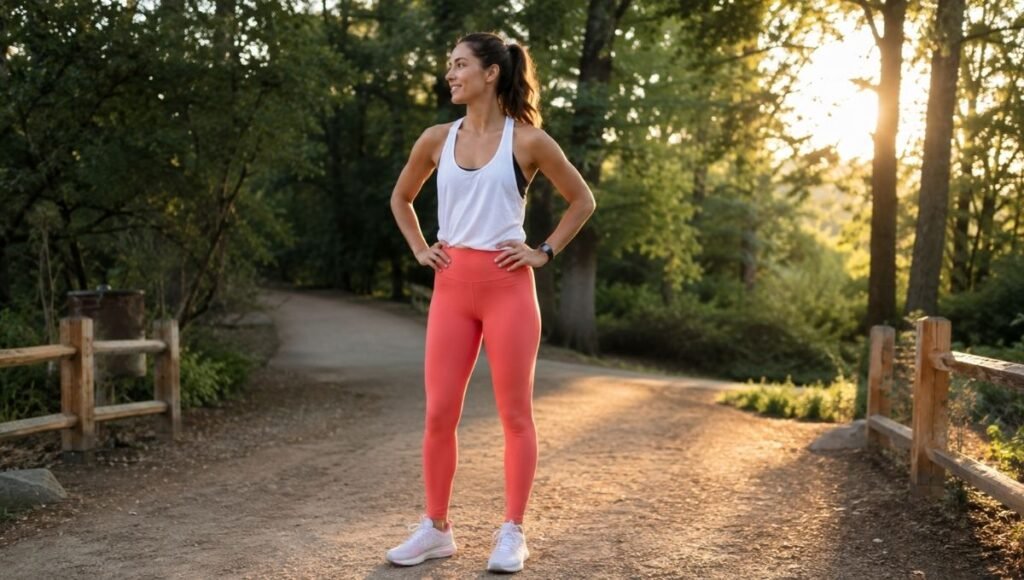
There’s a version of this that takes years to figure out on your own: buying leggings that look great and ride up at mile 3. Sports bras that fit in the fitting room and chafe by mile 6. Shorts with a pocket that’s technically there but launches your phone at the first downhill. Running clothes that look like running clothes but weren’t actually designed for running.
Most women who run for any amount of time eventually arrive at a small, reliable collection of running clothes that actually work — and they’re usually pretty specific about what that collection contains. Not the most expensive options. Not the trendiest. The ones that disappeared on their body during the run, did their job without requiring management, and kept working after 40 washes.
This guide is the shortcut to that collection. It covers the best running clothes for women across every category — tights, shorts, tops, sports bras, jackets, socks, and accessories — with honest picks at different price points and direct links to our detailed guides for each category. Whether you’re building your first running kit or upgrading specific pieces, this is your starting point.
Key Takeaways
- Build your kit in priority order — sports bra and tights/shorts first, then tops, then outerwear and accessories; getting the foundation right matters more than having everything at once
- Running-specific construction is different from general athletic wear — moisture-wicking sweatbands, seamless construction, phone-size pockets, and running-specific fit patterns make a measurable difference over longer distances
- You don’t need to spend $300 on a running kit — a functional $100-150 starter kit covers everything you need to run comfortably; premium upgrades show their value at higher mileage
- The sports bra is the highest-impact single purchase for women runners — getting this right changes the running experience more than any other garment
- Rotate at least 3-4 pairs of key items (tights, sports bras) so they can fully dry and recover between runs — this extends garment life and maintains performance
How to Build Your Running Kit: The Right Order
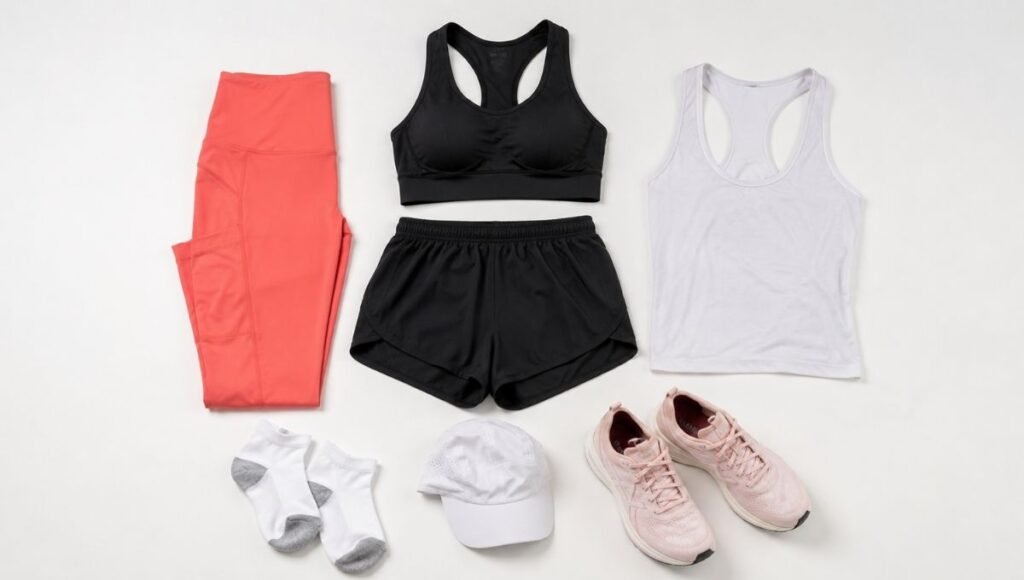
Most runners build their kit backwards — they start with what looks good and work backward to what functions. Here’s the order that actually makes sense.
Priority 1: Sports bra — The most impactful single piece of running clothing for women. Get this right first.
Priority 2: Bottoms (tights or shorts) — Chafing and waistband problems ruin runs more consistently than anything else. Solve this second.
Priority 3: Tops — A moisture-wicking running top matters, but a moisture-wicking generic athletic shirt is an acceptable bridge while you figure out the first two.
Priority 4: Socks — Underrated. Running-specific socks prevent blisters at a level regular socks can’t match.
Priority 5: Outerwear — A jacket, windshell, or thermal layer for cold and wet conditions.
Priority 6: Accessories — Hat, gloves, headband as conditions require.
This order matters because your limited gear budget goes further when the highest-impact items come first.
The Best Running Sports Bra for Women
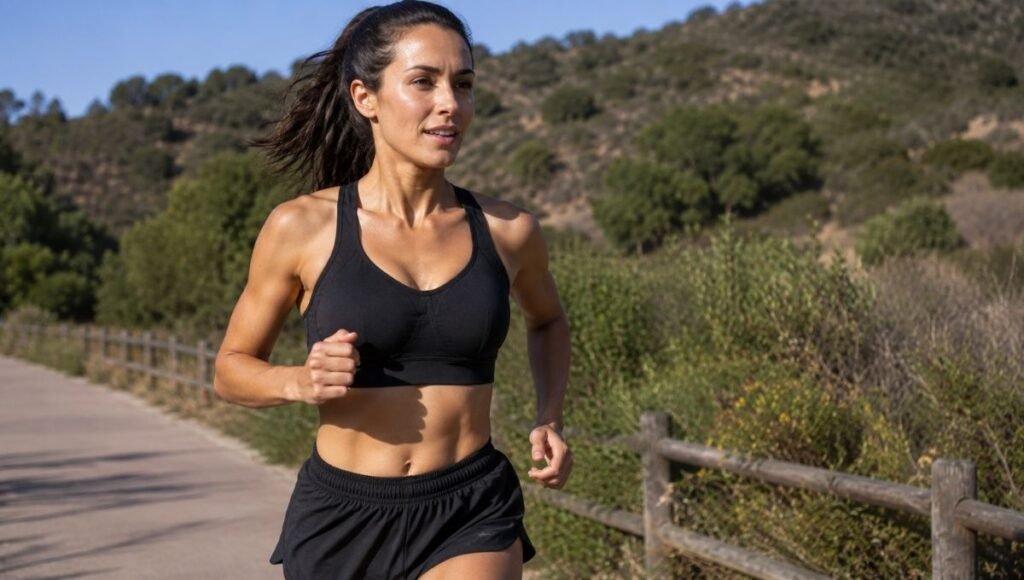
The sports bra conversation in running is more nuanced than most guides acknowledge. The right bra for a size A cup running 5K three times a week is genuinely different from the right bra for a size D cup running marathon training. Both deserve answers.
For low-to-medium impact and smaller cup sizes (A-C): Compression-style sports bras work well — they’re lighter, easier to put on and take off, and provide sufficient support for most running efforts. Look for moisture-wicking fabric and wide, flat straps that don’t shift during arm movement.
For high-impact running and larger cup sizes (D+): Encapsulation sports bras — where each cup is individually supported rather than compressed — are the right construction. Compression alone doesn’t provide adequate support at larger cup sizes during running, which creates bounce, discomfort, and potential long-term ligament stress. Panache Sport, Freya Active, and Brooks Running’s sports bra line consistently get strong reviews from runners in this category.
For all cup sizes:
- High-impact rating (check the product label — many brands now specify impact level)
- Moisture-wicking inner cup lining
- Adjustable straps for precise fit
- Test with a jumping jack or short jog before committing — if it moves more than a centimeter, it’s wrong for running
The brands runners actually wear: Lululemon’s Free to Be sports bra works well for A-C cups at medium-high impact. Nike’s Swoosh range covers the mid-support territory reliably. For D+ cups, Panache Sport and Brooks are worth the specific investment.
The Best Running Tights and Leggings for Women
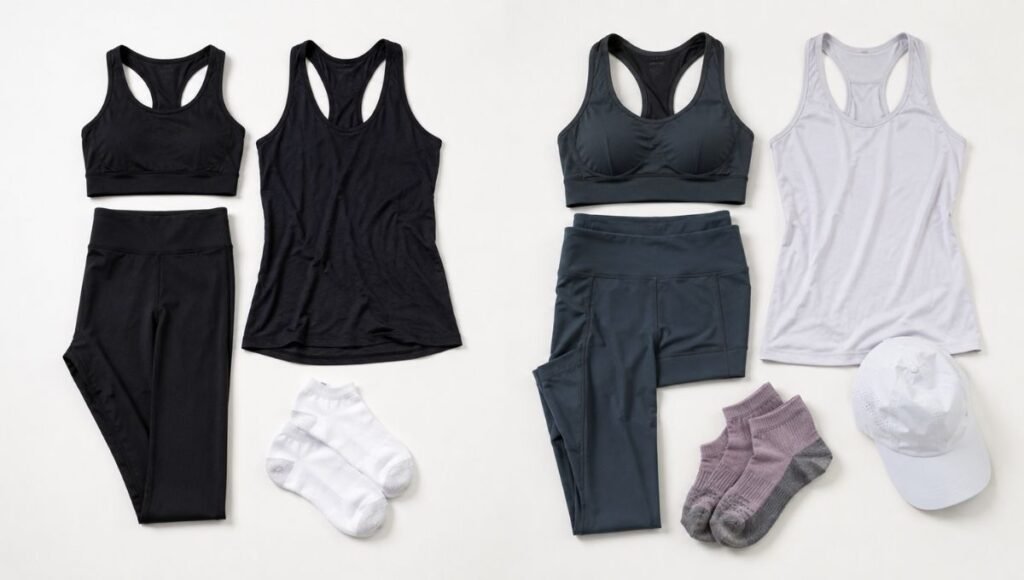
Running tights are where most women spend their first serious running clothes money — and where they make the most expensive early mistakes (yoga leggings for long runs, waistbands that roll, fabrics that go transparent under stride).
What separates running tights from regular leggings: Running tights are engineered for forward-stride mechanics that yoga leggings aren’t. The waistband construction, inner thigh seam placement, and moisture management are all different. A yoga legging that works perfectly in class will often slide, roll, or chafe by mile 5 of a run.
The waistband is the single most important feature:
- 3-inch minimum high-rise waistband for stability
- Internal drawstring for custom fit (critical for curvy runners)
- Non-roll construction that stays put through running stride
Top picks by use case:
Best overall: Lululemon Fast and Free High-Rise Tight — the benchmark that most other running tights are compared against. Nulux fabric, drop-in thigh pockets, high-rise waistband that stays.
Best for preventing chafing: Sweaty Betty Zero Gravity — bonded construction eliminates inner seam friction points.
Best budget option: The Gym People Running Leggings — honest performance at a fraction of premium price for shorter runs and training builds.
Best for cold weather: Girlfriend Collective Compressive High-Rise — thermal properties plus extended sizing through 6XL.
Best for curvy/plus-size runners: Fabletics PowerHold with wide mesh-lined waistband that grips and stays.
→ For the complete guide including fit tips by body type, see our best running leggings for women guide.
The Best Running Shorts for Women
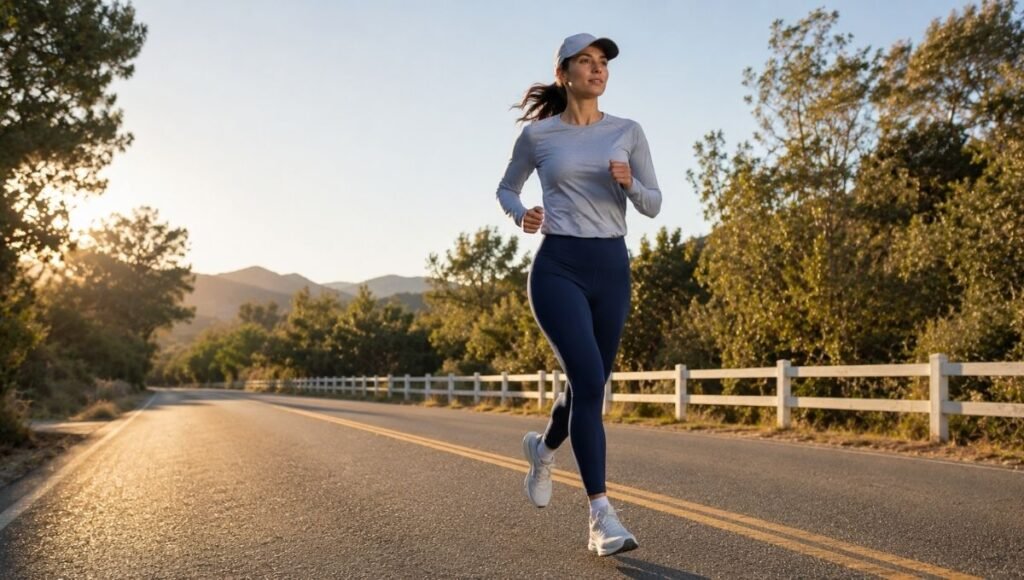
The shorts conversation centers on one functional question: do they ride up? Everything else — length, pockets, liner style — is secondary to this.
Inseam length is the most important fit decision:
- 2.5–3 inch: Maximum airflow, works for slimmer thigh builds; will ride up on muscular or curvier thighs
- 5 inch: The versatile sweet spot for most runners and body types
- 7 inch / 2-in-1: Best protection against chafing for thighs that contact during stride
Lined vs compression: Brief-liner shorts work for most short-to-medium runs. For distances over 90 minutes or runners prone to chafing, a compression-style short or 2-in-1 provides more reliable inner thigh protection.
Pockets are now non-negotiable: Any running short without at least one phone-sized pocket is behind the times. Test the pocket with your actual phone before buying — a pocket that holds your phone flat without bouncing is functional; one that bulges and shifts is decorative.
Top picks:
Best overall: Lululemon Track That High-Rise Lined Short (3″ or 5″) — the wide leg opening that prevents riding up for muscular builds is the differentiating feature.
Best for preventing chafing: Bandit Stamina Shorts (5″) — silicone taping on the inner hem grips the thigh and genuinely stays.
Best budget: Senita Baseline Shorts — 4-way stretch, multiple pockets, 4.8-star average from thousands of reviews.
Best for hot weather: Rabbit Float n’ Fly 3″ — deliberately breezy with an oversized liner that provides coverage even when the leg opening catches wind.
→ For the complete guide including all body type recommendations, see our best running shorts for women guide.
The Best Running Tops for Women
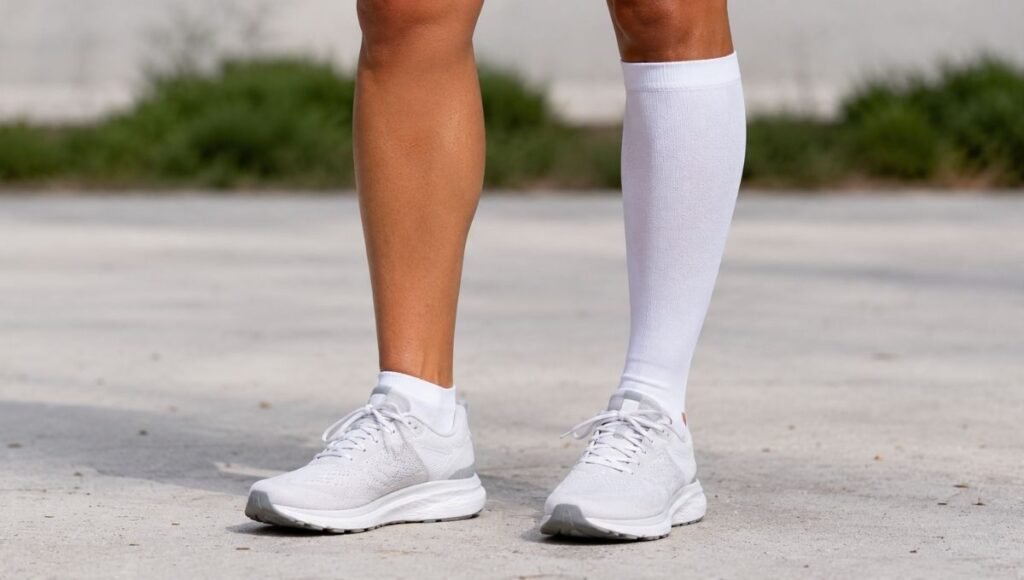
Running tops get less attention than they deserve, but the wrong top on a summer long run becomes a very specific and memorable problem. The right one disappears.
What to look for:
- Moisture-wicking synthetic fabric (polyester, nylon) or merino wool for cooler conditions
- Flat or seamless underarm construction — raised seams in high-contact arm swing zones cause chafing over distance
- Enough length to cover the waistband of your tights during full stride
- Ventilation: mesh back panels, open construction, or lighter weight fabric for warm weather
Singlet vs short sleeve vs long sleeve: Temperature and personal preference drive this. Above 65°F, a singlet or lightweight short sleeve maximizes airflow. 50–65°F is the short sleeve zone. Below 50°F, a long-sleeve base layer is the right call. The key in all cases: moisture-wicking technical fabric, never cotton.
The brands worth knowing: Brooks Distance Running Tanks consistently get strong reviews for their combination of lightweight fabric and flattering fit. Lululemon Swiftly Tech Short-Sleeve earns its popularity through consistent construction quality. For cold-weather running tops, Smartwool and Icebreaker make merino options that handle temperature regulation better than pure synthetics.
Editor’s note: A basic moisture-wicking running top from Nike or Under Armour at $35 performs closer to the $70 premium options than most runners expect. The fabric technology gap between mid-range and premium is smaller for tops than for tights or sports bras.
→ For the complete explanation of why fabric matters and how to read labels, see our moisture wicking running clothes guide.
The Best Running Socks for Women
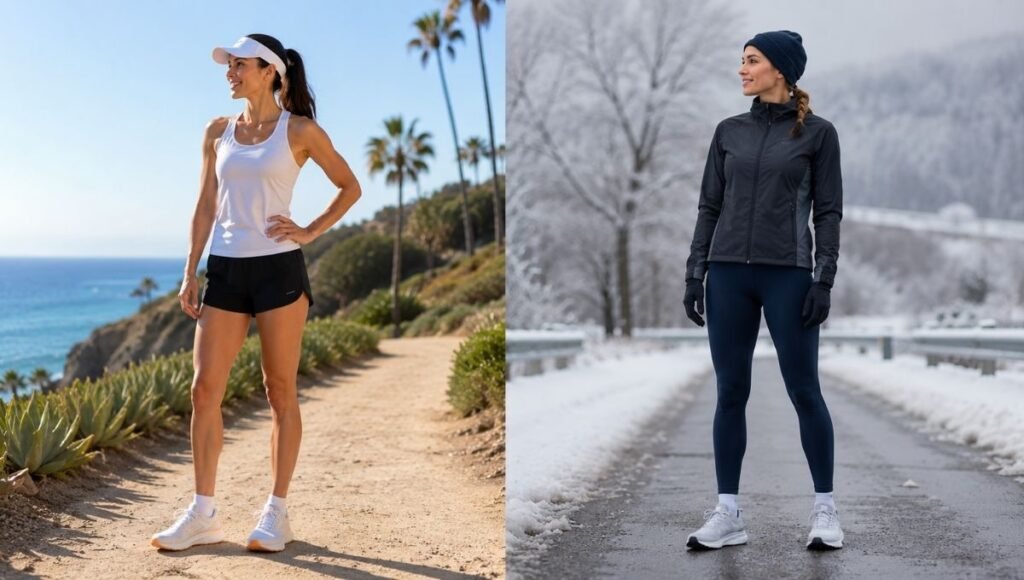
Running socks are the most chronically underinvested item in most runners’ kits, and the most common source of preventable blisters. A $20 pair of running-specific socks performs significantly better than a $3 athletic sock over 8 miles.
What running socks do differently:
- Moisture-wicking fiber composition (merino wool or synthetic — never cotton)
- Seamless toe construction that eliminates the friction ridge that creates blisters at distance
- Cushion placement specific to running impact zones (heel and ball of foot)
- Anatomical left-right construction that keeps the sock positioned correctly through stride
The brands worth owning:
Best overall: Feetures Elite Light Cushion No-Show Tab — anatomical left-right construction, seamless toe, the sock most serious runners land on.
Best for blister prevention: Balega Blister Resist Quarter — mohair fiber blend creates a genuinely friction-free interface.
Best for long runs and marathons: Darn Tough Run No-Show Tab Ultra-Lightweight — merino wool blend, unconditional lifetime guarantee.
Best budget: Bombas Women’s Running Ankle Sock — all the functional checkboxes at a third of the premium price.
→ For the complete guide including cushion levels by distance and fabric breakdown, see our best running socks for women guide.
The Best Running Jacket for Women
A running jacket is the item most runners put off buying and then regret not having the moment the weather turns. The key is knowing which type of jacket your conditions actually require — waterproof, water-resistant, and windproof are not interchangeable terms.
The terminology that matters:
Waterproof: Uses a membrane (GORE-TEX or similar) that physically blocks water. Works in sustained heavy rain. Heavier, less breathable, more expensive.
Water-resistant (DWR coating): Causes water to bead and roll off in light drizzle. Saturates in sustained rain. Lighter, more breathable, less expensive.
Windproof: Blocks air penetration — critical for cold weather where wind chill dramatically amplifies felt temperature.
What most runners actually need: A lightweight packable windshell for everyday variable conditions, plus a proper waterproof shell for serious rain running. Two jackets covering the full range usually costs less than one jacket trying to do everything.
Top picks:
Best overall for rain: Janji Rainrunner Pack Jacket 2.0 — solves the breathability problem that makes most waterproof jackets feel suffocating during actual running effort.
Best lightweight windshell: Patagonia Houdini — 94 grams, packs to tennis-ball size, handles wind and light drizzle.
Best for cold weather: Brooks Run Visible Thermal Jacket — reflective detailing for dawn and dusk running, thermal fabric for genuine cold-weather warmth.
→ For the complete guide including temperature framework and when you need a jacket vs just a long sleeve, see our best running jacket for women guide.
The Best Running Accessories: Hats, Headbands, and Compression
Running Hats
A running hat solves sweat-in-eyes, sun exposure, and cold ears depending on which type you choose. The sweatband is the feature that separates a running-specific hat from a regular baseball cap.
Type by conditions:
- Cap: Year-round versatility, sun + warmth + sweat management
- Visor: Hot weather maximum ventilation, any hair type
- Beanie: Cold weather below 35°F, covers ears
- Ear band: 35–50°F, pairs with a cap for ear coverage
Best overall cap: Ciele GOCap SC — UPF 40+, lightweight, adjustable, works for ponytails. Best visor: Lululemon Removable Sweatband All-Sport Visor — removable washable sweatband solves the hygiene problem. Best beanie: Headsweats Reflective Race Beanie — reflective, moisture-wicking, fast-drying.
→ For the complete seasonal hat guide, see our best running hat guide.
Compression Socks
Running compression socks show the strongest evidence for post-run recovery rather than in-run performance — the research supports wearing them for several hours after long runs rather than expecting a performance boost during the race.
Best overall: CEP Core Run Tall Compression Socks 5.0 — medical-grade 20–30 mmHg compression, verified by clinical testing standards.
→ For the complete guide including mmHg levels and when to wear them, see our best compression socks for running guide.
Building Your Kit at Different Budgets
Starter Kit (~$100-150)
This covers everything you need to run comfortably without overspending before you know your preferences:
- Sports bra: Nike Swoosh ($35) or similar mid-range high-impact option
- Tights or shorts: The Gym People Running Leggings ($25) or Senita Baseline Shorts ($30)
- Running top: Nike Dri-FIT short sleeve ($30)
- Socks: Bombas Running Ankle (2-pack, $25)
Total: approximately $115. Functional for everyday training runs up to half marathon distance.
Performance Kit (~$250-300)
The upgrade that shows its value at higher mileage and harder conditions:
- Sports bra: Lululemon Free to Be / Panache Sport for D+ ($60-80)
- Tights: Lululemon Fast and Free High-Rise ($128)
- Shorts (warm weather): Lululemon Track That / Bandit Stamina ($58-68)
- Running top: Brooks Distance Tank ($45)
- Socks: Feetures Elite (2-pack, $30)
Total: approximately $260-350 depending on selections. The gear that serious runners end up at after cycling through cheaper options.
The Running Clothes Mistakes That Cost You Comfort
Buying athletic wear instead of running clothes. Yoga leggings, gym shorts, and general athletic tops work for short easy runs. For anything over 45 minutes at real effort, the construction differences show up as chafing, waistband rolling, and sweat management failures that general athletic wear wasn’t built to handle.
Skipping the sports bra investment. The sports bra is the garment with the highest impact-per-dollar on running comfort, and it’s where many women underinvest. Running in a sports bra that’s wrong for your cup size or impact level affects every run you do in it.
Not rotating pairs. Compression leggings and sports bras need 24–48 hours to fully recover their elasticity and moisture management between hard runs. Running in the same pair daily degrades performance and shortens garment life.
Washing incorrectly. Fabric softener destroys moisture-wicking properties by coating the fibers that do the work. Cold wash, no fabric softener, air dry — every time.
FAQ: What Women Runners Ask About Running Clothes
What are the best running clothes brands for women? For tights and leggings: Lululemon, Sweaty Betty, Girlfriend Collective. For shorts: Lululemon, Bandit, Senita. For sports bras: Lululemon (A-C cups), Panache Sport and Freya Active (D+ cups). For socks: Feetures, Balega, Darn Tough. For jackets: Janji, Patagonia, Brooks. The honest answer is that no single brand dominates every category — mixing by category performance beats brand loyalty.
How much should I spend on running clothes? A functional starter kit runs $100-150 covering all essentials. Premium performance upgrades across all categories cost $250-350. The sports bra and tights are where the investment matters most; running tops and socks have smaller performance gaps between budget and premium options.
What running clothes are best for beginners? Start with: a high-impact sports bra appropriate for your cup size, one pair of moisture-wicking running tights or shorts with a secure waistband, a synthetic running top (not cotton), and running-specific socks. These four items cover everything a beginner runner needs to run comfortably.
Are expensive running clothes worth it? For sports bras and tights: yes, the construction quality difference is measurable and shows up in comfort over distance. For running tops: partially — mid-range options close the gap significantly. For accessories: generally no — a $25 running hat performs close to a $65 version for most runners.
What should I wear running for the first time? Moisture-wicking tights or shorts (no cotton), a technical running top or moisture-wicking athletic shirt, running-specific socks (even basic ones), and a properly fitting sports bra. Add a hat if it’s sunny or cold. Skip the cotton anything — it’s the one consistent gear mistake that affects every run.
The Bottom Line
The best running clothes for women aren’t the most expensive options or the most popular brand of the moment — they’re the ones engineered for the specific demands of running and matched to your body, your conditions, and your distances.
Build your kit in priority order: sports bra, tights or shorts, socks, top, outerwear. Get each one right before moving to the next. Use this guide as your entry point and the detailed category guides for each specific decision.
The goal is a kit where you stop thinking about what you’re wearing before mile 2. That’s what well-chosen running clothes actually do.
Explore our complete category guides:
- Best running leggings for women — fit guide, waistband types, top picks
- Best running shorts for women — inseam length, chafing prevention, body type guide
- Best running socks for women — cushion levels, fabric, distance matching
- Best running jacket for women — waterproof vs water-resistant, temperature guide
- Best running hat — cap vs visor vs beanie, seasonal guide
- Best compression socks for running — recovery science, mmHg guide
- Moisture wicking running clothes — fabric science, label reading
- Plus size running clothes — waistband guide, brands with true extended sizing
References:
- Laing, R.M., et al. (2020). Textile and clothing comfort in sport: A review of current knowledge. Sports Medicine.
- American College of Sports Medicine. (2023). Athletic Apparel and Exercise Performance. ACSM’s Health & Fitness Journal.
- Ali, A., et al. (2011). Compression socks and functional recovery following marathon running. Journal of Strength and Conditioning Research.
- American Academy of Dermatology Association. (2023). Sun Protection for Outdoor Athletes. AAD Patient Education.