
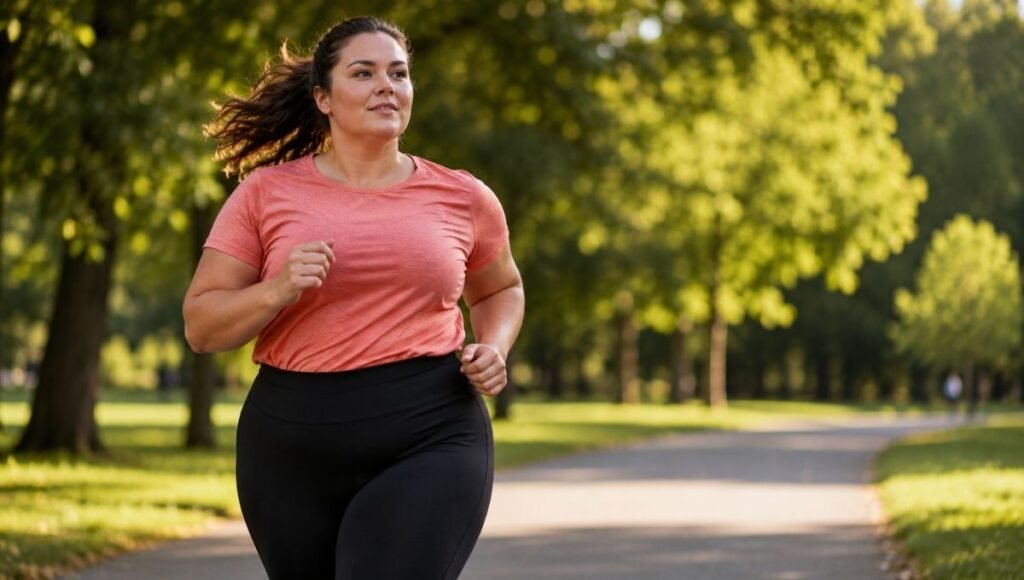
Here’s a frustration that doesn’t get talked about enough in running gear guides: buying “extended sizing” running clothes that are just regular running clothes made bigger — same proportions, same waistband construction, same inner thigh cut — and discovering around mile 2 that they don’t work any better than the last pair. The waistband rolls. The shorts ride up. The fabric bunches at the thighs. And you spend the rest of the run managing your clothes instead of running.
This is the core problem with most plus size running clothes on the market: the garment is sized up, but the design isn’t adapted for how a curvier body actually moves. A waistband that works on a straight-hipped frame may need to be fundamentally different in construction to work on a hip-waist differential of 14 inches. Shorts that prevent chafing for a size 6 thigh gap may fail completely at a size 16 where thighs contact throughout the stride.
The good news: the running apparel industry has genuinely improved in this area, and there are now brands and specific products that are designed — not just sized — for curvier and plus-size runners. This guide tells you what to look for, what’s changed, which brands are actually doing it right, and how to stop wasting money on gear that fails at mile 3.
Key Takeaways
- “Extended sizing” and “plus size design” are not the same thing — extended sizing scales up a standard pattern; true plus size design adjusts proportions for curvier hips, fuller thighs, and different waist-to-hip ratios
- Waistband construction is the single most important feature for plus size running tights and leggings — width (minimum 3 inches), internal drawstring, and non-roll construction matter more than fabric content
- Chub rub (inner thigh chafing) has four specific solutions: compression tights, longer inseams, anti-chafe balm, and fabric type — most runners need more than one simultaneously
- High-impact sports bra support is non-negotiable for plus-size runners regardless of cup size — the right bra changes the running experience more than any other single garment change
- Girlfriend Collective, Fabletics, and Under Armour currently offer the most consistently positive reviews from plus-size runners for technical performance, not just availability of larger sizes
Why Most Plus Size Running Clothes Fail (The Design Problem)
Understanding why gear fails helps you buy better. The most common failure modes for plus size running clothes are specific and preventable.
The Extended Sizing Problem
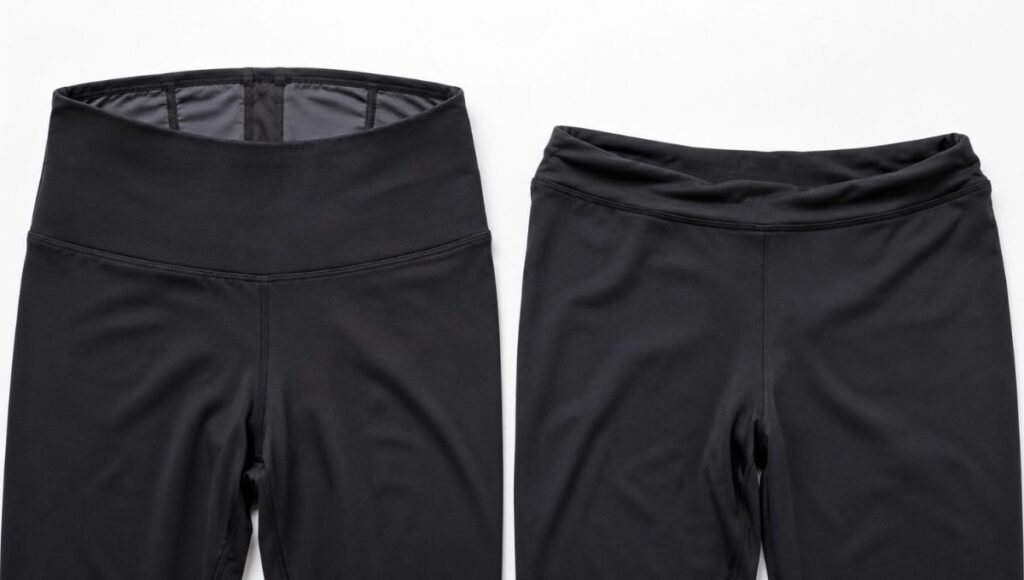
When a brand extends their existing running tights from a size 12 to a size 2X or 3X, they typically scale the existing pattern proportionally — everything gets bigger at the same rate. The problem: a curvier body doesn’t just scale proportionally. The waist-to-hip ratio is different. The inner thigh circumference relative to knee circumference is different. The position where the waistband sits relative to the belly changes.
A tights pattern optimized for a 10-inch waist-to-hip differential may fail when scaled to a 14-inch differential because the waistband is now sitting differently relative to the body’s curves. It rolls because it’s fighting the shape rather than accommodating it.
True plus size running apparel adjusts the pattern — not just the scale. Brands that do this correctly include more ease in the hip area without simply widening the waistband, adjust inner thigh seam placement for fuller thigh contact, and position the waistband to sit at the true waist of a curvier figure rather than at a mid-belly position.
The Waistband Problem
Rolling waistbands are the single most common complaint from plus size runners, and they happen for specific structural reasons. A waistband that rolls is typically: too narrow to span the hip-to-waist curve, insufficiently elastic to maintain position through the movement range of running, or lacking the internal structure (drawstring or boning) to hold position against the downward pull of fabric weight.
What prevents rolling:
- Width: A waistband of 3 inches or more has more surface area to grip and distribute pressure; narrow bands concentrate pressure at a single point and flip under the pressure differential
- Internal drawstring: Allows the runner to custom-set the waistband position; creates a mechanical hold that complements (rather than just relying on) fabric elasticity
- Non-roll construction: Some brands use specific stitch patterns or waistband lining that mechanically resists the rolling direction; look for “non-roll” or “stay-put” in product descriptions from brands that have actually solved this
The Inner Thigh Problem
Chub rub — the industry-preferred term is inner thigh chafing — happens when skin-to-skin or fabric-on-skin friction occurs repeatedly through the thousands of strides in a run. It’s not unique to plus-size runners (many runners with muscular thighs experience the same thing), but it’s more prevalent and more severe when thigh contact is sustained throughout the full stride cycle.
The mechanism is identical to other chafing: moisture softens the skin, repetitive friction tears it. The solution requires addressing both variables — moisture management and friction elimination. Covering exposed inner thigh skin with smooth fabric (not rough fabric, which makes it worse) eliminates the skin-to-skin contact that creates the problem.
What to Look for in Plus Size Running Clothes
Tights and Leggings
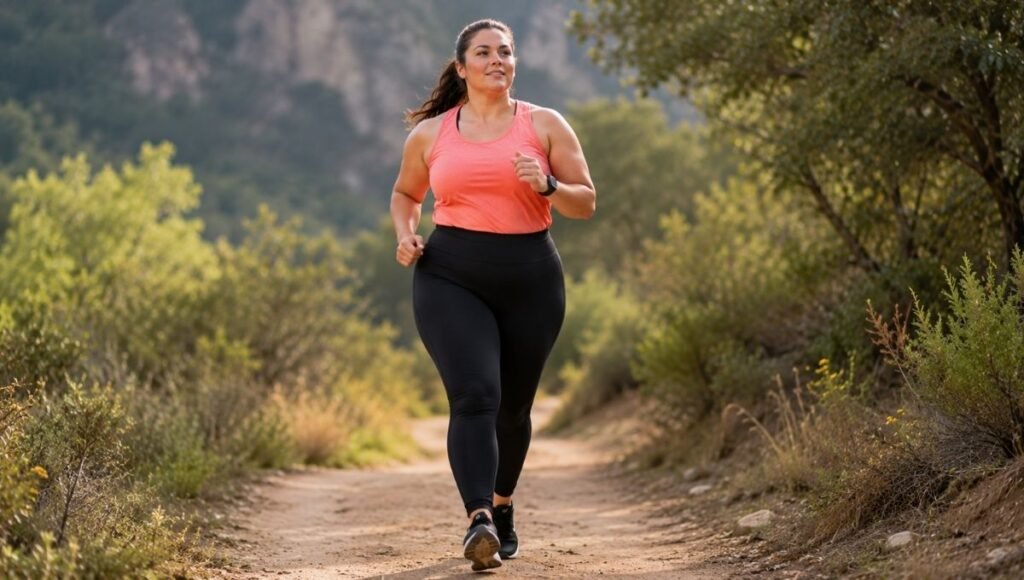
Waistband construction (most important):
- Minimum 3 inches wide — wider is better for stability
- Internal drawstring — mechanical position control beyond just fabric tension
- High-rise positioning — sits at true waist rather than hips; a waistband that sits at the natural waist stays up better than one positioned lower
Fabric composition:
- Four-way stretch is essential — two-way stretch fabrics restrict side-to-side movement during running stride
- 75-85% synthetic (polyester or nylon) for moisture management
- Opaque fabric — holds opacity when stretched; many cheaper leggings become transparent at larger sizes when fabric is under tension
Inner thigh construction:
- Flat or bonded inner thigh seams — raised seams become abrasion points over distance
- Seamless inner thigh panels in premium options eliminate the issue entirely
The opacity test: Before buying, stretch the fabric against the back of your hand. If you can see skin through the fabric when stretched, it will be worse when fitted to your body during running. This test eliminates most cheap options immediately.
Running Shorts
For plus-size runners, the shorts decision often comes down to: compression (biker-style, full thigh coverage) versus traditional (loose outer with built-in liner).
Compression shorts (recommended for most plus-size runners): High-waisted compression shorts or biker shorts provide continuous inner thigh coverage that prevents chafing at the contact zone. The fabric between thighs eliminates the skin-to-skin friction point entirely. Look for 7-inch inseam minimum — shorter compression shorts often end exactly at the high-friction zone.
Traditional running shorts with liner: The liner brief typically doesn’t extend far enough down the thigh to prevent chafing for runners with significant thigh contact. If you prefer the feel of traditional shorts, layer compression shorts underneath rather than relying on the liner.
Waistband for shorts: Same principles as tights — wide, high-rise, with drawstring. Shorts that fit the waist but gap at the hips on a curvy figure are a common fit problem; look for brands that specifically address hip-to-waist differential in their sizing.
Sports Bras
This is the category that makes the largest impact on the running experience for plus-size women, and it’s the most underdiscussed in general running gear guides.
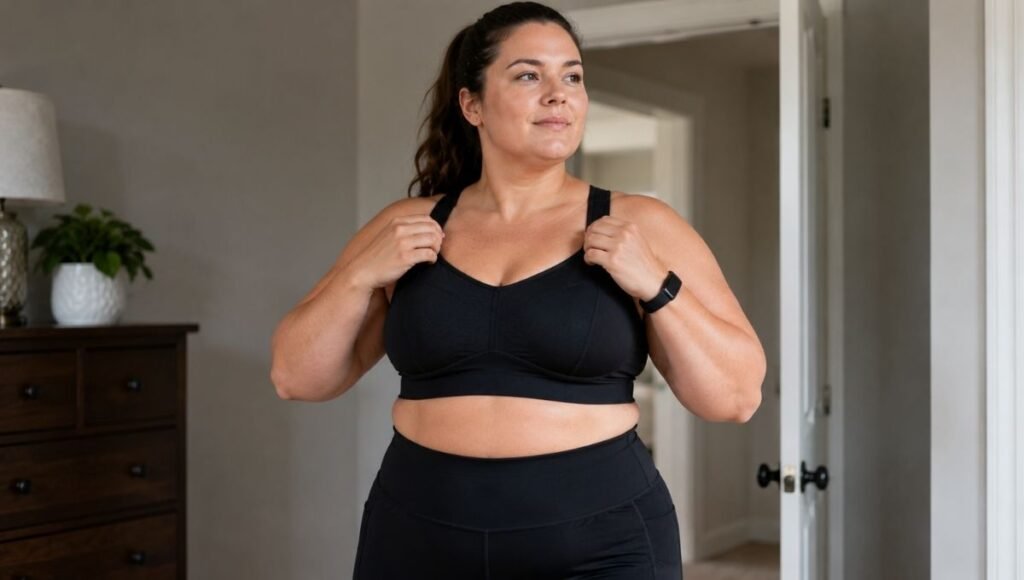
Running is a high-impact activity even at easy paces. For fuller busts, inadequate support creates discomfort, distraction, and over time, ligament strain. The right sports bra is the most important garment in a plus-size runner’s kit.
What to look for:
- Encapsulation (each cup individually supported) rather than compression-only — compression bras flatten but don’t truly support at larger cup sizes
- Underwire or structured cups in DD+ sizes — compression alone doesn’t replace structure at high-impact loads
- Wide, padded straps that don’t dig into shoulders or slip
- Back closure that adjusts — hook-and-eye closures provide more precise fit adjustment than pullover designs
- Moisture-wicking inner cup lining — essential for comfort on longer runs
Brands specifically worth researching for full-bust sport bras for running: Panache Sport, Freya Active, Enell, and Moving Comfort (now Brooks). These brands engineer for support first, style second — which is the right priority for running.
Running Tops
The fit bar for plus-size running tops is simpler than bottoms: moisture-wicking technical fabric, long enough to cover the waistband and provide coverage during stride, and relaxed enough through the torso to not restrict breathing.
What to avoid: Cropped tops that expose the waistband-belly interface during stride movement; compression tops that restrict breathing at higher exertion; anything with a rough seam at the underarm or side where arm swing creates repeated contact.
Editor’s note: A relaxed-fit technical tee is often more comfortable for longer runs than form-fitting athletic tops for plus-size runners — there are fewer pressure points and more airflow. Don’t buy fitted if comfortable doesn’t require it.
The Chub Rub Solution: A Layered Approach
Relying on a single fix for inner thigh chafing usually doesn’t work. The most reliable approach uses multiple interventions simultaneously.
Layer 1 — Fabric coverage: Compression tights or compression shorts (7-inch minimum inseam) with smooth, flat inner seams. This is the foundation. No other solution works as reliably without this.
Layer 2 — Anti-chafe product: Apply anti-chafe balm (Body Glide, Squirrel’s Nut Butter, or similar) to the inner thigh area before any run over 30 minutes, even if you’re wearing compression. On hot days or longer runs, sweat dilutes and reduces fabric protection — the balm provides a secondary layer.
Layer 3 — Moisture management: The friction mechanism requires moisture to progress from irritation to pain. Moisture-wicking fabric that moves sweat efficiently away from the inner thigh skin reduces the moisture variable. This is why fabric composition matters — synthetic, moisture-wicking fabrics chafe less than cotton in the same positions.
The backup: Carry a small amount of anti-chafe product on long runs (fits in a waistband pocket) for reapplication mid-run if you feel friction starting. You cannot stop chafing that’s already begun, but you can slow its progression.
Plus Size Running Clothes: Brands That Are Actually Doing It Right
Girlfriend Collective (Extended sizes through 6XL)
Girlfriend Collective is the brand most consistently recommended by plus-size runners in community forums for the combination of extended sizing and actual fit quality. Their compression leggings use recycled fabric with four-way stretch, a wide high-rise waistband, and proportioning that accounts for curvier hip ratios. Available through 6XL with consistent sizing across the range.
The Compressive High-Rise legging specifically gets strong reviews from plus-size runners for waistband stability and inner thigh seam construction. True extended sizing rather than scaled-up standard.
Best for: Everyday training, road running, any runner who has struggled with waistband rolling in other brands.
Fabletics (Extended sizes through 4X)
Fabletics’ PowerHold leggings have a wide, mesh-lined waistband and high compression that gets consistent positive reviews for staying put. The mesh-lined waistband adds grip against skin that standard waistbands lack. Available through 4X with a membership model that reduces per-item cost.
The High-Waisted PowerHold specifically earns its reputation for waistband stability — the mesh lining is the differentiating feature that prevents the rolling problem.
Best for: Runners who need maximum waistband stability, anyone who runs faster and generates more waistband movement.
Under Armour (Extended sizes through 3X)
Under Armour’s HeatGear compression line gets consistently strong reviews from plus-size runners for moisture management specifically. The fabric moves sweat efficiently even at high output, which reduces the moisture variable in the chafing equation. The tights use flat seams throughout.
For runners who run hot or in warm conditions, UA HeatGear compression tights are worth considering specifically for the moisture management performance.
Best for: Warm weather running, runners who generate significant sweat output, anyone where moisture management is the primary priority.
Old Navy (Extended sizes through 4X, BODEQUALITY initiative)
Old Navy’s BODEQUALITY initiative means all sizes are sold at the same price — no “fat tax” — and the mannequins and product imagery include extended sizes. The Go-Dry leggings get solid reviews for casual and light running use at a significantly lower price point than premium brands.
The sizing consistency and price point make these a reasonable starting option for runners new to the category who want to test fit before investing in premium options.
Best for: Budget-conscious runners, beginners building their gear rotation, casual running use.
Sizing Correctly for Plus Size Running Clothes
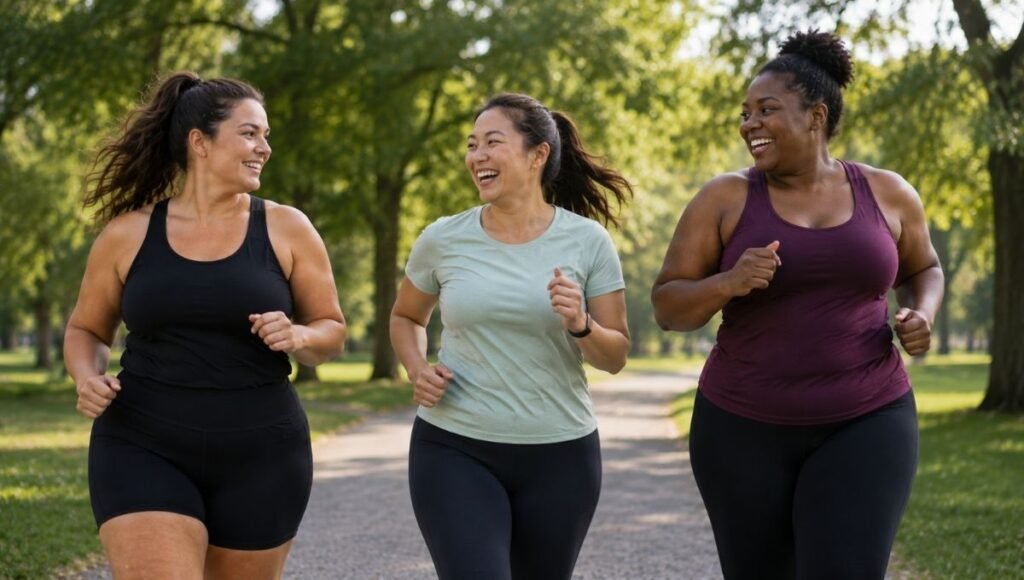
Sizing running clothes when you’re plus-size requires a different approach than standard sizing.
Measure, don’t guess:
- Natural waist (narrowest point above hips)
- High hip (approximately 3 inches below natural waist)
- Full hip (widest point)
- Inseam
- Thigh circumference at widest point
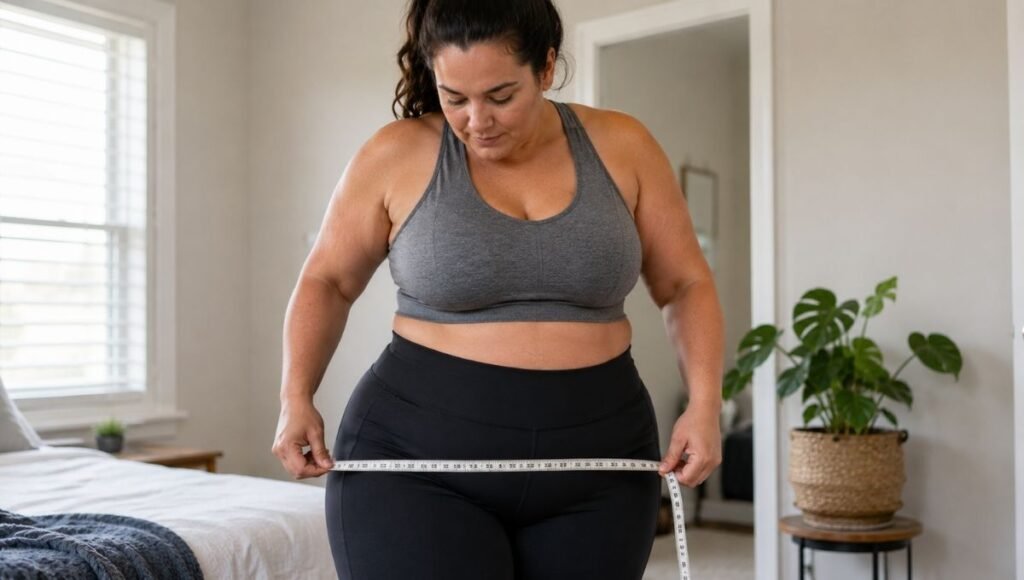
Use the hip/thigh measurement, not the waist: For plus-size bodies with significant hip-to-waist differential, using waist measurement often results in tights that fit the waist but are too small through the hips and thighs. Size to your fullest measurement and verify the waistband can be adjusted with a drawstring if needed.
Read reviews from runners, not just buyers: A legging that looks good and fits well standing still can fail during a 5-mile run. Prioritize reviews that specifically mention running, mention waistband stability, or describe the fit during movement — not just standing or walking.
Account for stretch: Most running tights should feel slightly compressive when you put them on. If they feel loose, they’ll feel worse mid-run when fabric has stretched and body heat has reduced elasticity.
FAQ: What Plus-Size Runners Actually Ask
What running clothes work best for chub rub? Compression tights or compression shorts with a 7-inch minimum inseam, flat inner thigh seams, and moisture-wicking fabric. Apply anti-chafe balm before any run over 30 minutes as a secondary layer. The most reliable solution uses both fabric coverage and anti-chafe product together rather than relying on either alone.
Why does my running waistband keep rolling down? Usually one of three reasons: the waistband is too narrow to span your hip-to-waist differential, the fabric elasticity isn’t sufficient to hold position through running movement, or the tights are sized for waist but too small through the hips causing downward pull. Try a high-rise waistband of 3 inches or more with an internal drawstring. Size to your hip measurement rather than waist.
What brands make plus size running clothes in larger sizes? Girlfriend Collective (through 6XL), Fabletics (through 4X), Old Navy (through 4X), Under Armour (through 3X), Nike (through 3X), and Athleta (through 3X). Girlfriend Collective and Fabletics consistently receive the strongest technical performance reviews from plus-size runners specifically.
Are compression tights or shorts better for plus-size runners? Compression tights with a 7-inch or full-length inseam provide the most consistent chafing prevention for plus-size runners. Compression shorts work well for shorter distances or warmer conditions. The key in both cases is that the compression fabric extends past the inner thigh contact zone — a compression short that ends at mid-thigh often fails at preventing chafing because it ends exactly where the friction happens.
Do I need a specific sports bra for running as a plus-size woman? Yes — this is the most impactful garment change most plus-size runners can make. For DD+ cup sizes, look for encapsulation-style sports bras (individually supported cups) rather than compression-only styles. Brands specifically worth researching: Panache Sport, Freya Active, Enell, and Brooks Dare sports bras. A well-fitted high-impact sports bra transforms the running experience more than any other single gear change.
The Bottom Line
The plus size running clothes that work aren’t just bigger versions of standard running gear — they’re designed around how curvier bodies actually move. Wide, structured, high-rise waistbands with drawstrings. Full inner thigh coverage with flat seams. Fabrics that maintain opacity under stretch. Sports bras engineered for actual high-impact support, not compression.
The brands catching up to this reality — Girlfriend Collective, Fabletics, and Under Armour leading the field — deserve their positive reputation from plus-size runners because they’ve made genuine design improvements rather than just adding sizes to existing patterns.
Start with the waistband. Find tights with a 3-inch minimum high-rise waistband with an internal drawstring. Add anti-chafe balm for anything over 30 minutes. Get a proper high-impact sports bra. From that foundation, the rest of your running kit becomes much more straightforward.
Building a complete running wardrobe? Our guide to the best running leggings for women covers the full range from budget to premium — and our moisture wicking running clothes guide explains what fabrics actually do the job in terms of sweat management.
References:
- Another Mother Runner. (2021). Running Gear for Plus-Size Women: Tested and Reviewed. AnotherMotherRunner.com.
- Coach Magazine. (2021). The Best Plus-Size Running Clothing Brands. CoachWeb.com.
- Laing, R.M., et al. (2020). Textile and clothing comfort in sport: A review of current knowledge. Sports Medicine.
- American College of Sports Medicine. (2023). Exercise Recommendations for All Body Types. ACSM’s Health & Fitness Journal.