
You know that specific moment somewhere around mile 4 when a bead of sweat rolls from your forehead directly into your eye and you have to break stride to blink it out? It happens once, you manage. It happens six times in a row on a hot July run and it starts to feel like your face is working against you.
A running hat fixes this. Not glamorously — it’s a hat, not a miracle — but a good one with a proper sweatband redirects the sweat that would otherwise run straight into your eyes, keeps sun off your face on long outdoor runs, and adds a surprising amount of comfort across a wide range of weather conditions. The wrong one just sits on your head getting hot and heavy.
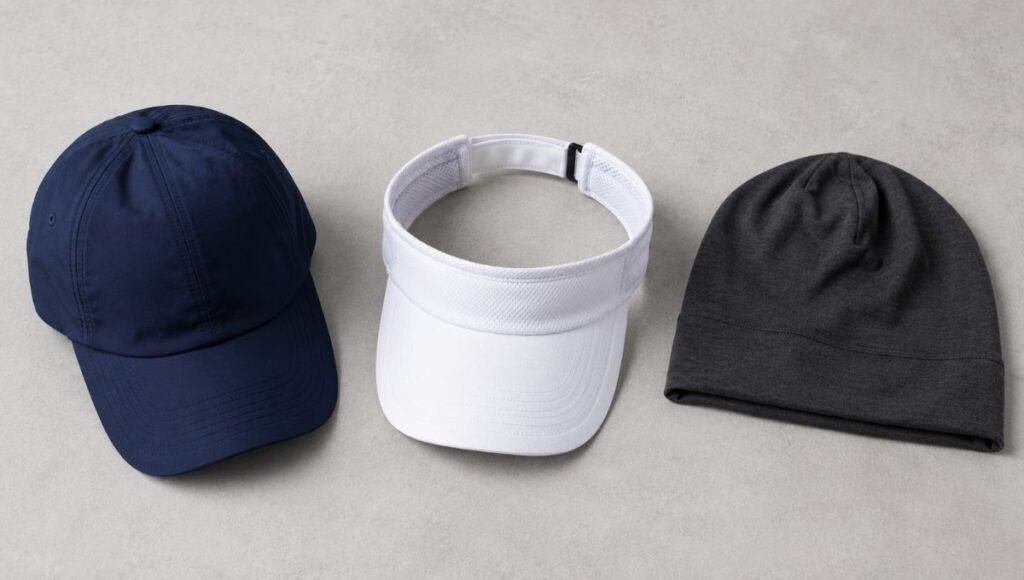
The running hat category is genuinely varied: caps, visors, beanies, headbands, and technical cold-weather options all serve different purposes. This guide covers what each type actually does, how to choose between them, and which specific options earn their place in a runner’s kit across the seasons.
Key Takeaways
- The sweatband is the most important feature in any running cap — a wide, absorbent, moisture-wicking sweatband prevents sweat from reaching your eyes; this single element separates functional running caps from regular baseball caps
- Cap vs visor comes down to heat management — caps trap more warmth (better for cool weather), visors maximize ventilation (better for hot weather)
- Running beanies with moisture-wicking fabric outperform cotton or wool beanies for running in cold weather — merino wool strikes the best balance of warmth, moisture management, and odor resistance
- UPF 40+ is the threshold for meaningful sun protection in a running hat — anything below UPF 25 provides minimal protection during the sustained UV exposure of a long outdoor run
- Ponytail-friendly design (open back or elastic closure) significantly affects fit and comfort for runners with longer hair — this feature should be checked before purchasing
Cap vs Visor vs Beanie: Which Type Do You Actually Need?
Most running hat guides jump straight to specific products. Here’s the decision framework that should come first.

Running Caps (Traditional Bill Cap Style)
Running caps cover the entire head and have a structured or semi-structured bill. They provide sun protection for the scalp and face, keep heat in on cooler days, and — with a quality sweatband — divert sweat away from the eyes effectively.
Choose a running cap when:
- Temperature is below 60°F and you want some warmth without a full beanie
- You’re running in strong sun and need scalp coverage in addition to face shade
- You run early morning or evening when temperature is lower and conditions can shift
- You want the most versatile year-round hat option
The ponytail problem: Standard caps with rear adjustable straps often conflict with ponytails or buns. If you run with your hair up, specifically look for caps with an open elastic rear closure (sometimes called a “ponytail hole”), rear cutout design, or a stretchy snapback that accommodates a bun. Several brands — Lululemon, Ciele, On Running — have built these features into their running caps as standard.
Running Visors
Visors cover only the brow and provide a bill for sun and sweat management, but leave the top of the head completely open. This maximizes ventilation and is the preferred choice for runners who generate significant head heat.
Choose a running visor when:
- Temperature is above 65°F and you run hot
- You find any full cap coverage makes your head overheat during hard efforts
- You want sun and sweat protection without trapping heat
- You have longer hair — visors accommodate any hairstyle with no conflict
The trade-off: No scalp protection. If you’re running for more than 60 minutes in strong sun, apply sunscreen to the top of your head or consider a lightweight cap with mesh panels instead.
Running Beanies
Beanies cover the head and ears in cold weather. For running, the fabric matters enormously — a cotton or thick knit beanie absorbs sweat and gets heavy and cold; a running-specific beanie in synthetic or merino wool manages moisture while retaining warmth.
Choose a running beanie when:
- Temperature is below 35°F — hands and ears feel the cold before your torso, and a beanie covers both
- Wind chill creates a significant feels-like temperature drop
- You’re doing easy long runs in cold where you generate less body heat
Temperature guide for beanies: Below 35°F: Full beanie covering ears is non-negotiable for most runners 35–45°F: An ear band or headband is usually sufficient; full beanie is optional based on personal cold tolerance Above 45°F: Most runners don’t need ear coverage; a lightweight cap handles the conditions
Running Headbands and Ear Bands
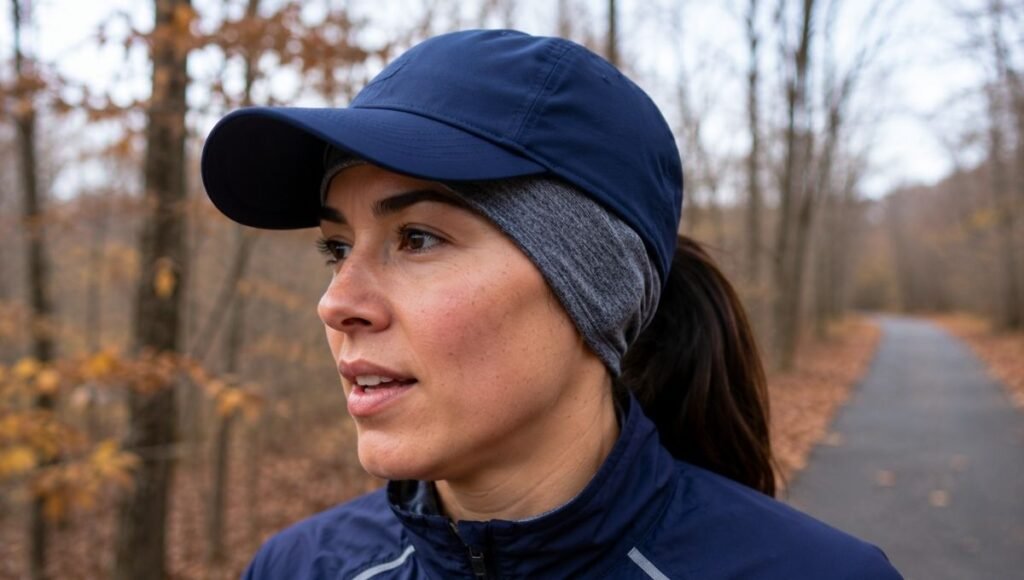
Headbands cover only the ears and forehead — the areas most sensitive to cold — without adding the warmth of a full beanie. They’re the cold-weather accessory that extends the range of a running cap without being its own complete layer.
Choose a running headband/ear band when:
- Temperature is in the 35–50°F range where you want ear protection but not full head coverage
- You’re pairing with a cap that doesn’t cover ears sufficiently
- You want to layer — cap plus ear band handles a wider temperature range than either alone
The Sweatband: Why This Detail Defines a Running Hat
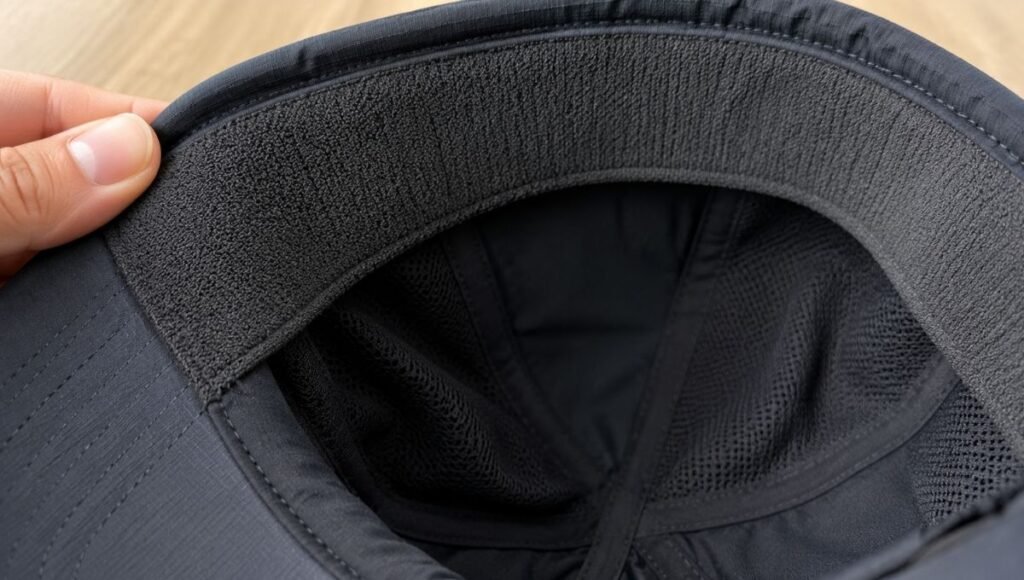
This is the feature that separates a running-specific hat from a regular outdoor cap, and it’s rarely discussed with the depth it deserves.
A sweatband is the fabric band that lines the interior of the hat at forehead level. In running hats, it does something specific: it catches sweat before it can run down your forehead and into your eyes. At easy running effort this sounds like a minor nicety. At mile 8 of a summer long run, it’s the difference between a comfortable run and one where you’re blinking through sweat every 90 seconds.
What to look for in a running hat sweatband:
Width: A wider sweatband (1.5–2 inches) catches more sweat across a larger surface area. Narrow sweatbands (less than 1 inch) can overflow quickly in high-sweat conditions.
Material: Terry cloth sweatbands feel soft and absorb well but dry slowly. Technical synthetic sweatbands move sweat into the hat fabric where it evaporates — the moisture management approach over pure absorption. For hot weather running, synthetic wicking sweatbands perform better over longer efforts.
The undervisor: Many quality running caps have a dark-colored underside to the bill — this reduces glare from bright surfaces reflecting upward. It’s a subtle detail that makes a real difference on sunny runs.
The Best Running Hat for Each Scenario

Best Overall Running Cap: Ciele GOCap SC
The Ciele GOCap SC has become the default recommendation among serious runners for good reason: it handles almost everything correctly. The 100% recycled polyester fabric is lightweight and fast-drying, the UPF 40+ rating provides meaningful sun protection without adding fabric weight, and the SOFTcurved brim is flexible enough to pack flat without losing its shape.
The adjustable rear closure works with most hair configurations, and the reflective branding adds visibility for low-light running without dedicated reflective strips. It’s a hat that does what it needs to do without announcing itself.
Best for: Year-round road running, trail running in varied conditions, runners who want one cap that handles most situations.
Editor’s note: Once you run in a Ciele, it’s hard to go back to generic athletic caps. The specific fit and construction quality is noticeable immediately.
Best Lightweight Cap: Janji AFO Hyperlight
At 28 grams — roughly the weight of a few paper clips — the Janji AFO Hyperlight is the category-defining lightweight running cap. The 88% recycled polyester/12% elastane construction provides a barely-there feel that holds through hard efforts and long distances. UPF 25 protection and rear bungee adjustment complete a minimalist package.
The trade-off for the weight is coverage — the brim is narrower than standard caps. For runners who prioritize feel and weight above maximum sun protection, this is the correct choice. For runners prioritizing protection, step up to a cap with UPF 40+ and slightly more fabric.
Best for: Ultralight trail runners, runners who find standard caps too heavy or warm, summer speed work, race day.
Best for Sun Protection: Sunday Afternoons Aerial Cap

The Aerial Cap leads with its UPF 50+ rating across the full cap construction — not just selected panels. Ultralightweight breathable polyester with strategic mesh ventilation keeps airflow moving despite the denser sun-blocking fabric. The highly adjustable rear closure fits heads from 21.6 to 24 inches in circumference.
For runners doing long efforts in full sun — trail running at altitude, road marathons in exposed conditions — the Aerial Cap’s sun protection credentials are verified and meaningful. Summer and sun-exposed terrain is where this earns its recommendation.
Best for: Trail running in alpine or exposed terrain, long sunny road runs, any runner with fair skin who prioritizes UV protection.
Best Running Visor: Lululemon Removable Sweatband All-Sport Visor
The standout feature is in the name — the sweatband is removable and washable independently of the visor, which solves the long-term hygiene problem that plagues non-removable sweatbands. The open-top design maximizes heat escape during warm-weather running, and Lululemon’s technical fabric handles sweat management efficiently.
The adjustable rear closure accommodates different hair configurations, including high ponytails. For hot-weather running where visor is the right category choice, this is one of the most consistently well-reviewed options.
Best for: Summer running above 65°F, runners who run very hot, anyone who wants maximum ventilation during hard efforts in warm weather.
Best Running Beanie: Headsweats Reflective Race Beanie
Most running beanies make a trade-off: warm but heavy and slow-drying, or lightweight but insufficient insulation. Headsweats threads this needle with a lightweight knit fabric that dries three to four times faster than cotton while providing enough warmth for cold-weather running. The interior terry cloth sweatband handles the specific moisture management problem that beanies face — the hat absorbs head sweat that would otherwise saturate the fabric and make you cold.
The reflective trim wraps the entire brim — making this the most visible cold-weather running hat option on this list. For pre-dawn winter runs, that’s not a minor feature.
Best for: Cold weather running below 35°F, pre-dawn and post-sunset winter runs, runners who need visibility combined with warmth.
Best Cold-Weather Ear Band: Brooks Greenlight Ear Warmer
A running headband that covers only the ears and forehead occupies a specific use case — 35–50°F conditions where full beanie warmth would be excessive but bare ears would be uncomfortable. Brooks’ Greenlight ear warmer uses moisture-wicking fabric with a fleece-lined interior for warmth without bulk.
At this temperature range, the ear band is often the difference between a comfortable run and one spent thinking about your ears. The lightweight construction means it can be removed and pocketed as you warm up, giving you the flexibility that a full beanie doesn’t.
Best for: 35–50°F conditions, pairing with a running cap for a layered approach to ear coverage, any runner whose ears get cold before the rest of them.
Running Hat for Different Hair Types
This is the practical consideration most hat guides skip entirely.
Short hair: Any running cap works. Standard adjustable closure, snapback, or fitted — all are functional. Focus on sweatband quality and sun protection rating.
Ponytail or bun: Look specifically for caps with an open elastic rear closure, a rear cutout, or a stretchy snapback that stretches over a bun without pressing down uncomfortably. Lululemon, Ciele, and On Running all design for this. Alternatively, visors work for any hair length with zero conflict.
Long hair worn down: Visors are the most practical choice — no conflict with hair flow, open construction, easy on and off. Caps can work if the rear closure has enough room, but visors simplify the situation.
Under a helmet (cycling or e-bike running routes): A lightweight running cap or skull cap works well under helmet straps. Full-brimmed caps are impractical under most helmets — the bill creates too much resistance. A visor or no-brim skull cap is the practical answer.
When Running Hats Become Safety Equipment
This is worth stating directly: in cold-weather running and high-UV conditions, head coverage isn’t just comfort — it’s safety.
Sun exposure: The American Academy of Dermatology notes that cumulative UV exposure causes skin damage that compounds over time, and the scalp and ears are among the most commonly sun-damaged areas in outdoor athletes. A UPF 40+ running hat during long outdoor runs meaningfully reduces this exposure. If you’re running more than 60 minutes in strong sun without shade, head coverage plus sunscreen on exposed skin is the appropriate standard.
Cold and wind: At temperatures below 20°F with wind, uncovered ears face frostbite risk within 30 minutes of exposure. A running beanie isn’t optional at these temperatures — it’s protective equipment with the same standing as gloves and thermal layers.
FAQ: What Runners Ask About Running Hats
What is the best running hat for hot weather? A visor or a lightweight cap with mesh panels and UPF 25–50+ rating. The visor maximizes ventilation by eliminating top coverage; a mesh-panel cap adds some scalp shade if you want it. Both should have a synthetic wicking sweatband. Above 70°F with direct sun, these are the practical choices.
Do I need a special hat for running or can I wear a regular baseball cap? A regular baseball cap works for short easy runs. For runs over 45 minutes, the differences matter: running-specific caps have moisture-wicking sweatbands (regular caps use cotton or minimal lining), lighter-weight fabrics that dry faster, and designs that stay in place during movement. The functional gap widens with run length and conditions.
What running hat works with a ponytail? Look for caps with an open elastic rear closure, a rear cutout specifically for ponytails, or a stretchy snapback. Visors work with any hair configuration by default. Brands to check: Lululemon (rear cutout), Ciele (elastic rear), On Running (flexible closure), Patagonia Duckbill (open back).
How cold does it need to be to wear a running beanie? Below 35°F, a beanie covering ears is recommended for most runners. Between 35–45°F, an ear band or headband is usually sufficient. Above 45°F, most runners don’t need ear coverage — a lightweight running cap handles the conditions.
What UPF rating do I need in a running hat? UPF 40+ for meaningful sun protection during extended runs. UPF 25–30 provides moderate protection sufficient for shorter runs. Below UPF 25, the fabric provides minimal UV blocking. If you’re regularly running 60+ minutes in direct sun, UPF 40–50+ is worth seeking specifically.
The Bottom Line
The best running hat is the one matched to your primary running conditions — not the most technical option available.
For year-round versatility, a Ciele GOCap in your preferred color handles most situations. For hot-weather specialists, a Lululemon visor maximizes ventilation when you need it most. For cold-weather running, a Headsweats reflective beanie covers warmth and visibility simultaneously. For the transition zones, a Brooks ear band pairs with your existing cap to extend its temperature range without adding a full second hat to your rotation.
Start with the sweatband. If it’s wide, moisture-wicking, and well-positioned, the hat will do its job. Everything else — color, brand, additional features — is secondary.
Building your complete running kit? Our winter running outfit guide covers how head coverage fits into your cold-weather layering strategy — and our best running jacket for women pairs with the right hat for full weather protection.
References:
- American Academy of Dermatology Association. (2023). Sun Protection for Outdoor Athletes. AAD Patient Education.
- GearJunkie. (2025). The Best Running Hats: Tested and Ranked. GearJunkie.com.
- iRunFar. (2026). Best Running Hats: Field Tested. iRunFar.com.
- National Weather Service. (2024). Wind Chill and Cold Weather Safety. NOAA.