
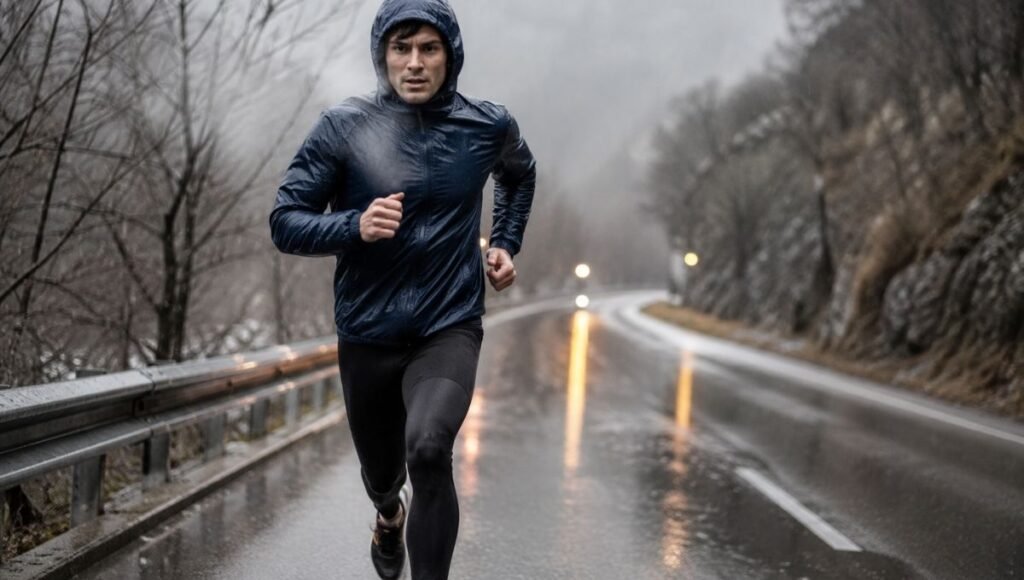
Here’s the running jacket mistake that happens constantly: you buy a jacket rated for “all weather,” wear it on a 45-minute tempo run in 40°F conditions, and spend the last 20 minutes completely soaked — not from rain, but from your own sweat trapped inside a waterproof shell that couldn’t evacuate the moisture fast enough. The jacket did exactly what it promised. You just bought the wrong type for how you run.
Men’s running jackets come in genuinely different categories — windshells, DWR-treated softshells, and fully waterproof membranes — and the right choice depends almost entirely on the conditions you actually run in, not the worst possible day you can imagine. This guide cuts through the options based on real running scenarios, gives you the technical language you need to evaluate products without being misled by marketing copy, and recommends specific jackets that deliver on their promises.
Key Takeaways
- Windshell jackets are the right choice for most men’s training runs — they’re lighter, more breathable, and appropriate for the cold-but-dry conditions that make up the majority of cold-weather running
- Fully waterproof jackets trap sweat — even high-breathability membranes struggle to evacuate moisture at running effort; fully waterproof is the right tool for sustained rain, not for general cold weather
- Hydrostatic Head (HH) rating tells you waterproofness; MVTR tells you breathability — both matter for running jackets; a jacket with high waterproofing and low breathability will keep rain out but trap sweat in
- Packability determines whether you’ll actually bring it — a jacket you leave at home because it’s bulky is no jacket at all; running-specific packable jackets compress to fit in a shorts pocket or palm
- Fit for running is different from fit for hiking — running jackets need freedom at the shoulder for arm drive, length that stays tucked during stride, and a hem that doesn’t ride up when raising your arms
The Three Types of Men’s Running Jackets (And When Each Works)
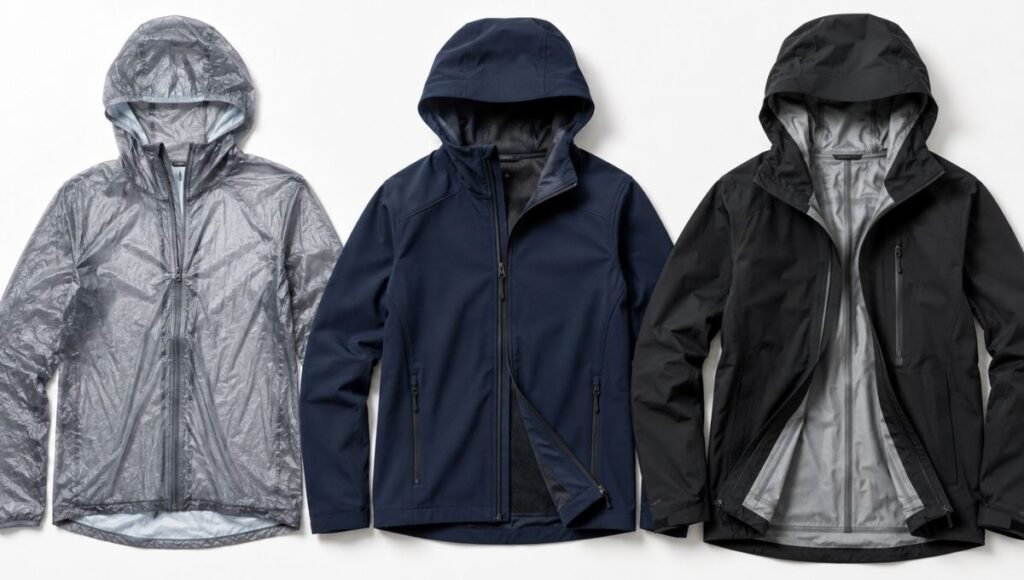
Before looking at specific products, matching the jacket type to your running conditions is the most important decision.
Windshell / Windbreaker
A windshell blocks wind penetration and typically has a DWR coating for light moisture resistance, but it’s not waterproof in sustained rain. The advantage: significantly more breathable than waterproof jackets, lighter, and more packable. <cite index=”39-1″>Lightweight air-permeable nylon fabrics are the main choice for windproof jackets, with some manufacturers adding merino wool panels under the arms for additional ventilation.</cite>
Use a windshell when: Temperature is cold with wind chill but no significant rain. Most cold-weather training runs fall in this category — your body generates enough heat that overheating in a non-breathable shell is a bigger problem than staying dry.
The best windshell temperature range: 30–55°F in calm to moderate wind. Above 55°F, even a windshell adds unnecessary warmth. Below 30°F in sustained wind, you may need a thermal mid-layer underneath.
DWR-Coated Softshell
A softshell has a DWR (Durable Water Repellent) coating that beads water off the surface, handles light drizzle for 20–30 minutes, and provides wind resistance without a sealed waterproof membrane. More breathable than fully waterproof jackets, softer against skin, and typically more stretch for running movement.
Use a softshell when: Conditions are variable — possibly some light drizzle but not sustained rain, cold with occasional wind. The Patagonia Wind Shield is the benchmark in this category specifically because its DWR handles unexpected weather without the breathability penalty of a waterproof membrane.
Fully Waterproof (Membrane Jacket)
<cite index=”43-1″>The hydrostatic head (HH) rating measures how waterproof fabric is — specifically, how much water pressure a material can withstand before leaking. Higher numbers mean more waterproof.</cite> A jacket rated 10,000mm handles moderate rain; 20,000mm handles sustained heavy rain. <cite index=”41-1″>The Compressport Thunderstorm, for example, has a 25,000mm waterproof rating and stood up to heavy downpours in testing while maintaining breathability that prevented the clamminess common in other waterproofs.</cite>
The honest tradeoff: Even the most breathable waterproof membranes struggle to evacuate the moisture generated during sustained running effort. You’ll stay dry from rain but potentially damp from sweat. <cite index=”40-1″>On most training runs, breathability is a higher priority than weather protection. If the jacket can handle light rain, that’s enough in most cases.</cite>
Use a fully waterproof jacket when: You’re deliberately running in sustained rain, racing in wet conditions, or living in a climate where proper rain is a consistent training reality rather than an occasional surprise.
Reading the Technical Specs: HH Rating and MVTR Explained for Runners
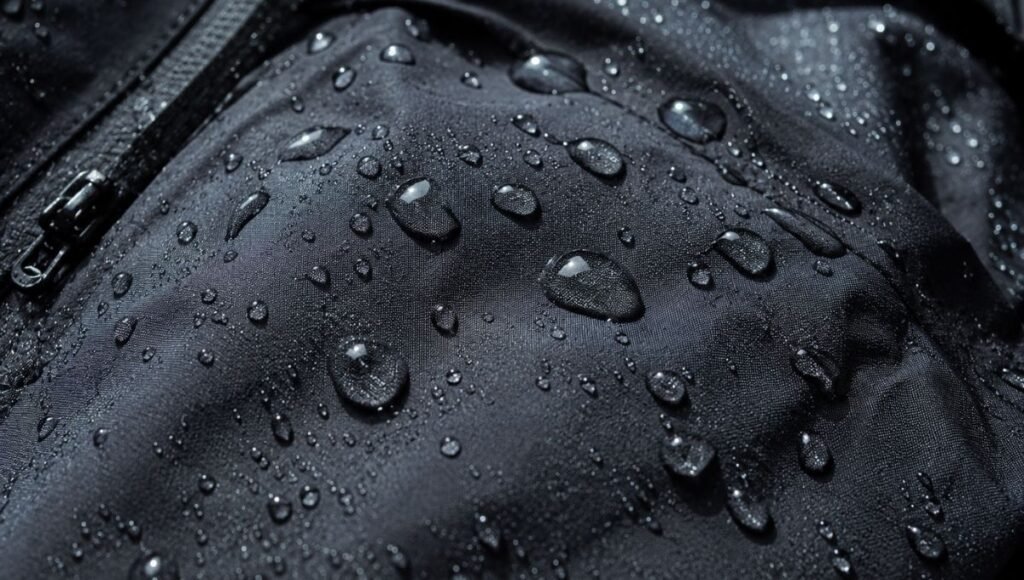
These two numbers appear on most waterproof running jackets and are worth understanding before spending $200+ on a shell.
Hydrostatic Head (HH) / Waterproof Rating (mm): Measures how much water pressure the fabric withstands before water penetrates. For running specifically:
- 5,000mm: handles light drizzle
- 10,000mm: handles moderate rain — sufficient for most running applications
- 20,000mm+: handles sustained heavy rain and high-pressure conditions
For running in typical wet weather (not monsoon conditions), 10,000mm is adequate. The diminishing returns above 15,000mm are real — you’re paying more for protection beyond what most training conditions require.
MVTR (Moisture Vapor Transmission Rate): Measures how much moisture vapor the fabric allows to escape — your breathability metric. Higher is more breathable. For running:
- Below 10,000g/m²/24hrs: feels restrictive and clammy during running effort
- 10,000–20,000g/m²/24hrs: acceptable for moderate-effort running
- 20,000g/m²/24hrs+: genuinely breathable for sustained running effort
<cite index=”41-1″>The Rab Phantom Mountain’s 20,000g/m²/24hrs breathability rating translated into excellent performance on wet runs — managing heat and moisture far better than most waterproof jackets despite its full waterproof construction.</cite>
The practical calculation: A jacket with 20,000mm waterproofing and 10,000 MVTR breathability will keep rain out but trap sweat. A jacket with 10,000mm waterproofing and 20,000 MVTR breathability will handle moderate rain while letting sweat escape. For running, the MVTR often matters more than the waterproof rating ceiling.
Men’s Running Jacket Fit: The Specific Things to Check
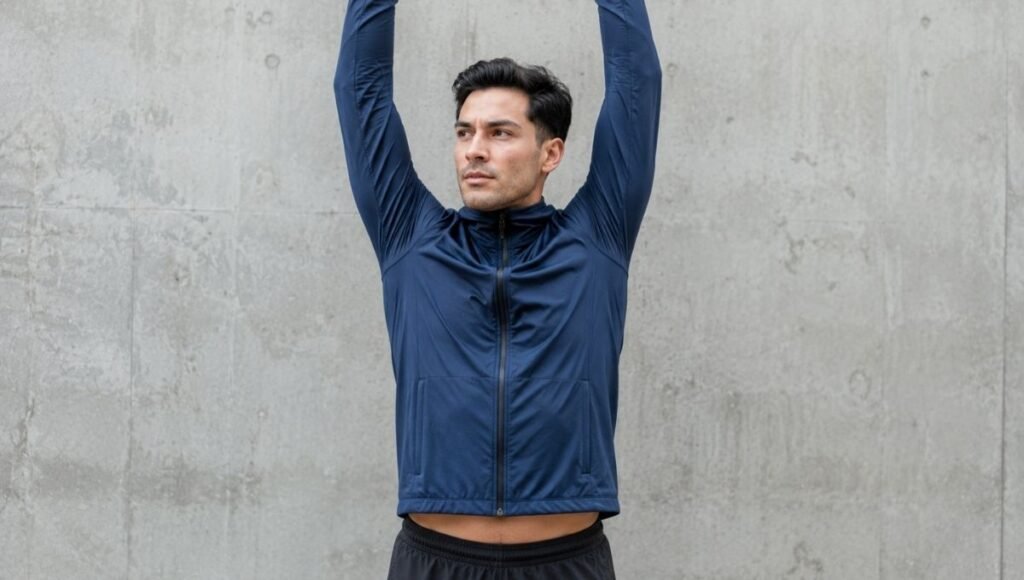
Men’s running jackets fit differently from hiking jackets, cycling jackets, or casual athletic jackets — and buying the wrong cut creates real problems mid-run.
Shoulder line: The seam should sit exactly at your shoulder point, not drooping toward the arm. A drooping shoulder seam restricts arm drive during running and creates friction at the upper arm. In the store, swing your arms in running motion — if the back of the jacket pulls forward across the shoulders, the jacket is too narrow in the chest or has insufficient shoulder girth.
Sleeve length: Sleeves should reach your wrist when your arms are at your sides and remain there when you raise your arms overhead. A sleeve that exposes your wrist when you raise your arm leaves a gap in wind and weather protection exactly where cold air penetrates first. <cite index=”48-1″>The best windbreaker for running will, at minimum, cover your wrists well and stay below your waistline when you raise your arms.</cite>
Hem length: The hem should sit at or below the hip when your arms are at your sides, and stay at the hip (not riding up to the waist) when you stride. A hem that rides up during running exposes your lower back to wind at exactly the moment it’s most uncomfortable — when you’re already sweating and the sweat-exposed skin cools rapidly.
Chest and torso: Enough room to layer a thermal base layer or light mid-layer underneath without the jacket feeling tight across the chest during deep breathing. Run in place in the fitting room — if the jacket restricts breathing depth at any effort level, it’s too tight in the torso.
The Best Men’s Running Jackets in 2026
Best Overall: Patagonia Houdini
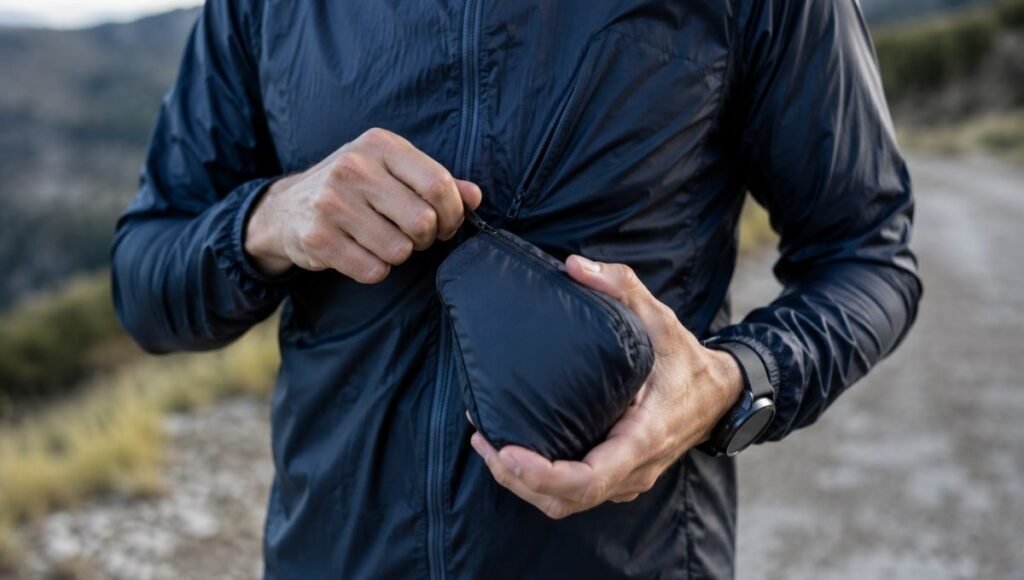
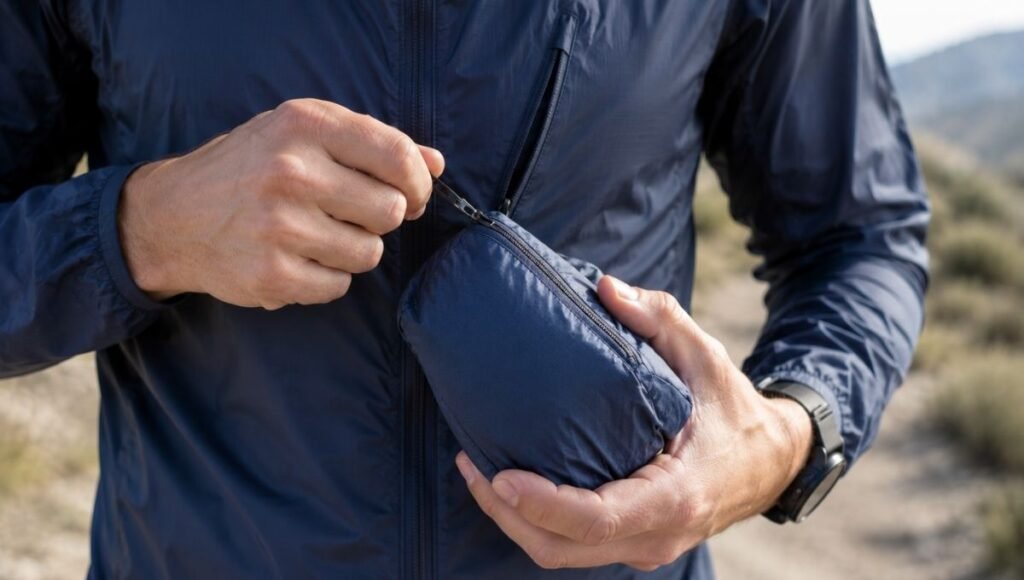
<cite index=”42-1″>The Patagonia Houdini paved the way for packability in running jackets. When packed into its front pocket, it’s tiny. Run into a powerful gust of wind above the treeline, the Houdini deploys quickly and provides immediate protection.</cite> At around 3 ounces, it packs to fist-size and fits in a jersey pocket, a shorts waistband, or a running vest pocket.
The Houdini is a windshell with DWR treatment, not a waterproof jacket — it handles unexpected drizzle and wind without the breathability penalty of a membrane. For the majority of cold training runs that are cold-and-dry rather than cold-and-wet, it’s the most versatile single running jacket for most men.
Best for: Road running in variable conditions, packable just-in-case carry on any run, trail running where conditions can shift quickly.
Editor’s note: If you only buy one running jacket, the Houdini covers 80% of training conditions for most runners. Add a waterproof membrane jacket only if your running regularly involves sustained rain.
Best Windproof: Black Diamond Distance Wind Shell
<cite index=”39-1″>The Black Diamond Distance Wind Shell is more wind resistant than most alternatives and packs the smallest of tested jackets — a minimal 5.75″ x 3.75″ packed size. It’s the right choice for runners who run cold and want to keep the chill away while keeping down the weight and volume.</cite>
The technical-looking nylon construction breathes better than it appears while blocking wind effectively. <cite index=”39-1″>If heading out into a challenging dry but cold day, the Black Diamond Distance is the jacket to reach for.</cite> The slim fit is purpose-built for running rather than adapted from hiking or outdoor use.
Best for: High-wind conditions, trail running on exposed ridges and summits, cold and dry training in genuinely windy environments.
Best Waterproof: Janji Rainrunner Pack Jacket 2.0
For sustained rain running, the Janji Rainrunner 2.0 solves the breathability problem that makes most waterproof running jackets feel suffocating during hard efforts. The 360-degree core venting system releases heat during high-intensity running while the waterproof ripstop nylon shell and taped seams keep rain out. YKK AquaGuard water-repellent zippers seal the ventilation points against water ingress — a detail most brands skip.
At roughly 200g, it’s light enough that wearing it doesn’t feel like a performance penalty. The scuba-style hood provides coverage without blocking peripheral vision.
Best for: Road running in sustained rain, trail running in wet climates, racing in unpredictable weather.
Best Lightweight Packable: Montbell Ex Light Wind Jacket
<cite index=”48-1″>At 1.6 ounces (47 grams), the Montbell Ex Light Wind Jacket uses 7-denier ripstop nylon Ballistic Airlight fabric</cite> — genuinely ultralight without the fragility that plagues many sub-2-ounce shells. For runners who want maximum packability for warm-weather training where weather protection is secondary to having something available, this is the category benchmark.
The trade-off for the weight is features — minimal pockets, no underarm zips — but for the specific purpose of a lightweight carry-along layer, the feature set is exactly right.
Best for: Warm-weather trail running where you need weather protection packable enough to forget you’re carrying it, minimalist runners, ultramarathon racing.
Best for Visibility: Brooks Run Visible Jacket
For pre-dawn and post-sunset road running where visibility to traffic matters as much as weather protection, Brooks built the Run Visible around reflective placement at motion zones — wrists and lower leg areas where repetitive running movement creates the motion-recognition pattern that drivers identify fastest. The 3M Scotchlite Carbon Black Stretch reflectivity provides high candlepower performance in a deep black colorway that doesn’t look like a safety vest during daylight.
Best for: Dawn and dusk road running, urban running near traffic, any runner whose training schedule consistently involves low-light conditions.
Best Budget Pick: Decathlon Kiprun Windproof Running Jacket
For runners building their cold-weather kit without premium investment, Decathlon’s running-specific windproof jacket delivers the essential features at a fraction of the cost — windproof construction, DWR treatment, packable design, and a running-specific cut that accommodates arm drive without binding at the shoulder.
Best for: Beginner runners, budget-conscious training, backup jacket for rotation.
Running Jacket Features Worth Paying For (And Which Ones Aren’t)
Worth paying for:
Underarm or back ventilation: Zip vents under the arms or mesh panels on the back allow heat to escape at the zones where running generates the most moisture. The difference between a jacket with and without this feature is noticeable at moderate-to-hard effort.
Packability into its own pocket: A jacket that packs into a chest or hand pocket is one you’ll actually bring on runs where you’re not sure you’ll need it. Jackets that require a separate stuff sack stay at home.
Reflective placement at cuffs and hem: Reflective elements at moving extremities are more effective for driver recognition than chest logos alone. Worth specifically checking placement, not just presence.
Ankle-to-wrist length: A jacket with adequate sleeve length and hem length stays protective during the range of motion running requires.
Less critical than marketed:
Extremely high waterproof ratings (above 20,000mm): The ceiling above 15,000mm provides diminishing real-world benefit for running conditions. The breathability number matters more.
Pockets beyond the essentials: A chest pocket for packing and one hand pocket for in-run access covers most running needs. Five-pocket systems add weight and bulk.
FAQ: What Men Ask About Running Jackets
What’s the difference between a windbreaker and a waterproof running jacket? A windbreaker blocks air penetration and typically has DWR for light moisture resistance, but isn’t waterproof in sustained rain. A waterproof jacket uses a membrane that physically blocks water while (ideally) allowing sweat vapor to escape. Windbreakers are more breathable and appropriate for most cold training runs; waterproof jackets are for deliberate rain running.
How should a men’s running jacket fit? The shoulder seam should sit at your shoulder point, sleeves should cover your wrists when arms are raised overhead, and the hem should stay at or below the hip during stride. Run in place in the fitting room — if the jacket restricts breathing depth or pulls across the shoulders during arm swing, the fit is wrong for running.
Is Gore-Tex worth it for running jackets? Gore-Tex provides excellent waterproofing and durability, but many running-specific membrane alternatives perform comparably at running effort and lower price. The breathability of the specific product matters more than the membrane brand for running applications. <cite index=”41-1″>The Rab Phantom Mountain’s Pertex Shield fabric performed comparably to Gore-Tex equivalents in real running conditions.</cite>
What weight running jacket is appropriate? For a windshell: under 4 oz (113g) is excellent, under 6 oz (170g) is good. For a waterproof jacket: under 7 oz (200g) is appropriate for running use; anything above 12 oz (340g) starts to feel like a weight penalty during faster running.
Can I wear a regular rain jacket for running? For short easy runs: yes. For sustained running effort, regular rain jackets are cut for static outdoor use, lack the shoulder freedom for running arm drive, and typically have insufficient breathability for the moisture output of running. The performance difference becomes apparent within 30 minutes of running at moderate effort.
The Bottom Line
The best men’s running jacket is the one that matches your actual running conditions — not the most technical option available, and not the lightest option that fails when unexpected rain arrives.
For most men running in cold but dry training conditions, the Patagonia Houdini covers the majority of the year. For dedicated rain runners or wet-climate training, the Janji Rainrunner 2.0 solves the breathability problem that makes most waterproof shells miserable during hard efforts. For maximum packability at minimal weight, Montbell’s ultralight options remain the category benchmark.
Get the fit right before anything else. A jacket that binds at the shoulder during arm drive or rides up during stride will fail regardless of its weather-protection credentials.
For the full cold-weather running outfit, check out our men’s running tights guide — the bottom half of your cold-weather kit matters as much as the jacket — and our winter running outfit guide for the complete temperature-by-temperature layering system.
References:
- Treeline Review. (2025). 4 Best Men’s Running Jackets: Tested over three years. TreelineReview.com.
- iRunFar Gear Team. (2026). Best Windbreaker Jackets. iRunFar.com.
- 220 Triathlon. (2026). Best Running Jackets. 220Triathlon.com.
- American College of Sports Medicine. (2023). Cold Weather Exercise and Apparel Selection. ACSM’s Health & Fitness Journal.