

Your first real trail run teaches you things that no guide fully prepares you for. The way roots appear from nowhere. The way a shaded north-facing slope stays wet long after everything else has dried. The way branches along an overgrown section at shoulder height aren’t a hypothetical — they’re there, and they’re scratching your arms, and you’re wearing a sleeveless road running top that offers exactly zero protection.
Or maybe it’s the pockets. You’re three miles in, starting to fade, and you reach for the energy gel in your road running shorts’ tiny side pocket — except the gel isn’t there anymore. It launched somewhere around mile 2.
Trail running asks different things from your clothing than road running does. The differences are specific and practical, and once you understand them, building a trail running outfit becomes straightforward. This guide covers what those differences are, which of your existing road running gear transfers directly, what actually needs to be replaced, and how to dress for the terrain type and conditions you’re actually running in.
Key Takeaways
- Most road running clothing works for trail running — with two main exceptions: shorts length and pocket security are genuinely different requirements on trail versus road
- Terrain type determines clothing choices as much as temperature does — overgrown brush trails need longer coverage; rocky technical terrain needs durable, abrasion-resistant fabric
- An emergency packable layer is non-negotiable for trail runs over 90 minutes — mountain and trail conditions change faster than road conditions, and being caught underprepared is a different kind of problem when you’re 5 miles from the trailhead
- Gaiters — the often-overlooked ankle attachment that keeps debris out of your shoes — matter more than most trail running clothing guides acknowledge
- High-visibility and reflective details are more important on trail than road — trees and terrain can make you invisible to other trail users and wildlife at dawn and dusk
Can You Wear Road Running Clothes for Trail Running?
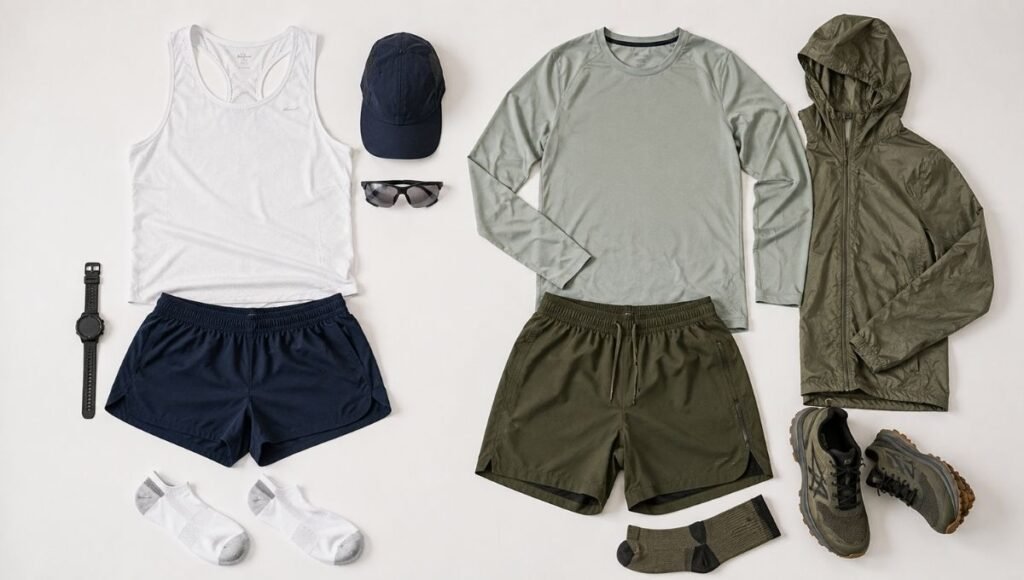
This is the most common question trail running beginners ask, and the honest answer is: mostly yes, with specific exceptions.
Road running shorts, tights, base layers, and jackets are generally fine for trail running. The technical fabric properties — moisture wicking, breathability, stretch — transfer directly. If it worked for your long road runs, it will work on trail for the same distance in similar conditions.
The exceptions are specific:
Shorts length: Road running shorts tend toward 3–5 inch inseams optimized for airflow and minimal fabric. On overgrown trails — anything with grass, brush, branches, or nettles at leg height — this leaves a significant amount of leg exposed to repeated scratching. After two hours on an overgrown trail section in 3-inch road shorts, the result looks like a rough encounter with a cat. Trail-specific shorts tend toward 5–7 inch inseams, and many experienced trail runners wear tights even in warm weather specifically for this protection.
Pocket security: Road running shorts pockets are sized for short-term storage during a 45-minute run — a key, maybe a gel. Trail running requires carrying more: multiple gels or bars for longer efforts, a phone for GPS and safety, emergency cash or a card, sometimes a small first aid item. Road running shorts pockets typically don’t secure items well enough for the more dynamic movement patterns of trail running. Items launch. Trail-specific shorts and tights have deeper, more secure pockets — often zippered — specifically because of this.
Everything else — tops, base layers, jackets — is almost entirely interchangeable. Road running gear works on trail. Trail-specific versions often add durability and abrasion resistance that road running gear doesn’t need, but it’s an upgrade, not a requirement.
Trail Running Outfit by Terrain Type
Temperature matters for trail outfit planning, but so does the specific terrain you’re running. A shaded forest trail and an exposed alpine ridge at the same temperature require different approaches.

Groomed or Maintained Trails (Parks, Rail Trails, Gravel Paths)
This is the easiest trail category for clothing crossover. Groomed surfaces, minimal debris hazard, and predictable conditions mean your road running kit transfers almost entirely.
What works: Road running shorts or tights, technical running shirts, your standard running socks. The main adjustment is upgrading pocket security if your road shorts aren’t sufficient.
What to add: A packable windshell if conditions include wind or variable cloud cover. Groomed trails are often in open areas with less tree canopy to buffer wind.
Forested or Overgrown Trails
This is where road running shorts start to fall short. Brushy sections, nettles, branches at leg height, wet undergrowth — all of these create repeated contact with exposed legs that adds up quickly over distance.
Bottom half: 5–7 inch inseam shorts minimum, or running tights for fuller coverage. Many experienced trail runners default to tights even in summer on heavily forested trails — the protection outweighs the warmth trade-off.
Top: A short-sleeve or long-sleeve technical shirt depending on temperature. Sleeveless tops leave your arms vulnerable to the same branch contact issue as short shorts.
Socks: Crew-height or quarter socks rather than no-show — the higher cut prevents debris from entering the shoe at the ankle opening, and provides some protection against low brush at ankle level.
Gaiters: Worth considering for particularly overgrown or wet trails. Lightweight trail gaiters attach to your shoe and seal the gap between shoe and sock, preventing stones, sand, and debris from getting inside. They add less than 50g per foot and save significant mid-run annoyance.
Rocky or Technical Terrain
Technical rock terrain — switchbacks, boulder fields, exposed root networks — requires durable fabrics that resist abrasion when you inevitably touch rocks with more than just your feet.
Bottom half: Tights or longer shorts in abrasion-resistant fabrics. If you’re butt-sliding down a rock section as part of the route (it happens on technical trails), you want fabric that can handle it. Many trail-specific tights use reinforced panels at high-wear zones for exactly this reason.
Top: A fitted top rather than a loose one — loose fabric catches on rocks and branches in a way that fitted fabric doesn’t.
Considerations: Knee protection becomes relevant for truly technical trails. Lightweight trail running knee sleeves add minimal weight and provide meaningful protection on rocky descents where falls are a real possibility.
Mountain or Alpine Trails (Variable Weather)
This is where trail running clothing most significantly diverges from road running. Altitude and exposure mean temperatures can drop 20–30°F within an hour as you gain elevation or as afternoon storms develop. What you wear at the trailhead may be completely wrong for what you encounter at the summit.
The layering system for alpine trail running:
Base layer: A moisture-wicking short or long-sleeve depending on start temperature. Merino wool base layers are worth considering here — they regulate temperature across wider ranges than synthetic fabrics, which matters when conditions shift dramatically.
Mid layer (optional): A lightweight vest or insulating layer that can be added at the summit or high point. A 100g insulated vest fits in the palm of your hand and transforms your top-of-the-mountain experience.
Outer layer (mandatory for any route over 90 minutes): A packable windshell or waterproof jacket. This is not optional for alpine trail running — it’s safety equipment. Mountain weather doesn’t wait for you to finish your run, and being caught at elevation in a soaked technical shirt with no outer layer is a genuine hypothermia scenario.
Bottom half: Tights are usually the right call for alpine trail running — they provide warmth at altitude and protection on technical terrain simultaneously.
The Trail Running Outfit: Layer by Layer
Tops for Trail Running
Short-sleeve technical shirt: The default for moderate temperatures (55°F+) on most trail types. Look for slightly heavier fabric weight than road running shirts — pure lightweight fabrics can snag and catch on vegetation more easily than slightly structured alternatives.
Long-sleeve base layer: The right choice for temperatures below 50°F or for forested trails where arm protection matters. Merino wool long-sleeves work well for trail running specifically because of their temperature-regulating properties across variable conditions.
Running vest or tank: Works well on groomed trails in warm weather. Less ideal for overgrown sections where arm protection matters.
Shorts and Tights for Trail Running
5-inch inseam shorts: The minimum practical inseam for trail running on anything other than groomed surfaces. Paired with crew socks, this provides reasonable lower-leg coverage.
7-inch inseam or 2-in-1 shorts: The better choice for mixed terrain, longer distances, or anywhere brushy sections are possible. The extended coverage prevents the leg-scratching issue that shorter road shorts create.
Running tights: The most versatile trail running bottom. Provide full leg protection, secure better around steep terrain, and stay in position better than shorts on technical sections. Compression tights specifically are preferred by many trail runners for the muscle support they provide on long climbs and descents.
Trail-specific shorts: Purpose-built trail running shorts typically feature longer inseams, zippered pockets sized for phones and multiple gels, and more durable fabrics with abrasion-resistant zones. Worth investing in if trail running becomes a regular habit.
Socks and Gaiters
Trail running socks: Slightly more cushioned than road running equivalents, with reinforced zones at the heel and toe where trail running creates additional impact. Merino wool trail socks are worth the premium — they manage moisture and temperature better than synthetic socks across the wider conditions trails present.
Ankle gaiters: Lightweight gaiters that clip to your trail shoe and seal the ankle gap. Essential for sandy or dusty trails where debris infiltrates constantly, and genuinely useful on any trail where you’re running through wet vegetation. Most trail runners who try them don’t go back to running without them.
The Emergency Layer
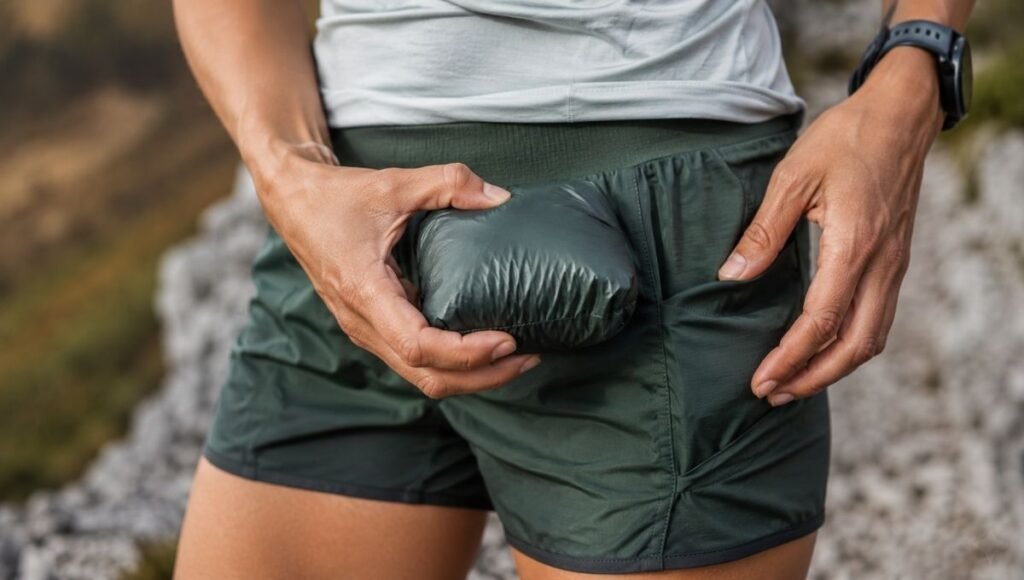
Any trail run over 60-90 minutes in terrain where weather or temperature can change warrants carrying a packable emergency layer. This doesn’t mean hiking with a full pack — modern ultralight windshells weigh 80-100g and compress to fist size.
The practical standard for trail running: carry a packable windshell (water-resistant at minimum, waterproof for mountain terrain) in your shorts pocket, vest pocket, or minimal running pack any time you’re more than 30 minutes from the trailhead.
The reasoning is simple: getting back to the car when you’re soaked and the temperature has dropped 15°F is genuinely unpleasant and potentially dangerous. The jacket weighs nothing while you’re running. You’ll be very glad it’s there if you need it.
Trail Running Outfit for Women: Specific Considerations
Sports bra for technical terrain: Trail running involves more varied movement than road running — scrambling, lateral movement on switchbacks, arms-up balancing. A sports bra that works for road running should work for trail, but test it on a run that includes the full range of motion before committing it to technical terrain. High-impact support matters more on trails than on roads for many runners.
Tights vs shorts on overgrown trails: This is a more significant decision for women runners on certain trail types because of the chafing implications of repeated branch contact on bare inner thighs. Many women trail runners default to tights on forested and brushy trails regardless of temperature.
Pockets for safety: On solo trail runs, carrying a phone is more important than on road runs — you’re in terrain where getting lost or injured is more likely and help is harder to summon. Make sure your trail running outfit includes pockets that securely hold your phone. A running vest (the light hydration-vest style, not an insulation layer) solves the storage problem entirely for longer trail runs.
Trail Running Clothing Mistakes That Cost You on the Trail
Wearing road running no-show socks on bushy trails. The exposed ankle gap becomes an entry point for every piece of debris on the trail. A run through dry grass in no-show socks results in socks full of seeds and plant material that creates friction and blisters. Wear crew or quarter-height socks on trails.
Not carrying an emergency layer. This is the most dangerous trail running clothing mistake. On road runs, being underdressed is uncomfortable. On trails, especially at altitude, it can be genuinely serious. The layer weighs nothing and costs nothing in terms of running performance. Carry it.
Using shorts with unsecured pockets. Losing a gel at mile 4 on a 10-mile trail run is more than inconvenient — it means completing the second half without the fuel you planned on. Any item you’re carrying that you actually need should be in a secured or zippered pocket.
Wearing cotton anything. The specific problem with cotton on trail is worse than on road — trails in wet conditions, stream crossings, morning dew on vegetation — all of these saturate cotton faster and keep it wet longer. The consequences are heavier clothing and faster heat loss when you stop or when wind picks up at elevation.
Tight-fitting compression tights on heavily vegetated trails. Compression tights can catch on branches and low vegetation in ways that looser fabric doesn’t — the snag resistance of compression fabric is lower. On technical, vegetated trails, looser-fit tights or longer shorts often move better.
When Trail Running Clothing Becomes a Safety Issue
Trail running clothing becomes a safety consideration in specific scenarios:
Altitude and weather exposure: Above the treeline, exposed to wind and potential afternoon storms, a soaked technical shirt without an outer layer creates real hypothermia risk. This is the single most important safety consideration in trail running clothing. Carry a waterproof layer for any mountain run.
Low visibility conditions: Dense forest at dawn or dusk dramatically reduces visibility compared to road running. High-visibility or reflective trail running clothing matters in these conditions both for other trail users and for your own visibility to rescue teams if needed.
Extreme heat on shadeless trails: Open alpine and desert trails in summer can expose you to sustained UV and heat with no shade. UPF-rated clothing, a sun hat, and sun sleeves are protective equipment in these conditions, not style choices.
If you experience signs of heat exhaustion (dizziness, nausea, stopping sweating in hot conditions) or hypothermia (uncontrollable shivering, confusion, difficulty moving) on the trail, stop running and prioritize getting to safety or summoning help. These are medical situations that clothing choices can prevent but not resolve once they’ve started.
FAQ: What Trail Runners Ask About Clothing
Can I wear road running clothes for trail running? Yes, with two main adjustments: longer inseam shorts for protection on overgrown trails, and more secure pockets for carrying essentials. Road running tops, base layers, and jackets transfer directly. The technical fabric properties are the same; the specific construction details differ.
What length shorts should I wear for trail running? 5-inch minimum for most trails; 7-inch or tights for overgrown or technical terrain. The longer inseam prevents the leg-scratching that shorter road running shorts allow on brushy trail sections.
Do I need trail-specific running clothes? Trail-specific gear adds durability, abrasion resistance, and purpose-built pocket systems. It’s an upgrade worth making if trail running becomes regular, but road running clothing works for starting out — with the shorts length and pocket security adjustments noted above.
What should I carry for a trail run in case conditions change? A packable windshell or waterproof jacket for any run over 60-90 minutes, especially in mountain terrain. Fits in a pocket, weighs almost nothing, and is the most important safety item in your trail running kit.
Are trail running gaiters worth it? Yes, on any trail with significant debris, sand, or wet vegetation. Lightweight trail gaiters weigh almost nothing, clip to your shoe, and prevent the mid-run annoyance of debris inside your shoe. Once most trail runners try them, they don’t go back.
The Bottom Line
A trail running outfit doesn’t have to be built from scratch. Most of what works on the road works on trail, with specific adjustments for shorts length, pocket security, and the addition of an emergency layer for anything beyond short groomed-trail efforts.
The terrain type matters as much as the temperature. On a groomed park trail in mild weather, your road running kit is fine. On an overgrown forest trail or an exposed mountain route, the specific clothing choices — longer bottoms, secured pockets, a packable jacket — stop being preferences and start being practical necessities.
Start with what you have, add the emergency layer first, and upgrade the shorts and socks as your trail running becomes more regular.
Building your full running kit for different scenarios? Check out our half marathon outfit guide for race day strategy — and our winter running outfit guide for when the trails get cold.
References:
- Public Lands. (2023). What to Wear Trail Running. PublicLands.com.
- American College of Sports Medicine. (2023). Exercise in Variable Environmental Conditions. ACSM’s Health & Fitness Journal.
- Laing, R.M., et al. (2020). Textile and clothing comfort in sport: A review of current knowledge. Sports Medicine.
- National Weather Service. (2024). Hypothermia Risk and Prevention Guidelines. NOAA.