

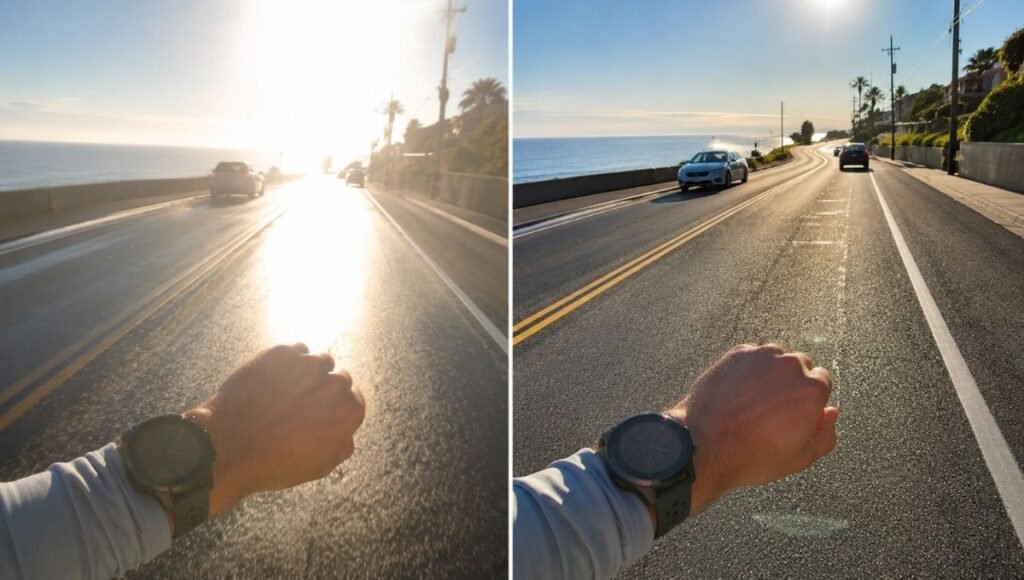
There’s a specific kind of misery reserved for running directly into morning sun with no eye protection. Your eyes are working overtime squinting against the glare, your face is tense, your form subtly tightens — and you spend the first two miles of your run thinking more about the light than about your breathing or your pace. Forty minutes in, you have the beginning of a headache that isn’t from exertion.
Running sunglasses fix this. And unlike some gear categories where the premium option is marginally better than the mid-range choice, a good pair of running sunglasses makes a perceptible difference from the first run you wear them — reduced eye strain, better contrast on uneven surfaces, the ability to actually relax your face and look where you’re going rather than squinting into the sky.
The hard part isn’t deciding whether to buy running sunglasses. It’s navigating the terminology — polarized vs non-polarized, photochromic lenses, lens tint colors, UVA vs UVB, wraparound vs standard frames — and figuring out which features actually matter for the specific way you run. This guide cuts through that and gives you honest picks across every budget.
Key Takeaways
- UV400 protection (100% UVA and UVB blocking) is the non-negotiable baseline — lens darkness has no relationship to UV protection; a pale-tinted lens can block 100% UV while a dark lens may block very little; always verify the UV rating before buying
- Polarized lenses reduce glare from reflective surfaces — they’re excellent for road running in bright sun and trail running near water; they can reduce depth perception on technical shaded trails where contrast cues matter
- Fit stability matters more than brand or price — a $200 pair that bounces is worse than a $25 pair that stays put; look for rubber or silicone nose pads and temple grips, not smooth plastic
- Goodr is the most recommended running sunglasses brand in running communities for the sub-$35 category — polarized, non-slip coating, lightweight, no bounce, $25
- Photochromic lenses automatically adjust tint based on light — worth considering for runners who do pre-dawn starts that transition to full daylight, or trail runs with variable shade and sun
Do Running Sunglasses Actually Make a Difference?
The honest answer: yes, in ways that go beyond comfort.
Research published in Frontiers in Sport found that athletes wearing polarized lenses reported significantly less eye strain and better visual comfort during outdoor activity, with researchers noting this could indirectly support performance by reducing a source of fatigue that isn’t obviously exercise-related. The American Academy of Ophthalmology separately notes that cumulative UV exposure to the eyes is a documented risk factor for cataracts and macular degeneration — conditions that develop over years, making the protection investment feel optional until it’s not.
The performance case is more immediate on uneven surfaces. Polarized lenses enhance contrast and depth perception in ways that help trail runners spot root patterns, potholes, and terrain changes that flat, unfiltered vision misses. On technical trail, a good pair of running sunglasses is partly a safety item.
For road runners, the practical benefit is simpler: you stop squinting, your face relaxes, your head stops aching from sustained glare exposure, and you spend your mental energy on the run instead of on the light.
The Polarized vs Non-Polarized Question (Answered Honestly)
This is the question most runners ask and most guides answer wrong — by defaulting to “polarized is better” without addressing when it isn’t.
What Polarized Lenses Actually Do
Polarized lenses contain a chemical filter that blocks horizontally polarized light — the specific wavelength of glare that reflects off flat surfaces like roads, water, snow, and car hoods. This is the light that creates that blinding, painful glare on a sunny day. By blocking it selectively, polarized lenses dramatically reduce eye strain in bright reflective conditions.
Polarized works best for:
- Road running in direct sunlight
- Trail running near water, snow, or any highly reflective surface
- Open, exposed conditions without significant shade variation
When Non-Polarized Works Better
On heavily shaded technical trails where you move constantly between sun and shadow, polarized lenses can slightly reduce the contrast cues that help you read terrain — the subtle shadows that indicate a drop, a root, or a change in surface. Some experienced trail runners specifically choose non-polarized for technical courses for this reason.
Also worth knowing: polarized lenses can interfere with LCD screens. If you run with a GPS watch that you frequently check, or use your phone for navigation, polarized can create rainbow patterns or washed-out displays at certain angles. Non-polarized avoids this entirely.
Non-polarized works best for:
- Technical shaded trail running where depth cues are critical
- Runners who frequently reference GPS or phone screens mid-run
- Overcast or low-light conditions where reducing brightness isn’t the priority
The practical answer for most runners: Polarized is the right default for road running and most trail running. Non-polarized is worth considering specifically for technical mountain terrain with heavy tree cover. When in doubt, polarized.
The Lens Tint Guide Nobody Explains
Lens color affects what you see, not just how much you see. This is the feature most buyers ignore and most guides skip — but it has real practical implications.
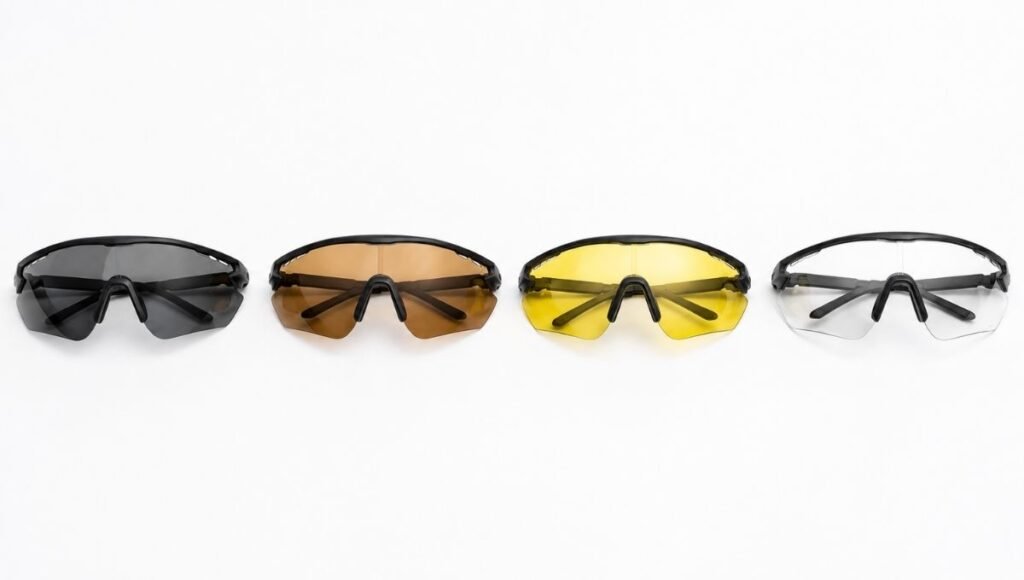
Gray/Smoke tint: The most neutral option — reduces brightness without significantly changing color perception. What you see looks like the world does, just darker. Best for: road running in bright sun, general purpose, situations where color accuracy matters. The default choice for most runners.
Brown/Amber tint: Enhances contrast and depth perception by filtering blue light. Objects appear slightly warmer-toned but terrain features are more defined. Best for: trail running where you want to pick out roots and rocks more clearly, variable light conditions. Many trail runners consider this the optimal general tint.
Yellow/Orange tint: High contrast in low-light conditions, filters blue light aggressively. Best for: dawn runs, overcast conditions, shaded forest trails. Not comfortable in bright direct sunlight.
Clear/Light tint: Maximum light transmission, minimal tinting. Best for: night running where you need eye protection without reducing visibility, pre-dawn starts, heavily overcast conditions. Often included as an alternate lens in multi-lens running sunglasses.
Photochromic (automatically adjusting): Transitions from clear to tinted based on UV exposure. Darkens in bright sun, lightens in shade. Best for: runners who transition from darkness to daylight (early morning starts), trail runs with variable shade, anyone who doesn’t want to think about which lens to use. The trade-off: photochromic lenses react to UV, not brightness — they may not fully darken on overcast but bright days, and they can take 30–60 seconds to adjust after sudden light changes.
What Makes a Running Sunglasses Fit Work
This is the variable that separates a useful pair of running sunglasses from an expensive annoyance. A pair that bounces on your nose bridge, slides down your face when you sweat, or creates pressure points on your temples becomes a distraction by mile 3.
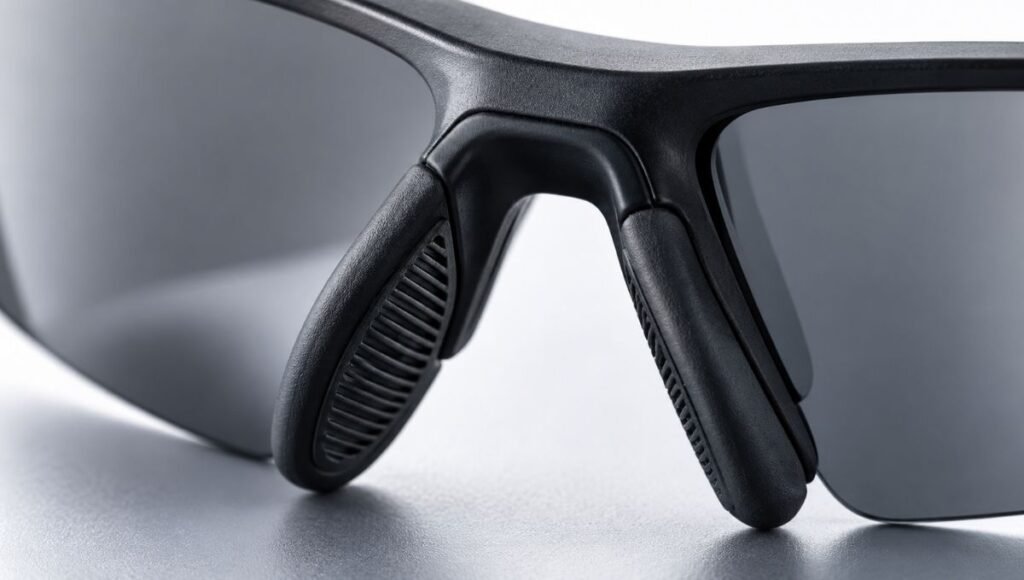
Nose pad design: Rubber or silicone nose pads grip even when your face is sweating. Hard plastic nose pads slide. This single design choice determines whether sunglasses stay put or require constant readjustment. Check specifically for rubber or “grippy” nose pads before buying.
Temple grip: The arms of running sunglasses should have rubber or silicone wrapping where they contact your ears and temples. Smooth plastic slides; textured rubber grips. Some running sunglasses have adjustable temple arms that curve behind the ear — more secure for running than straight arms.
Wraparound coverage: Wraparound frames that follow the curve of your face block peripheral glare and wind, and also sit more securely than flat-front frames that have less frame contact with your face. For trail running and faster pace running, wraparound is the better choice.
Weight: Running sunglasses should be under 30 grams — ideally under 25 grams. Heavier frames create more downward pressure on the nose bridge, accelerating the sliding problem. Most quality running-specific frames hit this target.
Face shape considerations: Runners with narrower faces often find standard-size running sunglasses too wide, creating side gaps that let in peripheral light and wind. Look for brands that specify frame width or offer size options. Goodr’s OG style works well for narrower faces; their larger BFG style accommodates wider faces.
The Best Running Sunglasses in 2026
Best Overall: Oakley Sutro Lite
The Sutro Lite is the running sunglasses most professional runners and serious amateurs converge on — not because of brand loyalty but because the combination of features is genuinely hard to beat. The shield-style single lens eliminates the gap at the bridge of the nose, the Unobtainium nose pad and temple material grips better as it gets wetter, and the Prizm lens technology enhances color and contrast beyond standard polarization.
At around 26 grams, the Sutro Lite barely registers on your face. The coverage is substantial enough to block wind and peripheral sun without feeling restrictive. The trade-off is the price — these are an investment. The return is sunglasses that stay where you put them, enhance rather than just filter your vision, and work from easy long runs to race day without adjustment.
Best for: Road running, road racing, trail running in open terrain, runners who want one pair that handles all conditions reliably.
Editor’s note: The Prizm Road and Prizm Trail lens variations are different products optimized for different surfaces — buy the correct version for your primary running environment.
Best Budget: Goodr OG Running Sunglasses
Goodr is the brand that running communities consistently recommend for the sub-$35 category, and for straightforward reasons: $25, polarized, grippy coating that prevents sliding on a sweaty face, lightweight at 32 grams, available in enough colors that you’ll find something you want to wear. They don’t bounce. They don’t slip. They protect your eyes.
The lens quality isn’t at Oakley or Rudy Project level — they’re fine for casual training, not optimal for technical trail navigation or race day. But for runners who spend most of their time on roads or groomed trails in training, Goodr delivers everything the category needs to do at a price that makes replacing them guilt-free.
Best for: Entry-level running sunglasses, budget-conscious runners, beginners, backup pair, casual training runs, runners who lose or break glasses regularly.
Best for Trail Running: Smith Shift Split Mag
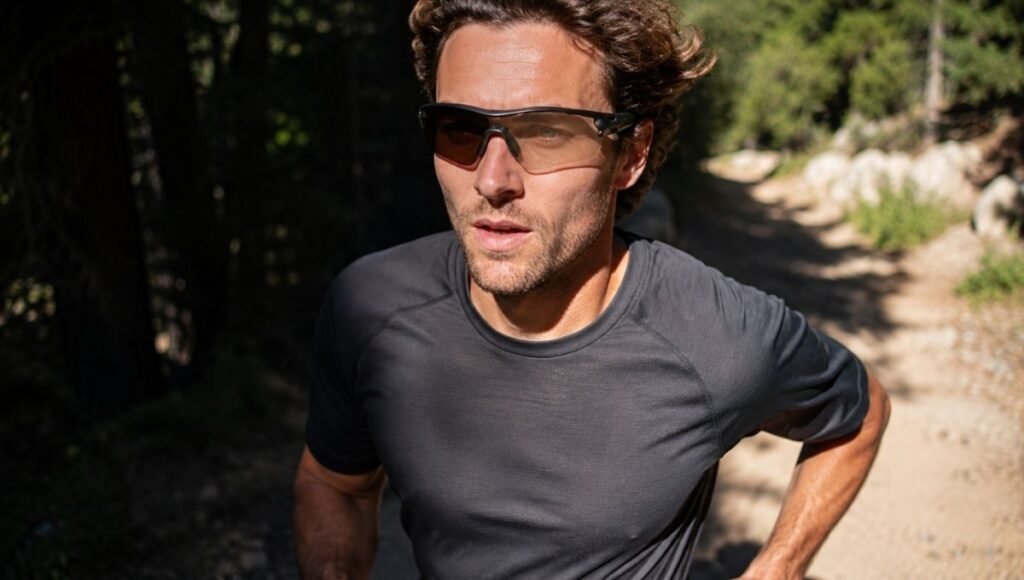
The Shift Split Mag uses a photochromic lens that adjusts from 17% to 80% light transmission — covering the full range from pre-dawn to full-altitude sun exposure. For trail runners who start in darkness and finish in full sun, or run under heavy tree canopy that alternates with exposed ridgelines, this range matters. You stop making lens decisions and just run.
The Mag magnets that attach and release the lens make swapping lenses genuinely fast if you prefer fixed lenses in specific conditions. The frame is lightweight, the nose pad is grippy, and the coverage wraps far enough to block the wind that becomes significant at trail running speeds and altitude.
Best for: Trail runners with variable light conditions, pre-dawn starts, mountain running, anyone who has struggled with lens-swapping inconvenience.
Best for Women: Tifosi Swank
Most running sunglasses guides treat women’s sunglasses as an afterthought — a standard frame in pink. The Tifosi Swank earns its recommendation as a genuinely women’s-specific design: slightly narrower frame, smaller lens dimensions, and a fit that works for faces that standard “one size” running frames don’t accommodate. Polarized lens, rubber nose pads, and wraparound-adjacent coverage at a mid-range price.
For women runners who’ve found standard running sunglasses too wide across the temples or too loose at the nose bridge, trying a women’s-specific fit is worth the experiment before going premium.
Best for: Women runners, narrower face shapes, runners who find standard running sunglasses too large, mid-range budget.
Best Photochromic: Rudy Project Propulse

The Propulse pairs photochromic lenses with vented frame construction that prevents the fogging problem that plagues most photochromic sports eyewear — as your face heats up and sweat accumulates, non-vented frames create a warm microclimate that fogs the lens. The strategic vents in the Propulse frame allow airflow that keeps the lens clear.
The photochromic range adjusts based on UV exposure (not brightness), transitioning across light conditions with a short lag. The fit is precise and secure, the weight is appropriate for running, and interchangeable lens options mean you can use a fixed tint when conditions are predictable and switch to photochromic when they’re not.
Best for: Variable-light trail running, half and full marathon racing in uncertain weather, runners who want maximum versatility in one pair.
Best for Prescription Runners: Oakley Flak 2.0 XL
For runners who wear prescription lenses, finding running sunglasses involves an extra step — not every frame accommodates prescription inserts or custom lenses. The Oakley Flak 2.0 XL is widely prescription-compatible, available from numerous optical retailers who can fit custom lenses to the frame, and the frame itself performs well for running: lightweight, secure fit, wraparound coverage.
The prescription process adds cost and lead time, but running with correctly corrected vision is meaningfully better than running with slight prescription blur or the compromised peripheral vision of contact lenses.
Best for: Prescription-dependent runners, runners who prefer not to wear contacts during exercise, anyone for whom standard over-the-counter sunglasses don’t provide adequate vision correction.
Running Sunglasses Mistakes That Make Every Sunny Run Worse
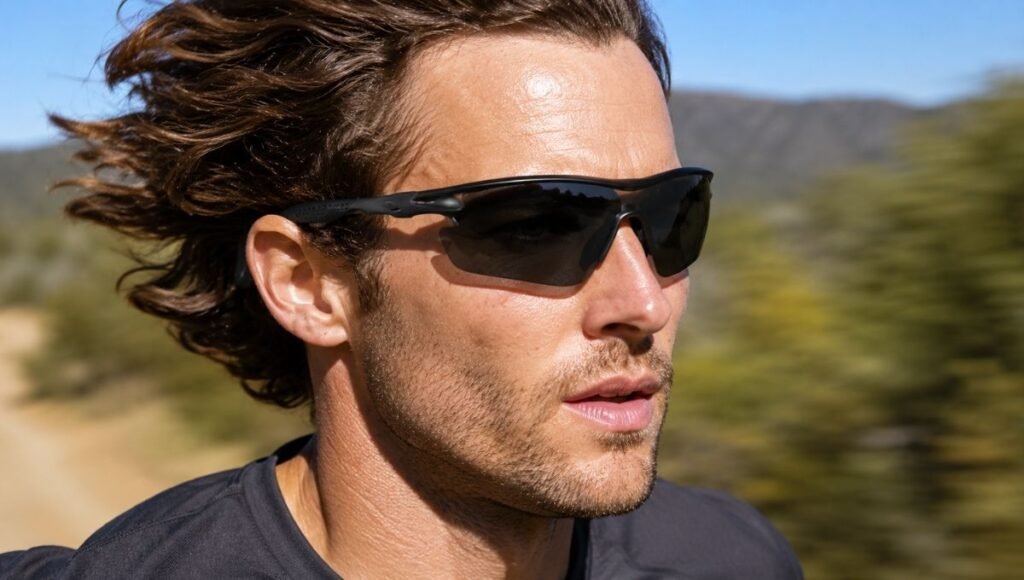
Trusting lens darkness for UV protection. A deeply tinted lens that blocks no UV is worse than clear lenses with UV400 protection — your pupils dilate behind the dark lens, allowing more UV to reach the retina while giving you false confidence you’re protected. Always verify UV400 or 100% UVA/UVB protection specifically, not just tint level.
Buying standard sunglasses and expecting them to work for running. Fashion sunglasses aren’t made for the nose pad grip, coverage, or weight requirements of sustained physical activity. They slide, bounce, and leave gaps at the temples that defeat their purpose. Running-specific construction addresses these problems; general sunglasses don’t.
Ignoring the nose pad material. Smooth plastic nose pads are the single most reliable predictor of sliding. Check specifically for rubber or silicone nose pads before any running sunglasses purchase.
Not testing at pace before race day. Sunglasses that feel stable during a 15-minute test run may slide during the second hour of a half marathon as sweat accumulates and the nose pad becomes saturated. Test your race day sunglasses on multiple long runs first.
Assuming polarized is always better. For technical shaded trail running, non-polarized can provide better depth perception and terrain contrast. Match the lens type to your actual running environment.
FAQ: What Runners Ask About Running Sunglasses
Are polarized running sunglasses worth it? For most road runners and trail runners in open terrain: yes. Polarized lenses significantly reduce eye strain from reflective glare and enhance contrast on uneven surfaces. The exception is technical shaded trail running where depth cues matter more than glare reduction — some runners prefer non-polarized for this specific use case.
What UV protection do I need in running sunglasses? UV400, which means the lenses block 100% of UVA and UVB radiation up to 400 nanometers. This is the universal standard — any quality running sunglasses should meet it. Lens darkness, tint color, and polarization are separate from UV protection and don’t indicate its level.
Why do my running sunglasses keep sliding down? Almost always a nose pad issue. Smooth plastic nose pads slide on sweaty skin; rubber or silicone nose pads grip. If your frames have plastic nose pads, no amount of tightening will reliably fix the sliding problem. Look for glasses with rubber nose pads, or use anti-slip nose pad covers as a temporary fix.
What are the best running sunglasses for small faces? Women’s-specific designs like the Tifosi Swank or Goodr’s OG style work well for narrower faces. Look for frame width measurements — most running sunglasses list lens width and bridge width; smaller numbers indicate a more compact fit. Goodr specifically offers multiple size profiles for different face dimensions.
Do I need different sunglasses for trail running vs road running? Not necessarily, but there are differences worth knowing. Trail running benefits from higher coverage (wraparound, ventilation, wind protection), brown/amber tint for enhanced terrain contrast, and potentially photochromic lenses for variable light under tree cover. Road running is well-served by any quality running sunglasses with good glare management. Many runners use one pair across both; serious trail runners often have terrain-specific choices.
The Bottom Line
The best running sunglasses are the ones you stop thinking about by mile 2 — staying where you put them, enhancing contrast on the surface you’re running on, and keeping UV radiation out of your eyes for the cumulative hours you spend running outdoors.
For most runners, the starting point is simple: Goodr OG for the budget category, Oakley Sutro Lite for a serious investment that handles everything. Make sure the nose pads are rubber, verify UV400 protection, and choose polarized unless your primary terrain is technical shaded trail.
The rest — photochromic lenses, specific tint colors, premium frame materials — is optimization. Get the basics right first, then refine from there.
For the rest of your running kit, check out our best running hat guide — sunglasses and a cap together cover your full sun protection setup for long outdoor runs — and our best running clothes for women guide for the complete kit picture.
References:
- Mercatelli, L., et al. (2023). The effect of polarized lenses on visual performance and eye strain in outdoor athletes. Frontiers in Sport and Active Living.
- American Academy of Ophthalmology. (2024). UV Protection and Eye Health for Outdoor Athletes. AAO Patient Education.
- iRunFar. (2026). Best Running Sunglasses: Tested across terrain and conditions. iRunFar.com.
- Revant Optics. (2026). Polarized vs Non-Polarized Sunglasses: The complete guide. RevantOptics.com.