
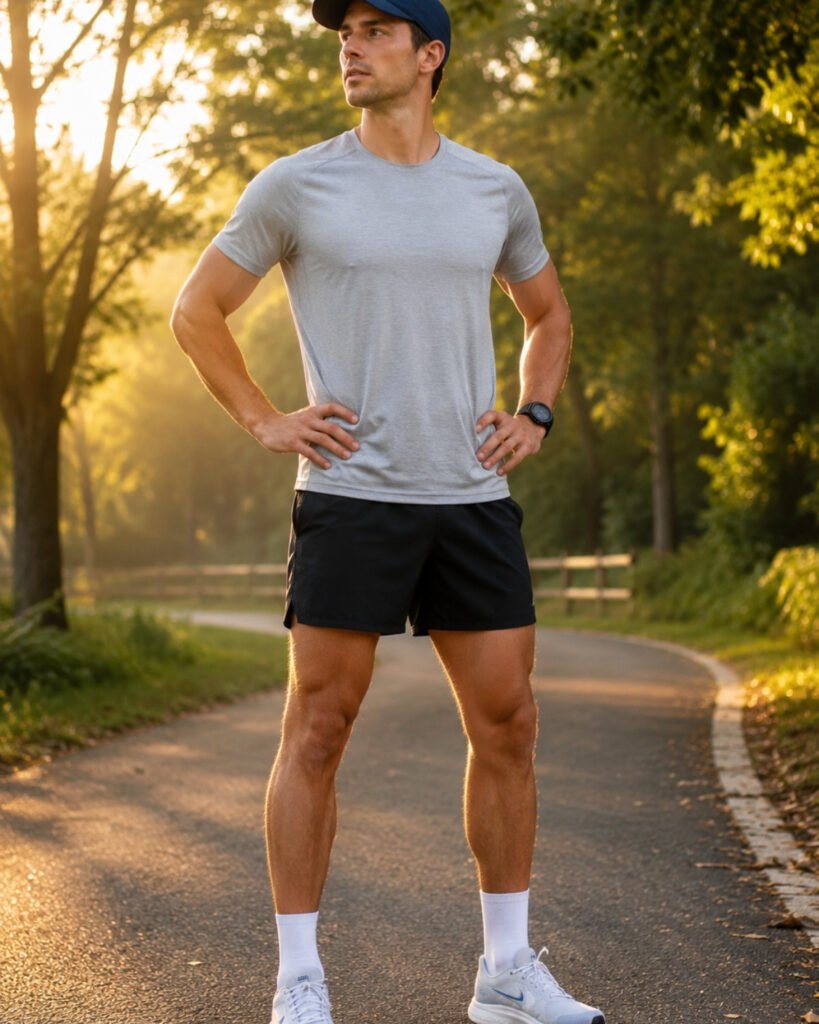
A great pair of running shoes won’t stop your thighs from chafing, your shirt from soaking through, or your phone from bouncing with every stride.
That’s why so many runners spend hundreds of dollars on shoes but still finish their runs feeling uncomfortable.
The truth is, shoes get you moving—but your clothing and accessories determine how comfortable every mile feels. The right running gear keeps sweat under control, reduces friction, carries your essentials without distraction, and helps you focus on running instead of constantly adjusting your kit.
The problems usually don’t show up in the first mile. They appear when your shirt starts holding sweat instead of releasing it, your shorts begin rubbing your inner thighs, or your phone refuses to stay still. By then, you’re no longer thinking about your pace—you’re thinking about how soon the run will be over.
I’ve learned most of this the slow way — one uncomfortable run at a time, one piece of gear replaced at a time. This guide is the shortcut. It covers what to buy first, what to skip until later, and what small accessories make a bigger difference than anything fancy.
First time I ran in a cotton t-shirt — genuinely believed that was fine. Five kilometers in, the shirt had absorbed what felt like a gallon of sweat. The collar was pulling at my neck. Both shoulders were starting to rub. I finished the run, took the shirt off, and it was visibly heavier than when I started. Never again.
Quick Start Checklist
| If you’re… | Start with… |
|---|---|
| New to running | Technical shirt + running shorts + running socks |
| Running 5K–10K | Add a running belt if you carry a phone |
| Half marathon | Upgrade to compression-liner shorts and anti-chafe balm |
| Marathon training | Build a full gear rotation and weather-specific layers |
A Simple Running Gear System: What Actually Matters First
Before you buy anything, the most useful reframe is this: running gear isn’t about performance optimization. It’s about removing problems that pull your attention away from actually running.
The goal is gear you forget you’re wearing. The moment you’re adjusting your shorts, pulling your shirt collar away from your neck, or holding your phone against your leg to stop it bouncing — you’re not running, you’re managing equipment.
Why Comfort Beats Expensive Gear
A $200 running jacket doesn’t make you faster. Shorts that don’t chafe your inner thighs make every run better. These are different problems.
Most running performance problems — slowing down, stopping early, not wanting to go out again tomorrow — come from physical discomfort that accumulates over the course of a run. Comfort gear eliminates those friction points. Expensive gear does other things.
Buy comfort first. Upgrade performance second.
The Three Essentials Every Beginner Needs
If you’re starting from zero, three things cover 90% of what you need for runs up to an hour:
Technical shorts — not basketball shorts, not gym shorts. Running-specific shorts with a built-in liner, moisture-wicking fabric, and an inseam length that works for your body.
Technical socks — moisture-wicking, seamless toe, the right cushion for your distance. The single most underestimated piece of running gear.
Technical shirt — any moisture-wicking synthetic or merino. The only rule: not cotton.
That’s it. Everything else — belts, hats, compression gear, reflective vests — can wait until you know what your runs actually require.
What Can Wait Until Later
Running belt: wait until you’ve established a consistent running habit and know whether you need to carry things.
Compression tights: wait until you’re running long enough that leg fatigue and chafing become real issues.
Running jacket: wait until you’ve run in cold weather enough to know what conditions you’re actually facing.
Reflective gear: add it when you start running before sunrise or after sunset.
Build the foundation first. The rest follows from actual experience.
Fabrics That Keep You Comfortable Instead of Soaked
This is where most guys lose the first few runs. The wrong fabric doesn’t announce itself immediately — it waits until mile 3 or 4 and then gets progressively worse.
Why Cotton Fails During Runs
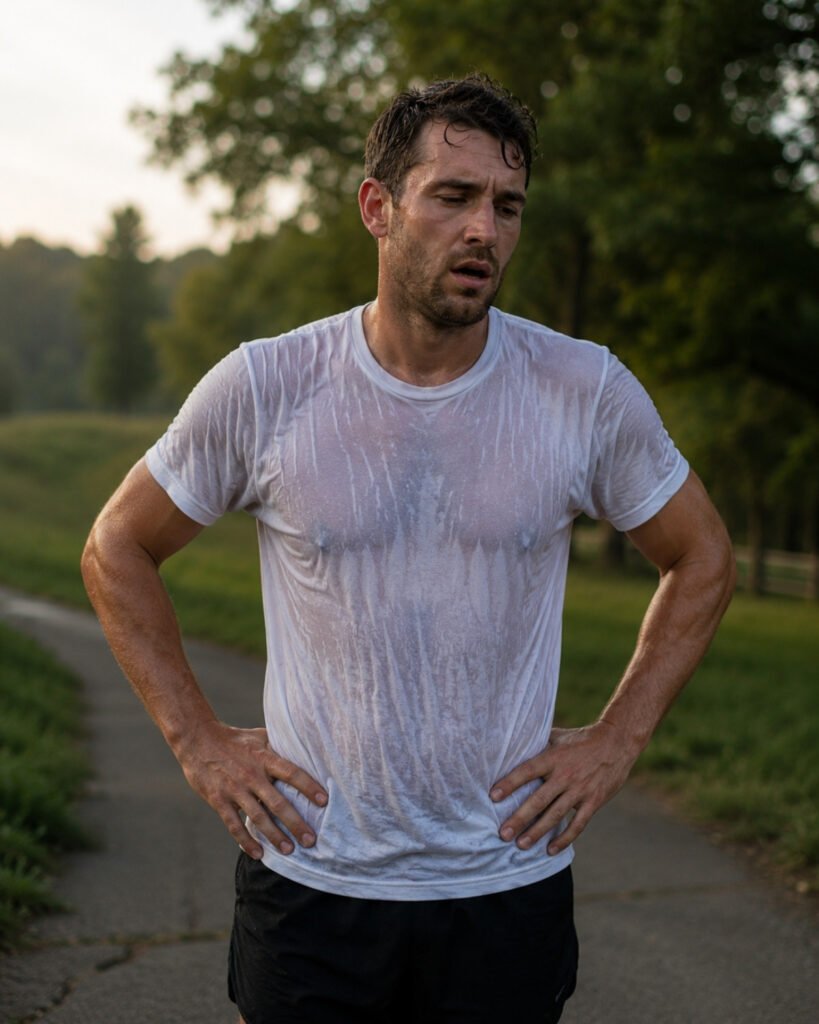
Cotton is hydrophilic — its molecular structure attracts and bonds with water. When you sweat in a cotton shirt, the fibers absorb that moisture and hold it. They don’t release it. They don’t move it to the surface to evaporate. They just hold it, and the shirt gets heavier.
At low sweat rates — a slow 20-minute walk — cotton’s absorbency is actually fine. At running sweat rates, which can reach 1-2 liters per hour during sustained effort, a cotton shirt saturates. Wet cotton against moving skin creates friction. Friction at your collar, your underarms, and your shoulders turns into abrasion. By mile 5, what started as mild irritation is a genuine skin problem.
The other issue: wet cotton cools aggressively when exposed to air or wind. If you slow down, stop at a traffic light, or have any breeze, a saturated cotton shirt conducts heat away from your body faster than bare skin would. You get cold at exactly the wrong moment.
Polyester vs Nylon vs Merino Wool
Polyester is the standard for running gear for a reason. It’s hydrophobic — repels water at the molecular level — so rather than absorbing sweat, it moves moisture along the fiber surface to the outside of the fabric where it can evaporate. It dries quickly, holds its shape through repeated washing, and handles high sweat output effectively. The downside: polyester develops persistent odor from bacteria embedded in the fibers. One wash with fabric softener can permanently reduce its wicking ability.
Nylon has similar moisture-wicking properties to polyester but is softer against skin and more abrasion-resistant. You’ll find it more commonly in shorts and tights than in shirts, specifically because it handles repeated leg-contact friction better.
Merino wool works differently — it absorbs moisture vapor into the fiber structure and releases it through evaporation, a process that generates a small amount of warmth as it happens. The result is temperature regulation that synthetics can’t match in variable conditions. It’s also naturally antimicrobial, which means you can wear a merino shirt two days in a row without it becoming unwearable. The trade-off: it dries more slowly than synthetics and costs more.
The practical guide: Polyester or nylon for warm-weather and high-intensity running where fast drying matters. Merino for cool-weather running, variable conditions, or any situation where odor management matters.
How Moisture-Wicking Fabrics Reduce Friction
The mechanism: moisture on skin softens the outer skin layer. Softened skin is more vulnerable to friction damage than dry skin. Moisture-wicking fabric keeps skin drier by moving sweat away before it can saturate — not just for comfort, but for the specific reason that drier skin chafes less. This is why fabric choice and anti-chafe balm work together: the fabric reduces moisture, the balm reduces friction coefficient, and the combination is more effective than either alone.
When Lightweight Isn’t Always Better
Ultralight fabrics — 80-100 GSM polyester — are appropriate for warm weather and racing where every gram matters. For daily training in variable conditions, a slightly heavier fabric (120-150 GSM) is more durable, less likely to snag, and provides slightly more coverage against wind. Don’t default to the lightest option available. Match fabric weight to your actual conditions.
Running Shorts: Preventing Chafing Starts Here
I switched to compression liner shorts after my third half marathon in standard brief-liner shorts. The difference in inner thigh chafing was immediate and significant. I’d been applying anti-chafe balm before every long run and still finishing with raw skin by mile 10. With a compression liner, the same route in the same weather with no balm — nothing. The liner covers the contact zone entirely.
The specific run that convinced me: 11 miles in 72°F weather with high humidity. Previous shorts, I’d have been uncomfortable by mile 7. New shorts, I genuinely forgot about my legs.
Brief Liner vs Compression Liner
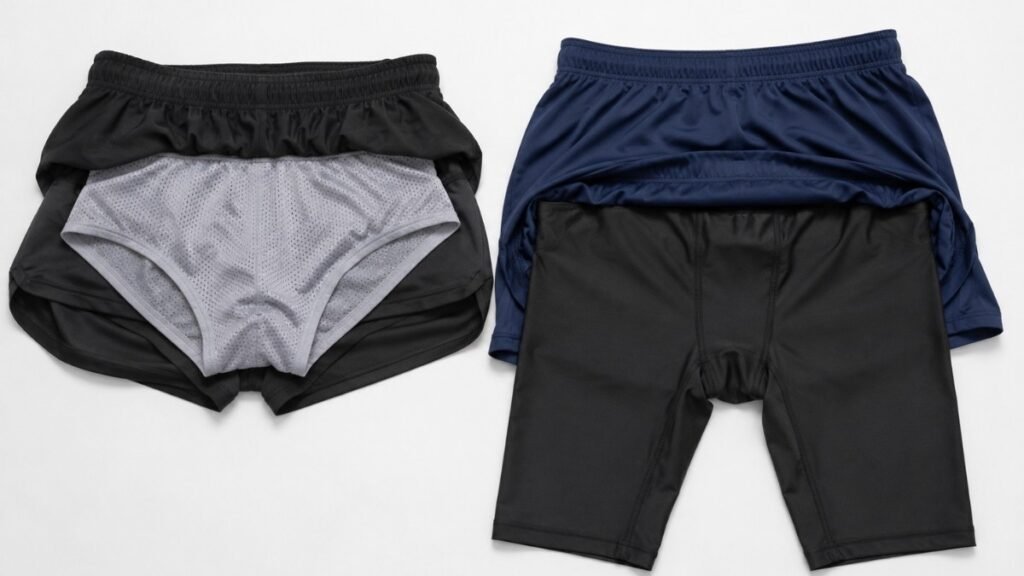
This is the single most impactful shorts decision for male runners, and it gets almost no attention.
Brief liner: A built-in underwear-style brief inside the outer shell. Provides support and eliminates the need for separate underwear. The brief typically ends at the upper thigh — above the zone where most inner thigh chafing occurs. For runners whose thighs don’t contact significantly during stride, this is fine. For runners with muscular or larger thighs where skin-to-skin contact happens throughout the stride cycle, the brief liner ends exactly where the problem starts.
Compression liner: Extends down the thigh like a shorter pair of compression shorts integrated inside the outer shell. Provides continuous coverage through the contact zone, physically separating the thighs with smooth fabric rather than leaving bare skin against bare skin. More effective for chafing prevention. Slightly warmer. The right choice for long distances and runners prone to inner thigh friction.
The biomechanics: Running stride involves hip extension, knee flexion, and leg abduction — a range of motion that brings the inner thighs into contact thousands of times per run. At short distances and low sweat rates, this is manageable. At long distances or high humidity, the repeated contact between sweaty skin surfaces becomes a friction problem. The compression liner interrupts this mechanism at the source.
Finding the Right Inseam Length
3-inch: Maximum airflow and freedom. Works well for lean builds and speed work. Creates more inner thigh exposure — will cause chafing for runners with significant thigh contact during stride.
5-inch: The practical default for most male runners. Covers enough of the thigh to reduce contact without restricting stride. Works across most body types and most running distances.
7-inch: More coverage, more warmth. Appropriate for cooler weather, muscular builds, or any runner who has found 5-inch shorts insufficient for chafing prevention.
The right inseam is the one that doesn’t require management during the run. If you’re adjusting your shorts in the first mile, the inseam is wrong for your body.
Pocket Placement and Bounce Control
Phone bounce is a physics problem. Weight concentrated at a single point away from your body’s center of mass oscillates during running stride. The solution: weight close to your core, distributed rather than concentrated.
Rear waistband zippered pockets bounce least — they’re closest to your body’s vertical center of mass. Side hip pockets bounce most — they’re at the hip rotation point and farthest from center. When evaluating shorts with pockets, the placement matters more than the size.
The practical test: put your phone in the pocket and jog in place for 30 seconds. If the phone moves noticeably, the pocket doesn’t work for running regardless of how well it fits standing still.
→ Full guide: Best Running Shorts for Men | Running Shorts with Pockets
When 2-in-1 Shorts Are Worth Buying
2-in-1 shorts pair a loose outer shell with an integrated compression liner — the best of both in a single garment. They’re worth buying specifically when:
You run long distances where the compression liner’s chafing prevention matters throughout. You prefer the look of regular shorts but want inner thigh protection. You run in variable temperatures where the outer shell can be removed mid-run if needed.
The trade-off: slightly heavier and warmer than either garment alone. For runs under 60 minutes in warm weather, the added weight isn’t worth it. For 90-minute-plus efforts in any temperature, the protection is.
Running Tops That Stay Dry and Reduce Friction
The nipple chafing conversation that no running guide handles honestly: it’s common, it’s painful, and it has a straightforward solution. I found out the hard way on a wet 15-miler. The shirt was moisture-wicking but had standard sewn seams across the chest. Six hours later, the areas the seams had contacted repeatedly were genuinely raw. Switched to flatlock seam construction for every long run since. Problem gone.
Why Shirts Cause Nipple Chafing
Two mechanisms, both fixable.
Seam placement: Standard sewn seams create raised ridges on the interior of shirts. Across the chest, where the front and back panels meet, a raised seam contacts the nipple area with every arm drive repetition. At 10,000 strides per hour, a race lasting 2-3 hours involves 20,000-30,000 contacts between seam and skin. Combined with sweat, this is a friction abrasion problem.
Wet fabric: Moisture-saturated fabric changes its friction coefficient. Dry technical fabric has low friction against skin. The same fabric wet from sweat has higher friction — it grabs rather than slides. This is why chafing problems that don’t appear on short dry runs appear on long wet ones.
The solution to both: flatlock seam construction and fabric that moves moisture away fast enough to stay drier longer.
Flatlock Seams vs Regular Seams
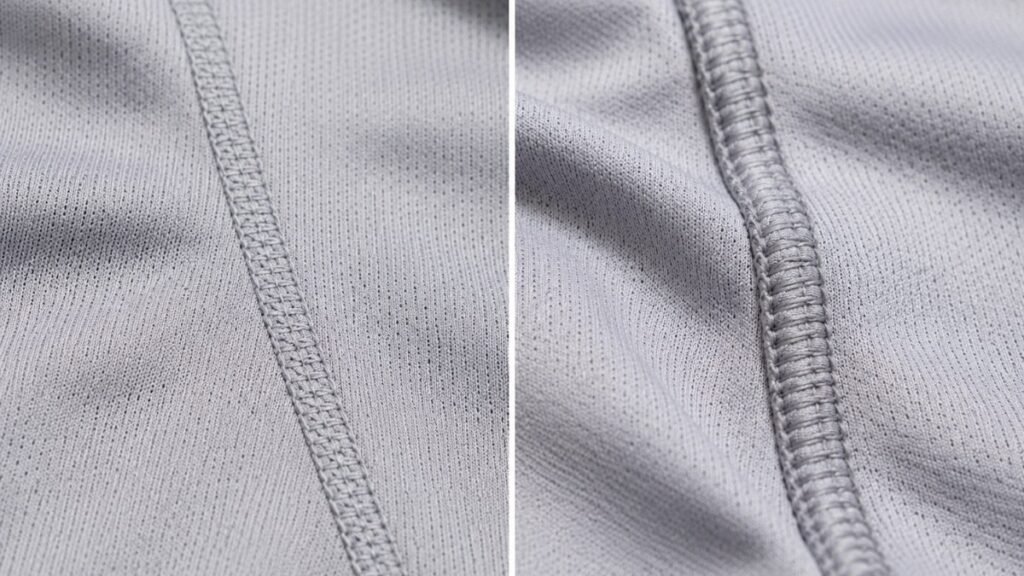
A regular seam joins fabric panels by overlapping them and stitching through the overlap. The result is a raised ridge on the interior of the garment.
A flatlock seam joins fabric panels edge-to-edge, stitching through both simultaneously. The result is a seam that lies flush against the skin — no raised ridge, no mechanical contact point.
Run your thumb along the interior seam of any running shirt before buying. If it has a raised ridge, it will become a friction point over distance. If it’s flush against the fabric, it won’t.
Compression vs Relaxed Fit
Compression tops reduce aerodynamic drag, provide mild muscle support, and hold their position during stride without shifting. They work well for faster running and racing.
Relaxed fit tops allow more airflow, feel less constricting during breathing at sustained effort, and work better for easy runs and long slow distance where compression benefit is minimal and the ability to breathe deeply matters more.
Neither is universally better. Match to effort level: relaxed for easy and long, compression or fitted for tempo and racing.
Layering for Different Temperatures
Above 55°F: Single layer — lightweight short sleeve or singlet. Adding layers above this temperature creates heat accumulation that impairs performance.
45-55°F: Single long sleeve or short sleeve plus arm warmers. Arm warmers are removable without stopping — the correct layering solution for variable conditions.
35-45°F: Long sleeve base layer plus light windshell. The windshell blocks wind chill while remaining breathable enough for running effort.
Below 35°F: Thermal long sleeve plus mid layer (vest or light insulating layer) plus windshell. Three layers for the torso, but each one should be removable as you warm up.
Socks and Small Accessories That Make the Biggest Difference
I used to think of socks, belts, and hats as afterthoughts. Then I got a blister at mile 8 of a 13-mile training run from a sock I’d washed with fabric softener. The softener had degraded the moisture-wicking fibers, the sock got wet and stayed wet, and the wet fabric created friction at the heel that I couldn’t stop once it started. Three miles of limping. Small gear, big consequences.
Technical Socks vs Everyday Socks
The difference is not subtle. Everyday athletic socks — even ones marketed as “performance” — typically use cotton blends that absorb moisture. Running-specific socks use merino wool or synthetic fibers that wick moisture to the outer surface, have seamless toe construction that eliminates the friction ridge that causes blisters, and include strategic cushioning at the heel and ball of the foot where running impact concentrates.
The seamless toe is the most important individual feature. A raised seam at the toe contacts the same spot on your skin thousands of times per mile. You don’t notice it at mile 2. You notice it at mile 8.
Rotate at least 3-4 pairs. Socks need full drying time between runs to restore their properties.
→ Full guide: Best Running Socks for Women | Best Compression Socks for Running
Running Belts vs Shorts Pockets
My phone spent three months bouncing in the side pocket of running shorts before I admitted the problem wasn’t the shorts — it was the pocket location. Side hip pockets place the weight at your hip rotation point. Every stride moves that weight forward and back. Switching to a rear waistband belt placed the weight at my lower back — close to center of mass — and the bounce disappeared.
If your shorts have a secure rear waistband pocket that fits your phone flat, use it. If not, a running belt with rear placement solves the problem. A side-pouch fanny pack works for trail running and long efforts where you’re carrying more; for road running with just a phone and key, a slim belt is cleaner.
→ Full guide: Best Running Belt
Caps and Sunglasses
A running cap does two things: diverts sweat from your forehead into the sweatband rather than into your eyes, and shades your face during direct sun exposure. The sweatband is the functional element — rubber or silicone grip prevents the cap from sliding during running movement. A running cap without a grippy sweatband is a cap that needs constant readjustment.
Running sunglasses protect against cumulative UV damage during sustained outdoor running. UV400 rating (100% UVA and UVB blocking) is the standard to look for — lens darkness doesn’t indicate UV protection level. Non-slip nose pads are the other critical feature: sunglasses that slide down your face during running become useless and annoying faster than almost any other gear failure.
→ Full guides: Best Running Hat | Best Running Sunglasses
Reflective Gear for Early Morning and Night Runs
Reflective material returns light directly toward its source — headlights hit it, and the light bounces back toward the driver. It only works when a light source is aimed at you. On roads with vehicle traffic, this is effective. On unlit trails without traffic, you need active lighting instead.
The specific placement detail that most guides skip: reflective elements at your wrists and ankles are more effective for driver recognition than reflective patches on your torso. Human vision recognizes biological motion — the specific pattern of limb movement — faster than it recognizes static shapes. Reflective material at moving extremities creates the motion-recognition signal. A reflective vest alone doesn’t.
→ Full guide: Reflective Running Gear
Running Gear by Distance: What Changes From 5K to Marathon
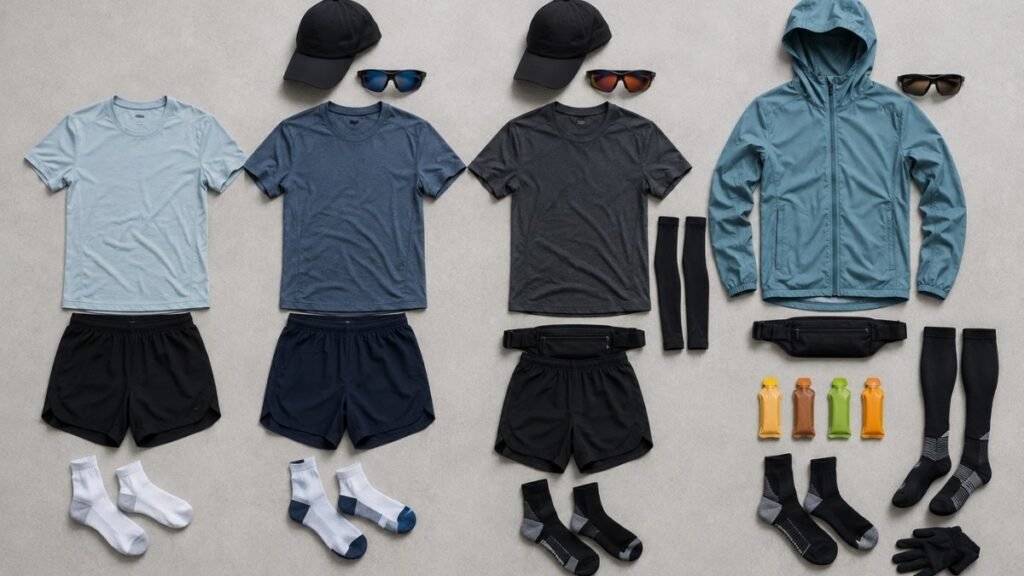
This is where most running gear guides fail. They give you a general list and leave you to figure out what applies to your actual running. Here’s the honest breakdown by distance.
5K Checklist
✓ Must have:
- Technical shorts (brief liner fine at this distance)
- Technical socks (seamless, moisture-wicking)
- Technical shirt (not cotton)
✓ Optional:
- Running cap if running in direct sun
- Anti-chafe balm if prone to chafing anywhere
- Running sunglasses for comfort in bright conditions
✗ Don’t bother:
- Running belt (you don’t need to carry anything for 3.1 miles)
- Compression gear (distance too short for meaningful benefit)
- Nutrition (you don’t need to fuel for a 5K)
10K Checklist
✓ Must have:
- Everything from the 5K list
- Running cap or sunglasses for runs over 45 minutes in sun
✓ Optional:
- Running belt with phone if you use GPS or music
- 1 gel or chews if you fuel during runs (rare at this distance)
- Anti-chafe balm at any friction zone you’ve experienced before
✗ Don’t bother:
- Hydration vest (aid stations or handheld bottle sufficient)
- Compression tights unless you have a specific chafing or support need
Half Marathon Checklist
✓ Must have:
- Technical shorts with compression liner (inner thigh chafing becomes real at this distance)
- Technical socks, tested on long training runs
- Technical shirt with flatlock seams
- Anti-chafe balm applied before the race — inner thighs, underarms, nipples
- Running belt with 2-3 gels and key
- Everything worn and tested on at least two long training runs first
✓ Optional:
- Running cap or arm warmers based on temperature
- Compression socks for post-race recovery
- Throwaway warm layer for the starting corral if it’s cold
✗ Don’t bother:
- Hydration vest unless the course is self-supported
- Anything new on race day
Marathon Checklist
✓ Must have:
- Everything from the half marathon list
- 4-6 gels or equivalent nutrition
- Compression liner shorts without exception — miles 18-26 will reveal any chafing problem you’ve been avoiding
- Reflective gear if start time is pre-dawn
- Compression socks ready for within 30 minutes post-finish
✓ Optional:
- Running jacket for cold starts (remove and hand to spectator or use a throwaway layer)
- Arm warmers for temperature management mid-race
- Sunglasses for long sunny races
✗ Don’t bother:
- Any item not tested on a 20-mile training run
- New shoes, new shorts, new socks — nothing new on race day
→ Race day deep dive: Half Marathon Outfit Guide
Build Your Running Wardrobe in the Smartest Order
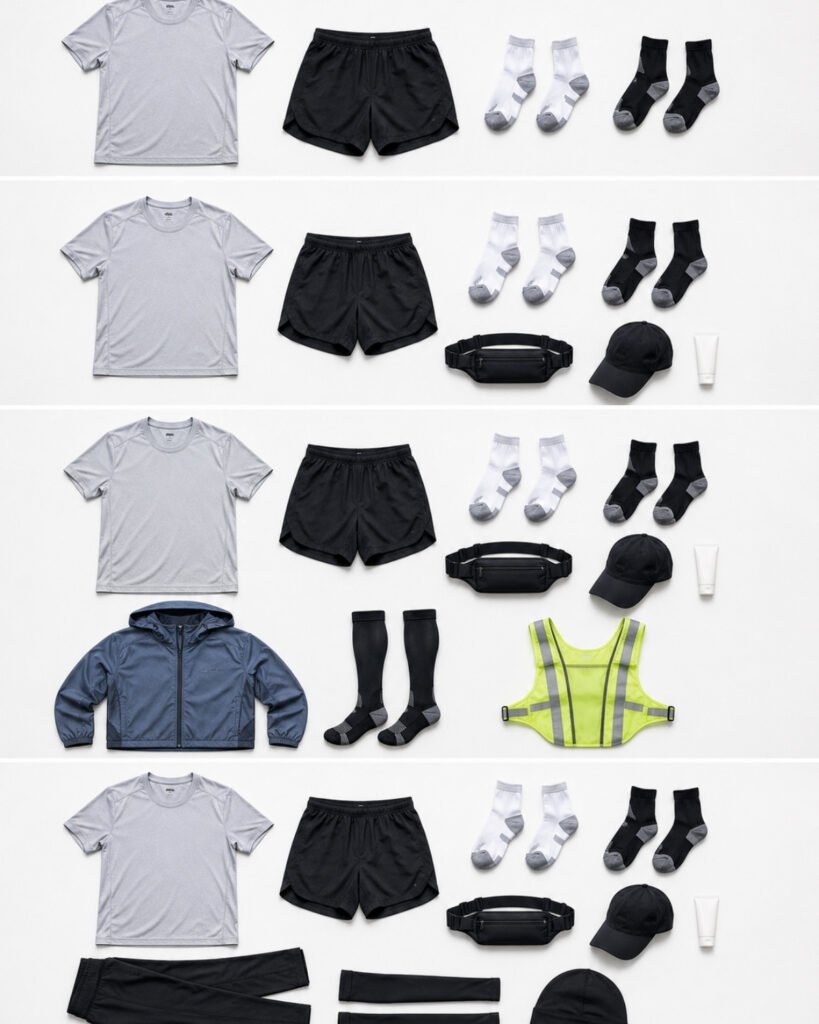
Most runners I know — including myself — built their wardrobe backwards. We bought the interesting stuff first (jacket, compression tights, GPS watch) and ran in mediocre shorts and cotton socks until something failed badly enough to force a replacement. This is the order I wish I’d known.
Stage 1: First Week
Buy only what you need to run without cotton against your skin:
- 1 technical shirt
- 1 pair of running shorts (5-inch, compression liner)
- 2-3 pairs of running socks
That’s it. Run in these for two weeks and notice what actually bothers you. That information is more valuable than any gear guide.
Stage 2: First Month
Add based on what you’ve actually experienced, plus the basics that improve most runs:
- Running belt (if you’ve been hand-carrying your phone)
- Running cap (if you run in sun)
- Anti-chafe balm (apply proactively, not reactively)
- Second pair of shorts and two more socks (for rotation)
Stage 3: Long Distance Training
When runs exceed 90 minutes consistently, the gear requirements change:
- Compression liner shorts if you haven’t already
- Running jacket or windshell for weather flexibility
- Compression socks for post-run recovery
- Reflective gear if your schedule includes pre-dawn or post-sunset runs
- Arm warmers for temperature management on variable-weather long runs
→ Full guide: Running Arm Sleeves
How to Make Your Running Gear Last Longer
Quality running gear performs best when it’s properly maintained. Rotating your shoes, washing technical fabrics correctly, and replacing worn-out socks before they fail can improve comfort while extending the life of your equipment.
Here are a few simple habits worth following:
- Rotate between two pairs of running shoes whenever possible.
- Wash technical clothing in cold water and avoid fabric softener.
- Replace running socks once cushioning and elasticity begin to decline.
- Air-dry technical apparel to protect moisture-wicking fabrics and elastic fibers.
| Gear | Typical Lifespan |
|---|---|
| Running shoes | 300–500 miles |
| Racing shoes | 200–300 miles |
| Running socks | 300–400 miles |
| Technical shorts | 12–18 months |
A few good maintenance habits can save money over time while keeping your gear performing the way it was designed.
Stage 4: Serious Training
For runners building toward marathons or consistent high mileage:
- Seasonal gear: Thermal tights and running pants for winter training, sun sleeves and lightweight caps for summer long runs
- Recovery gear: Compression socks worn for several hours after long efforts
- Night running gear: Reflective vest plus active LED light for unlit routes
- Gear rotation system: Two pairs of running shorts in active rotation, 4-5 pairs of socks, enough shirts to never repeat within 24 hours
→ Full guides: Men’s Running Tights | Men’s Running Jacket | Winter Running Outfit
Common Running Gear Mistakes That Cost Comfort
The fabric softener story: I used regular laundry detergent plus fabric softener on my running clothes for about six months. The shirts smelled fine coming out of the wash but developed a persistent odor within 20 minutes of running. I tried washing them more frequently, which made it worse. Eventually figured out that fabric softener coats the moisture-wicking fibers with a waxy residue that both blocks wicking and traps odor-causing bacteria. Switched to cold wash, no softener, inside out, air dry. The odor problem resolved within a few washes.
Buying everything from one brand. No single brand is best at everything. Brooks makes excellent socks. Lululemon makes excellent tights. Patagonia makes an excellent windshell. Loyalty to one brand means you’re not always getting the best option for each category.
Keeping one pair of shoes for every run. Shoe foam needs 24-48 hours to decompress after a run. Running in the same pair daily means you’re always running on partially compressed foam. Two pairs in rotation extends the lifespan of both and provides better cushioning on every run. (This applies to running shoes specifically — outside the scope of this guide, but worth knowing.)
Using cotton underwear under running shorts. Cotton underwear under technical shorts creates the worst of both worlds: the technical outer fabric is doing its job, but the cotton next to your skin is absorbing moisture and creating the exact chafing environment you’re trying to avoid. Technical underwear or commando in lined shorts — no cotton.
Ignoring rotation for gear other than shoes. Sports bras, compression tights, and compression socks need recovery time for their elastic properties to restore. Running in the same gear daily degrades it faster and means you’re never running in fully-performing compression fabric.
Overloading pockets. Every item in a pocket adds bounce weight. A rear waistband pocket designed for one phone bounces when you add a phone plus two gels plus a key. Match what you carry to your pocket system’s actual capacity, or get a running belt with distributed carry.
Skipping anti-chafe protection. Anti-chafe balm is the cheapest and most effective running comfort upgrade available. Apply it before you feel like you need it. Once chafing starts mid-run, you can’t stop it — you can only finish the run and deal with the aftermath. For any run over 60 minutes: inner thighs, underarms, nipples, anywhere fabric edges contact skin.
Washing running gear incorrectly. Cold wash. Inside out. No fabric softener. Air dry. Every time. High heat degrades elastic and compression fabrics. Fabric softener blocks moisture-wicking properties. Regular detergent residue on synthetic fabrics contributes to persistent odor. The washing method matters as much as the gear itself.
Quick Comparison Table Before You Buy
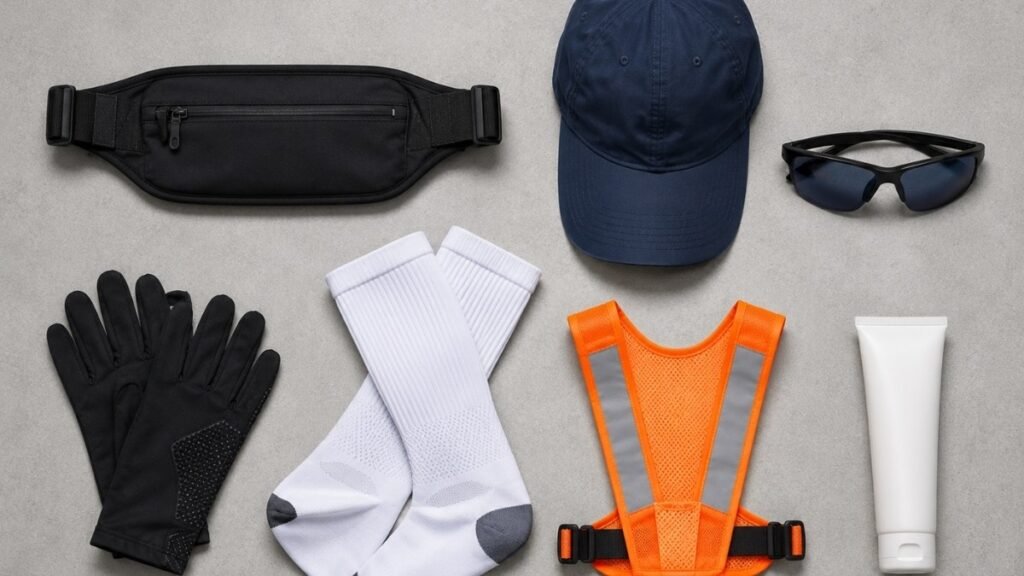
| Gear | Problem It Solves | Best For | Skip If |
|---|---|---|---|
| Technical shorts (compression liner) | Inner thigh chafing | Runs over 45 min, muscular builds | Short easy runs in cool weather |
| Technical socks | Blisters, moisture buildup | Every run | Never skip these |
| Technical shirt | Sweat saturation, friction | Every run | Never wear cotton |
| Running belt | Phone bounce, carrying essentials | Runs where you need to carry things | Your shorts pocket works fine |
| Anti-chafe balm | Skin abrasion from friction | Every run over 60 min | Short easy runs |
| Running cap | Sweat in eyes, sun exposure | Sunny runs, warm weather | Running indoors or on cloudy days |
| Running gloves | Cold hands | Below 45°F | Above 50°F |
| Reflective vest | Visibility to traffic | Pre-dawn, post-sunset road runs | Daytime runs only |
| Compression socks | Post-run recovery | After long runs and races | Short easy training runs |
| Running jacket | Wind chill, light rain | Below 45°F or wet conditions | Above 55°F calm weather |
| Arm warmers | Temperature flexibility | Variable conditions, race starts | Consistent temperature runs |
FAQ
What running gear do beginner men actually need? Three things cover most runs up to an hour: technical shorts (not cotton, with a liner), technical socks (seamless, moisture-wicking), and a technical shirt (any polyester or merino, not cotton). Everything else — belts, compression gear, jackets, reflective vests — can wait until you’ve established a consistent running habit and know what your runs actually require.
Is cotton ever okay for running? For very short easy efforts — 20 minutes or less at low intensity — cotton is merely uncomfortable rather than actively problematic. For anything over 30 minutes at real running effort, cotton accumulates sweat, gets heavier, and creates friction. The longer the run, the worse it gets. There’s no distance above 30 minutes where cotton is the right choice.
Brief liner or compression liner: which prevents chafing better? Compression liner, specifically for inner thigh chafing. The compression liner extends past the upper thigh contact zone, physically separating the inner thighs with smooth fabric. The brief liner typically ends above this zone — where it ends is often exactly where chafing begins. If inner thigh chafing has been a problem in brief-liner shorts, compression liner shorts will likely fix it.
How do I carry a large phone without it bouncing while running? Pocket placement matters more than pocket size. Rear waistband pockets — positioned at the small of the back, close to your center of mass — bounce significantly less than side hip pockets, which are at the hip rotation point and farthest from center. A slim running belt with rear placement is the most reliable phone-carry solution if your shorts don’t have a rear waistband pocket.
Why do my running shirts cause nipple chafing? Two causes: raised seams across the chest that contact the nipple area with every arm drive repetition, and moisture-saturated fabric that increases its friction coefficient. The fix for the first is flatlock seam construction. The fix for the second is faster-drying fabric and anti-chafe balm applied before runs over 60 minutes. Both together eliminate the problem.
How often should I replace running shorts and socks? Socks: replace when the cushioning has gone flat, the moisture-wicking feels degraded (socks stay wet instead of drying), or elastic has stretched out. Roughly every 300-400 miles of use. Shorts: replace when the liner has lost its shape or grip, the waistband no longer holds position, or fabric has thinned. Quality shorts last 12-18 months of regular training.
Can wearing the same running shoes every day shorten their lifespan? Yes, significantly. Shoe foam needs 24-48 hours to fully decompress after a run. Running daily in the same pair means you’re always on compressed foam, which both reduces cushioning performance and accelerates foam breakdown. Two pairs in rotation typically extends the lifespan of each pair by 30-50% while providing better cushioning on every run.
How should I wash running gear to prevent permanent sweat odor? Cold water wash, inside out, with regular detergent — no fabric softener. Fabric softener coats moisture-wicking fibers with a waxy residue that blocks their function and traps odor-causing bacteria. Machine dry on low or air dry. For gear that already has persistent odor: soak in 1 part white vinegar to 4 parts cold water for 30 minutes before washing — this breaks down the odor compounds that detergent alone doesn’t remove.
Final Thoughts
The best running gear isn’t about owning more—it’s about solving the problems that make running less enjoyable.
Every runner is different. The shorts that feel perfect for one person may cause chafing for another. A lightweight shirt that’s ideal on a cool morning might feel completely different during a humid summer long run. That’s why no review or specification can replace real miles.
Start with the essentials, pay attention to what your runs are telling you, and upgrade your gear only when you have a reason to. Over time, you’ll build a running kit that fits your body, your climate, and your goals—not someone else’s.
When your gear disappears from your mind and all you notice is the run itself, you’ve chosen well.
🏃 Editor’s Notes: How We Built This Guide
Finding the right running gear isn’t about buying the most expensive products.
More often, it’s about understanding which pieces solve real problems—whether that’s reducing chafing, managing sweat, carrying your essentials comfortably, or staying comfortable across different distances and weather conditions.
Many runners focus on shoes first, but a comfortable run depends on your entire gear system. That’s why this guide emphasizes practical choices backed by running experience, sports science, and real-world usability rather than marketing claims.
This guide is built around four core principles:
👕 Comfort Before Performance
Understanding how fabrics, fit, and construction reduce friction, improve moisture management, and help you stay comfortable on every run.
🩳 Smarter Gear Selection
Choosing the right clothing and accessories based on your running distance, climate, body type, and training goals—not simply buying more equipment.
🔄 Long-Term Gear Strategy
Learning how to build your running wardrobe gradually, rotate equipment properly, and make every purchase last longer.
📖 Evidence + Real Running Experience
Combining sports science, product knowledge, and practical running experience to recommend gear that performs beyond the store fitting room.
Because comfortable running isn’t about owning more gear.
It’s about wearing gear you barely notice once your run begins.
Continue Building Your Running Kit
Whether you’re training for your first 5K or preparing for a marathon, these guides can help you build a smarter running wardrobe.
→ brief liner vs compression liner
→ running shorts with secure pockets
→ running socks that prevent blisters
→ compression socks for post-run recovery
→ running belt that doesn’t bounce
→ reflective gear placement that actually works
→ men’s running tights for cold weather
→ half marathon race day gear checklist
❤️ A Final Note
A better run isn’t built by buying more gear—it’s built by making smarter choices, one mile at a time.
At kineticv, we’re here to help you cut through the marketing noise, avoid expensive mistakes, and build a running kit that feels comfortable, practical, and worth relying on.
Whether you’re preparing for your first 5K or training for your next marathon, our goal remains the same:
Helping you run with greater comfort, confidence, and consistency—one smart gear choice at a time.